

- Admissions
- Academics
- Research Office
- Student Life
- News & Events
- Outreach
- About

The Department of Management Science and Engineering at Khalifa University prepares individuals to apply engineering knowledge to lead, create impact, and make effective decisions in complex and dynamic systems.
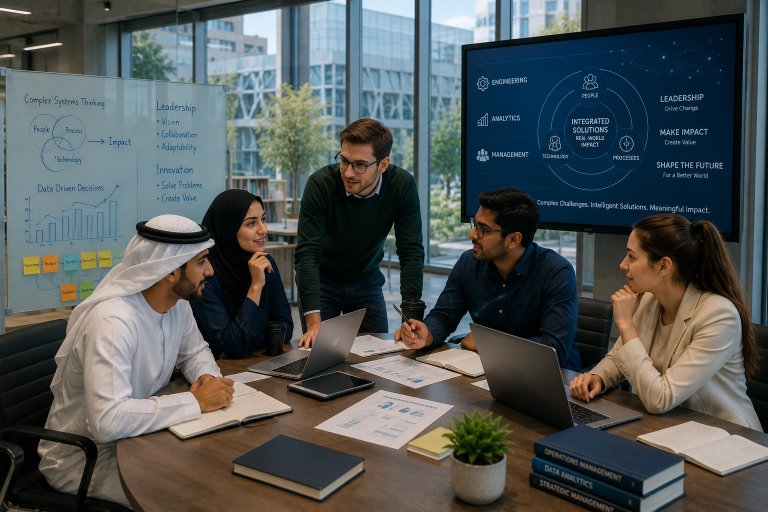
The Department of Management Science and Engineering at Khalifa University brings together engineering, analytics, and management to prepare students for leadership in a rapidly evolving and technology-driven world. The department focuses on addressing complex challenges where technical systems, data, and organizational processes intersect, enabling graduates to create meaningful impact across industries.
Our programs emphasize systems thinking, analytical problem-solving, and engineering management, equipping students with the ability to understand and improve how complex systems operate. Students learn to make informed, data-driven decisions, optimize performance, and lead engineering initiatives in environments characterized by uncertainty and interdependence.
Through a combination of rigorous coursework, practical experience, and applied research, students develop both technical depth and professional capabilities. They are prepared to contribute to areas such as infrastructure, energy, healthcare, logistics, finance, and advanced industries, supporting innovation and sustainable development at both national and global levels.
The department is home to five academic programs that provide a coherent pathway from undergraduate to doctoral studies:
Together, these programs reflect Khalifa University’s commitment to advancing engineering management, systems innovation, and data-informed decision-making in support of national priorities and global challenges.
Human Performance Lab (HPL) — R01032
Understand how people work, and use that knowledge to design better workplaces.
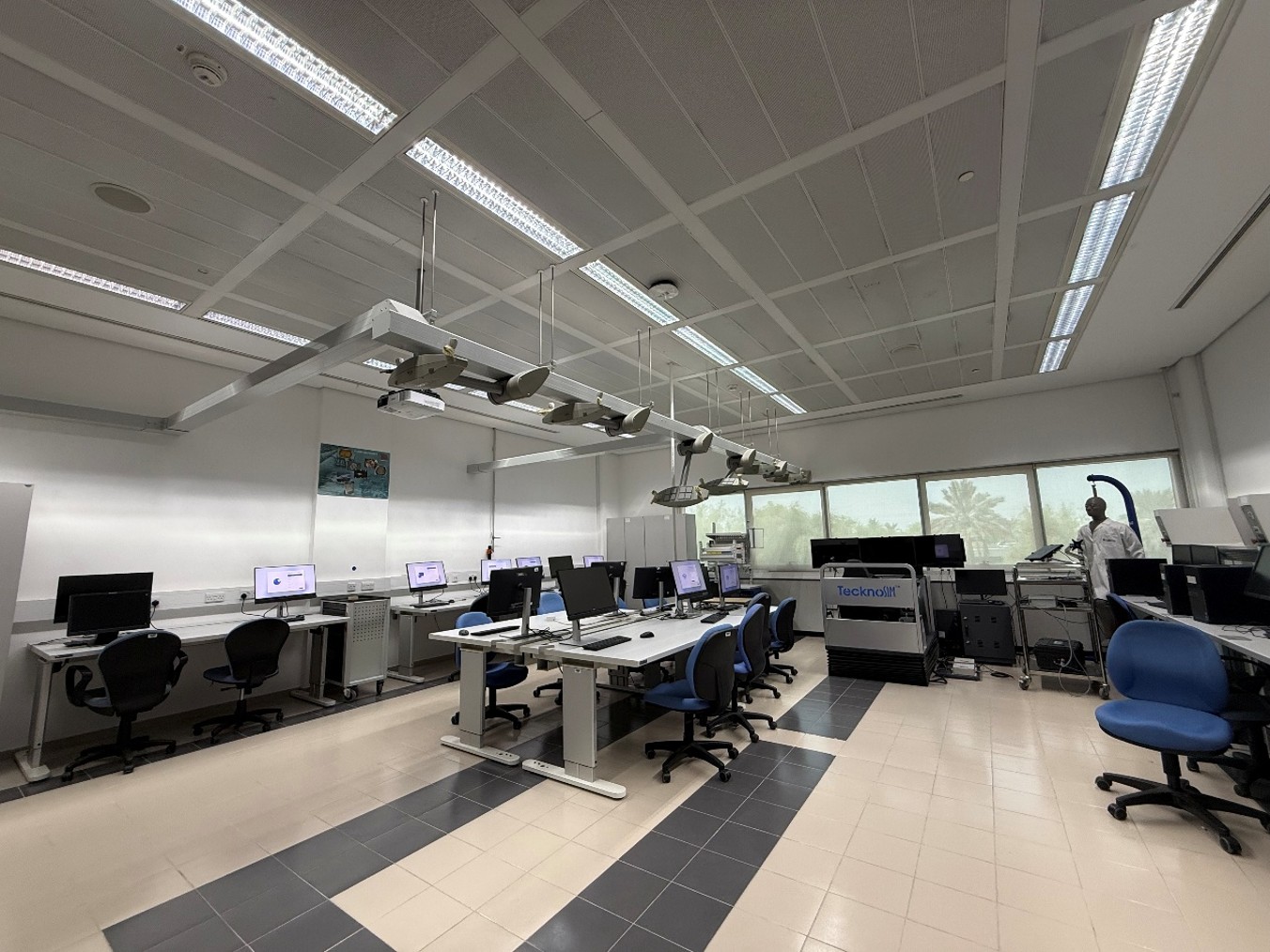
How does a workstation affect comfort? What happens when a task becomes more demanding? The Human Performance Lab helps students and researchers investigate these questions through practical experiments in ergonomics, human factors and workplace design.
The lab examines human capabilities, behavior and performance, including fatigue, workload and interaction with machines. By studying the relationship between people and their working environment, students learn to evaluate design choices in terms of safety, comfort and productivity. Researchers can use the same experimental setting to investigate how systems can better support the people who use them.
Selected tools and capabilities. Adjustable workstations, strength and dexterity testing, body measurement equipment, an age simulation suit, wearable eye tracking, environmental measurement and a thermal manikin.
Supply Chain Operations Lab (SCORE) — C03021
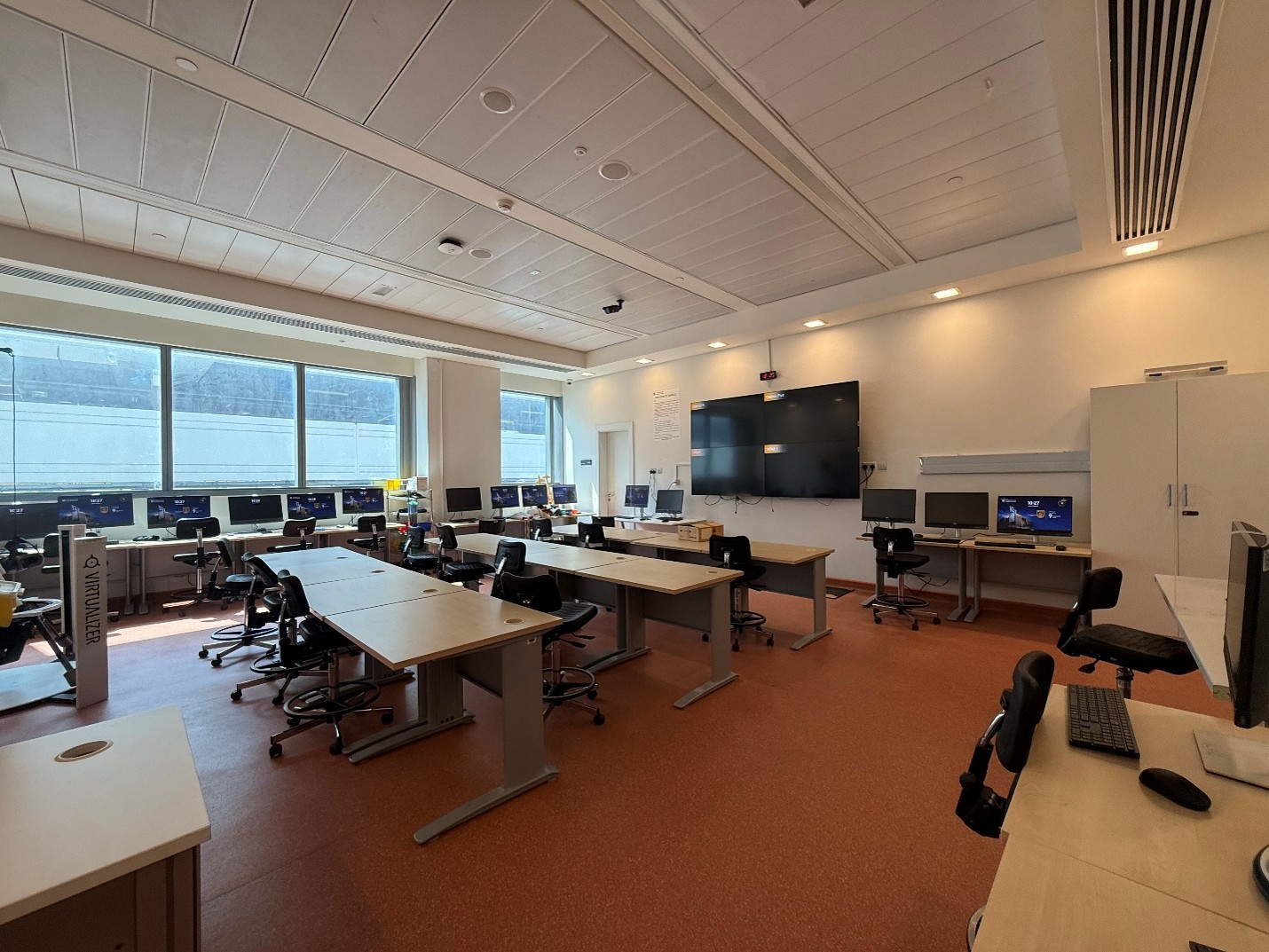
Test operational decisions and discover what the data reveals.
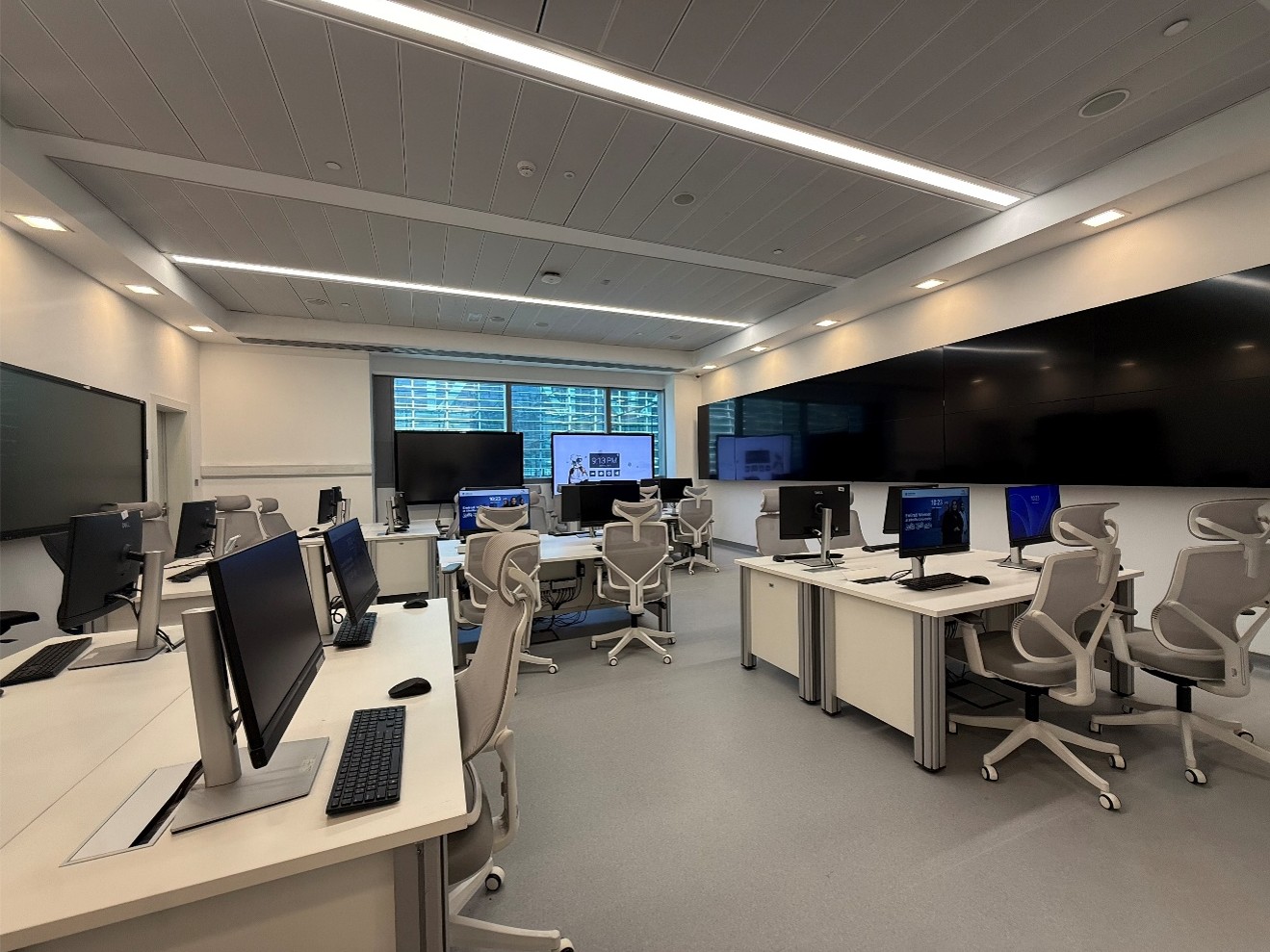
A change in inventory, capacity or process design can affect an entire operation. The Supply Chain Operations Lab gives undergraduate and graduate students a practical environment for exploring those connections through data analysis, simulation and visualization.
Students use Minitab to bring statistics to life, creating histograms, examining data distributions and developing cause-and-effect diagrams to investigate variation and potential sources of manufacturing defects. Computing and business simulation tools extend that learning to capacity planning, inventory management and supply chain coordination.
Research themes include analytics, process digitalization, computer simulation and digital twins, which are digital representations used to study systems. Applications span healthcare, transportation, manufacturing and supply chains, connecting analytical methods with decisions about how services and operations perform.
Selected tools and capabilities. Minitab, systems engineering and optimization software, SAP HANA, simulation and analytics packages, interactive displays and a video wall.
Computer-Aided Visualization Environment (CAVE) — C03057
Step inside engineering ideas and explore them from a new perspective.
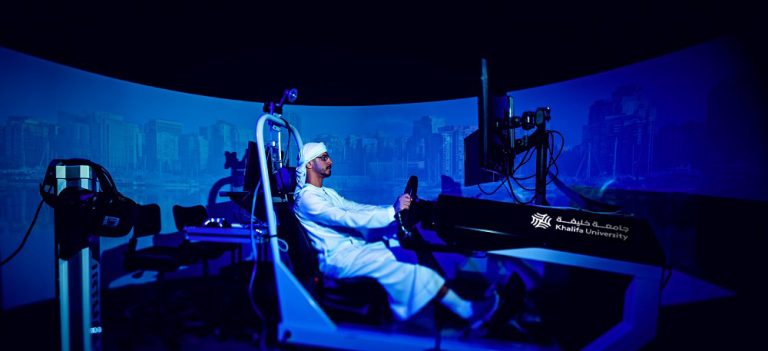
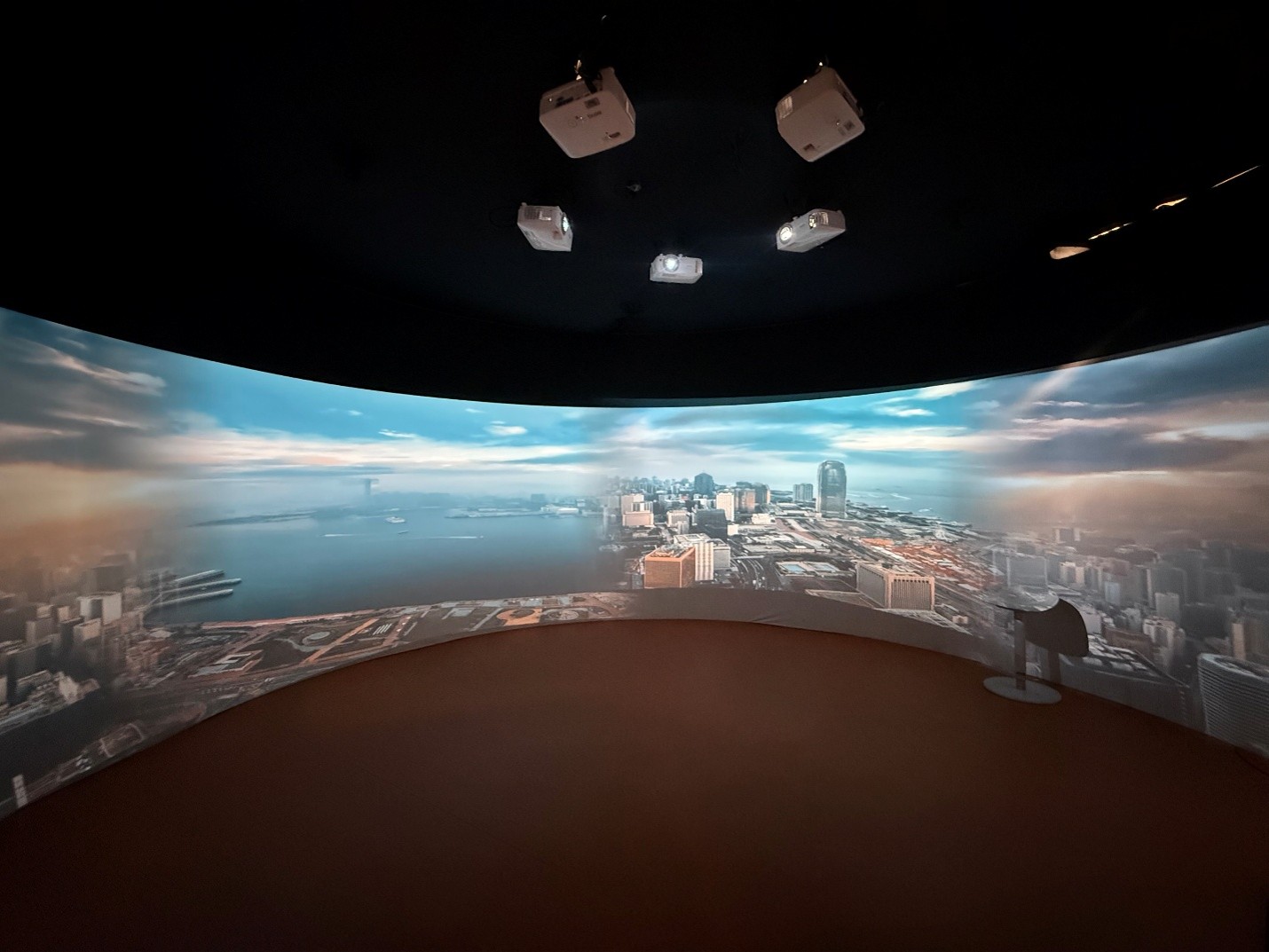
The Computer-Aided Visualization Environment brings panoramic and 3D content into an immersive learning space. Its projection system allows students to interact with visual representations of industrial processes, workplace environments and engineering systems.
Viewing a system from multiple perspectives can make spatial relationships easier to understand. Students can explore how an environment is arranged, examine ergonomic scenarios and discuss possible solutions while working with a shared visual reference. The experience supports problem-solving in a safe setting where complex situations can be examined without exposure to the corresponding industrial environment.
Operational Excellence Lab (OPEX) — C03023
See how manufacturing systems work, and investigate how to make them work better.
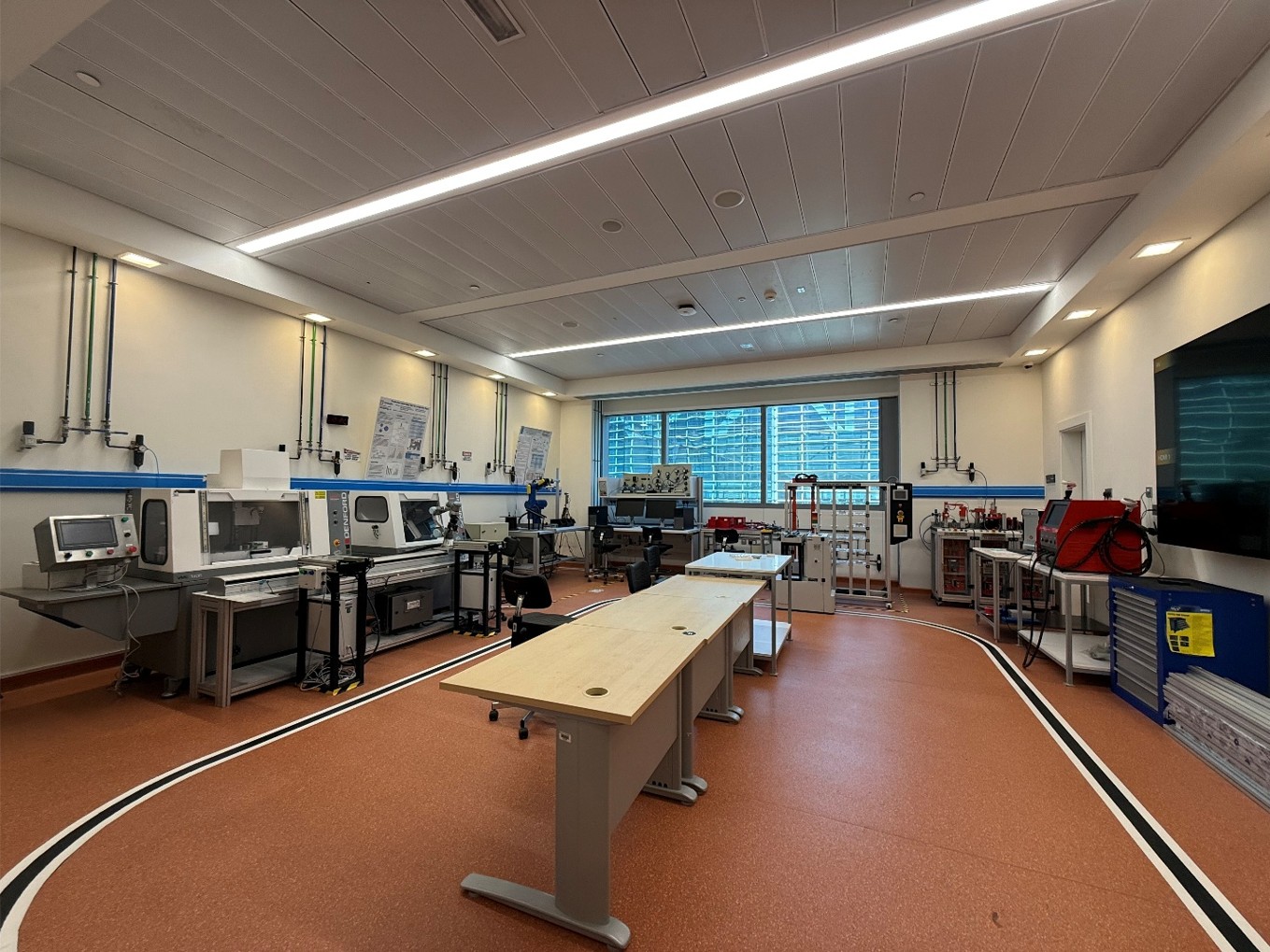
The Operational Excellence Lab brings production and automation concepts into a hands-on teaching and research environment. Its mini-factory setting introduces students to industrial equipment, robotic systems and automated material movement, helping them connect individual tasks with the performance of a wider operation.
Students can examine how production activities are organized, where waste occurs and how automation supports the flow of work. Research themes include agile manufacturing, worker instrumentation, autonomous monitoring and visual quality control. Lean manufacturing provides another practical focus, distinguishing activities that add value from those that consume resources without improving the product or service.
Selected tools and capabilities. A manufacturing automation system with an automated guided vehicle, automated storage and retrieval, a Universal Robots UR3 collaborative robot with wrist-mounted camera, and an Intelitek Scorbot ER9 robotic system.
Decision Analytics Lab (DANA) — C03012
Explore engineering choices through digital design and industrial visualization.
Engineering decisions become easier to examine when ideas can be modeled and visualized. The Decision Analytics Lab gives students practical experience with software used to design products, plan manufacturing activities and understand industrial systems.
With TechnoMax CNC Programming Software, students learn computer numerical control programming, machining processes and manufacturing planning. SolidWorks develops skills in 3D modeling, product design and engineering drawing. These activities connect design intent with the practical choices involved in making a component.
Industrial visualization adds a human perspective through virtual workplace and plant layouts, digital human modeling and studies of how people interact with industrial environments. Together, these approaches help students examine design alternatives and explain the reasoning behind engineering decisions.