
Sifting Through the Noise to Find the Nucleus with Artificial Intelligence

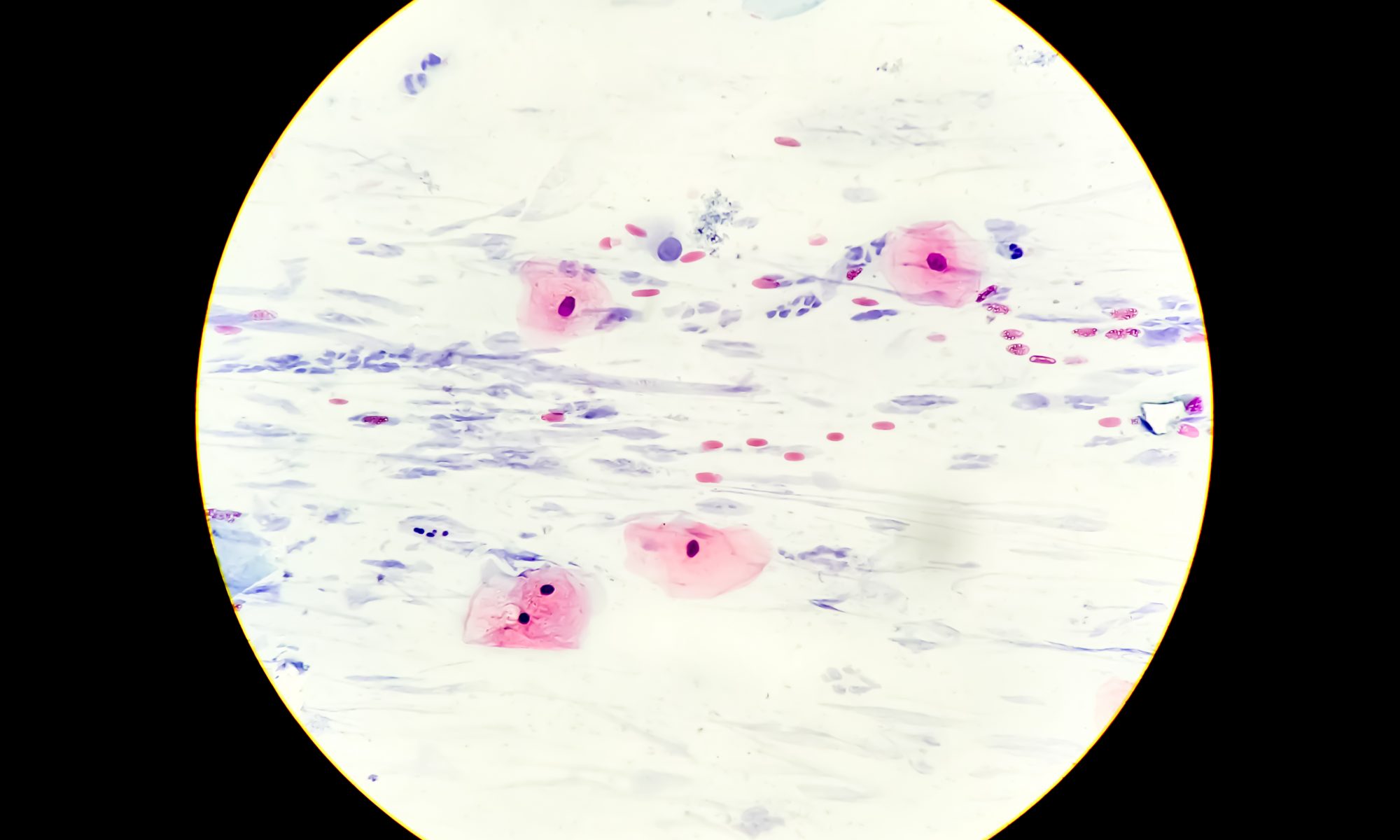
The features of a cell nucleus can reveal much about the health of a cell, but finding the nucleus among the background noise of a tissue sample can be laborious and time-consuming when done manually. Khalifa University researchers are exploring how AI can be leveraged to speed up the process of detecting a cell’s nucleus.


Known as the cell’s ‘command center’, the nucleus is a large organelle that stores the cell’s DNA. The nucleus controls all of the cell’s activities, such as growth and metabolism, using the DNA’s genetic information.


Pathologists use features of the cell nucleus to distinguish benign from malignant cells. They examine tissue samples for cells with increased nuclear size and irregularities in the nuclear membrane or abnormal distribution of chromatin, a substance within the chromosomes in the nucleus.


Artificial intelligence techniques are being investigated to streamline the process of nuclei detection. However, these techniques struggle when the tissue samples are noisy or when nuclei appear crowded.


Dr. Naoufel Werghi, Associate Professor, has collaborated with Dr. Sajid Javed, Assistant Professor, and Dr. Jorge Dias, Professor, to develop a machine learning solution that can sift through the background noise and more easily identify individual nuclei. Their results were published in Medical Image Analysis.


In an ideal world, a sample of tissue would contain only that tissue, but most samples contain a rich mix of several other types. Most normal epithelial cells have nuclei which are round to oval-shaped, most lymphoid cells have round nuclei, while stromal cells have ovoid to spindle-shaped nuclei. Any machine learning algorithm would need to be trained on the specific nucleus shape for the nucleus it is tasked to detect, adding a further layer of training required if the algorithm were to be used in other applications.
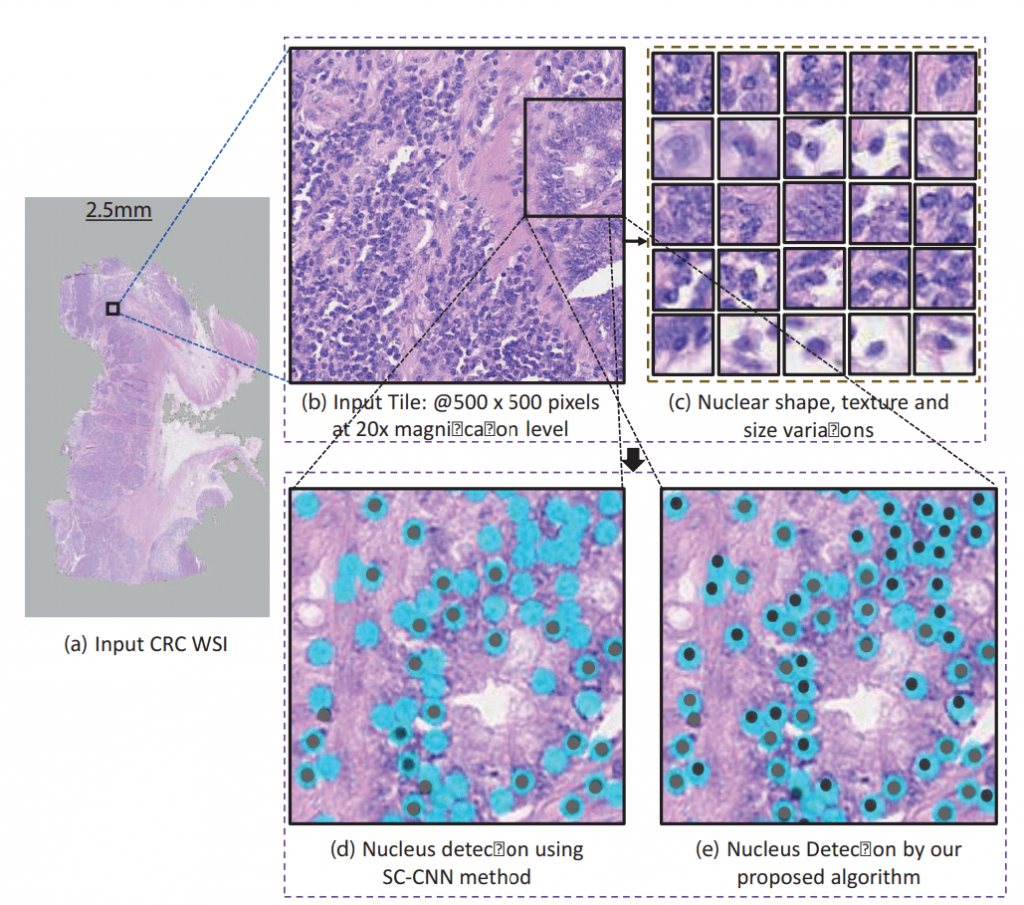
 

An example of multi-gigapixel whole slide image of colorectal cancer and the results of the proposed algorithm for nucleus detection compared with current state-of-the-art SC-CNN method under varying nuclear shape, morphology, texture, and clutteredness.


“Nucleus detection is a challenging task because of the nuclear clutter and diverse shapes and sizes,” said Dr. Werghi. “Additionally, computation challenges arise because the images analyzed are multi-gigapixel images, and could contain billions of pixels and tens of thousands of cell nuclei.”


A number of potential methods have been reported for automatic detection of cell nuclei, including deep learning methods to train a convolutional neural network (CNN) to generate probability maps of where the cell nuclei are present.


Existing approaches are promising, but they require a significant amount of training data and expensive platforms to cater to the high computational requirements. The model proposed by the research team can be trained using much smaller training datasets that can be executed on a typical desktop computer.


“Our solution uses correlation filters to sort through the data and identify nuclei,” explained Dr. Werghi. “Compared to end-to-end deep learning in previous methods, correlation filters are computationally effective and require significantly less training data. The correlation filters are also flexible and can detect complex and irregular-shaped nuclei without requiring handcrafted features.”


These correlation filters help the algorithm to better discriminate different nuclear components from the non-nuclear regions and also to discern each nucleus from the remaining nuclei where they are clustered.


Constraints are placed on the spatial structure of the nucleus and its local contextual information in the correlation filter framework to handle varying nuclei shapes, texture, and clutter. The first considers the spatial structure of the nucleus, while the second discriminates between the nucleus and the non-nucleus region. Both of these help to reduce the noise in any given sample.


The team plans to explore the strength of correlation filters in analysis classifying cell nuclei and tissue phenotyping problems, such as cancer detection.


This research was funded by Khalifa University Center for Autonomous Robotic Systems (KUCARS).


Jade Sterling
Science Writer
5 July 2021

 

Leveraging AI to Detect Colorectal Cancer

Khalifa University researchers find a way to use convolutional neural networks to identify cancer in tissue samples, which could speed up diagnosis and improve outcomes in patients with colorectal cancer.


Colorectal cancer is the third most common cancer among men and women worldwide, and the second most common cause of cancer-related mortality. Most colorectal cancers are due to old age and lifestyle factors, with only a small number of cases due to underlying genetic disorders. It typically starts as a benign tumor, such as a polyp, which over time becomes cancerous. Like all forms of cancer, early diagnosis and differentiation of the tumor are crucial for a patient’s survival and wellbeing.


Colorectal cancer may be diagnosed by obtaining a sample of the colon and using histopathology – the study of changes in tissues caused by diseases – to determine the characteristics of the tumour tissue at the microscopic level.


Histology is the study of the microanatomy of cells, tissues and organs as seen through a microscope. The structure of each tissue in the body is directly related to its function and diseases affect tissues in distinctive ways. Studying the histology of a tissue can be very useful in making a diagnosis and determining the severity and progress of a condition.


Because of the great variety of tests that are available, and the high level of skill needed to carry out and interpret them, researchers are beginning to turn to computational pathology and artificial intelligence techniques to identify in tissue samples diseases like cancer.


Dr. Sajid Javed, Assistant Professor, and Dr. Naoufel Werghi, Associate Professor of Electrical Engineering and Computer Science, have collaborated with researchers from around the world to develop algorithms to identify samples of colorectal cancer tissue. A paper based on this research has been published in Medical Image Analysis.


“Computational pathology is a fast-growing research area in cancer diagnosis and can play an instrumental role in helping medical professionals detect and classify tumors,” said Dr. Javed.


Cancer histology reveals underlying molecular processes and disease progression and contains rich phenotypic information that is predictive of patient outcomes.


The phenotype is the set of observable characteristics or traits of an organism or a tissue. Image-based phenotyping aims to develop the computer vision techniques and tools needed to recover quantitative data from a wide range of images. But phenotyping presents challenging problems, particularly in images from colorectal cancer tissues.


Aided by advances in slide scanning microscopes and computing, convolutional neural networks (CNNs) have emerged as an important image analysis tool. CNNs use a network of interconnected layers of filters that highlight important patterns in the images and can continue to learn from previous results.


“Manual examination of tissue samples is time-consuming, highly subjective, and often affected by the observer,” explained Dr. Javed. “Meanwhile, algorithms analyzing digitized Whole Slide Images (WSIs) can examine hundreds of thousands of cells and billions of pixels to differentiate seven distinct tissue phenotypes.”


Deep learning methods require large amounts of annotated histology data for training, which may be tedious to obtain. Additionally, while these methods may be effective in determining tumor tissue, the tissues in colorectal cancer also contain a rich mix of several other types of tissue, including smooth muscle, inflammatory, necrotic, and benign tissue. Any algorithm must be taught to distinguish between these tissue types to be effective.


Texture analysis is a commonly used approach for tissue phenotyping, where texture features are computed to train classifiers, which are then used to predict distinct tissue types.


“Texture analysis may be attractive due to its simplicity but it does not fully capture the biological diversity of tissue components,” explained Dr. Javed.


“Recent methods have proposed integrating cellular connectivity features, which are used as a proxy to cellular interaction features. The notion of cellular connectivity features is based on the fact that spatially adjacent cells have a higher probability of receiving inter-cellular signals from each other than from cells that are farther away. It has also been shown that inter-cellular signals between various types of cells can influence the progression of cancer. However, a dynamic network of tumor growth cannot be adequately modelled by a single type of interaction. Our technique uses a multiplex network model to represent the intricate relationships between cell populations. We propose four different types of cellular networks integrating a variety of features representing tissue characteristics at different levels.”


In the researchers’ model, cells from a WSI are detected and classified into five distinct categories using a deep neural network. Then, four different types of cellular interaction features are computed and used to construct a four-layer multiplex graph. Since each slide contains thousands of cells, the slides are segmented into tiles or patches, which helps the algorithm determine the distribution of different types of tissues across the cells.


“There are many directions in which this work can be further extended,” added Dr. Javed. “Further cellular types such as blood cells could improve performance and also reveal more micro-level tissue communities. Additionally, our framework could be adapted to WSIs of different types of cancer. Of course, in clinical practice, our work can help medical practitioners understand the contents of the WSI and make more accurate and timely diagnoses.”


This work was funded by the Khalifa University of Science and Technology and the UK Medical Research Council. The collaborators were also supported by the PathLAKE digital pathology consortium, which is funded from the Data to Early Diagnosis and Precision Medicine strand of the UK government’s Industrial Strategy Challenge Fund, managed and delivered by UK Research and Innovation. 


Jade Sterling
Science Writer
5 July 2021
 

Khalifa University’s Society of Petroleum Engineers Student Chapter Receives Excellence Award

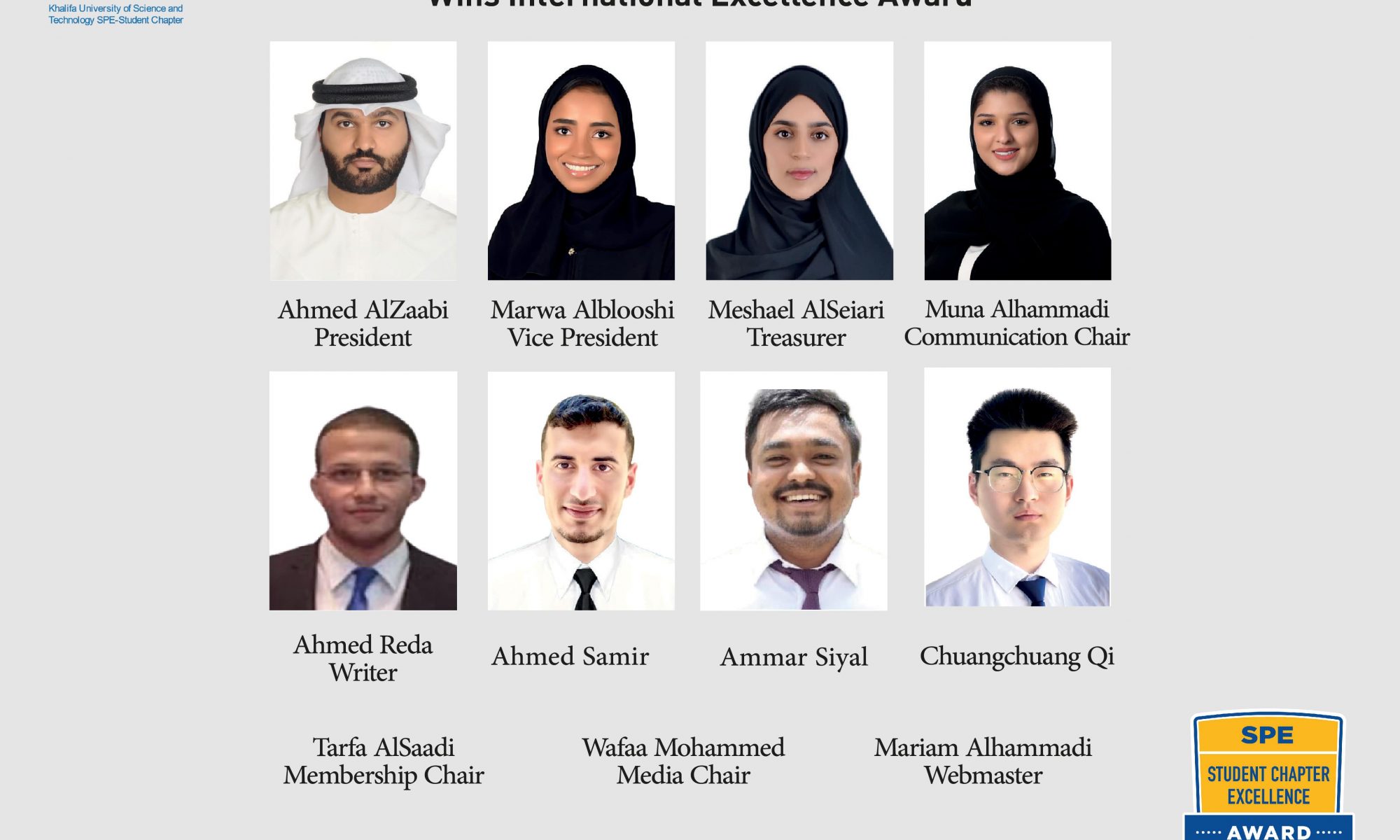
Khalifa University’s very own Society of Petroleum Engineers (SPE) Student Chapter was recognized with the SPE International Student Chapter Excellence Award. The Excellence Award is the second highest honor given by the SPE to the top 20% of their student chapters all over the world in acknowledgement of the chapters’ success in fulfilling the SPE’s mission through their programs and activities.


This year’s award also highlights the resilience of the KU SPE Student Chapter during these challenging times, especially at the beginning of the school year. 


The chapter continued the mission of the SPE and promoted the exchange of technical knowledge about the exploration, development, and production of oil and gas resources. 


The KU SPE Chapter also took part in different SPE activities, such as the Energy4me event, Drillbotics, and SPE Annual Technical Conference and Exhibition (ATCE). 


Though the SPE is known to be focused on petroleum engineering, the KU student chapter also organized activities that would reach out to a more diverse audience. Programs such as personal and professional development for students, skills enhancement, and discussions with alumni from different industries about their success stories demonstrate how the chapter works hard to engage its KU members in a range of skill-building and knowledge-sharing activities. 


Ahmed Khalid AlZaabi, KU SPE Student Chapter President, details his experiences through the year: “I became the student chapter president during a very difficult time. Aside from the impact of the pandemic, the chapter was facing challenges due to a lack of members. It was difficult to adapt to new norms and regain the chapter’s status.”


“Opportunities and doors are always there when you continuously work hard. The most important task is to remember that the effort and struggles you go through today will eventually pay off. The chapter was facing difficulties at the start of the academic year,  but we saw this as an opportunity for growth and we created and implemented several plans to turn this around,” commented Marwa Mohamed AlBlooshi, KU SPE Student Chapter Vice President.


“We approached this academic year differently. We took time to understand why the chapter was at risk and what is the best approach to recovery from it. Further, we wanted to clear the misconception that the Society of Petroleum Engineers (SPE) is limited to petroleum engineering,” Ahmed said. 


Marwa added, “The amazing and incredible tasks the whole team carried out by pulling on each other’s strengths enabled us to innovate and create a platform that benefited across the spectrum. In return, this allowed us to excel as a team making us a candidate for this internationally recognizable award.”


The honor of receiving the Chapter Excellence Award would not have been possible without the support of the Petroleum Engineering Department and the exceptional efforts of the team behind the chapter. 


Dr. Hadi Belhaj, Petroleum Engineering Associate Professor and KU-SPE Faculty Advisor, has guided the chapter and shared his expertise with the students, said: “The KU-SPE Student Chapter is always one of the very active chapters around the world and the top of the region. Their success in recent years, including winning the 2021 SPE Student Chapter Award, is a testament for this leading role. I am very proud of our KU-SPE Student Chapter for their remarkable achievements. Their resilience, hard work, and dedication to the SPE despite the current unprecedented challenges of C-19 restrictions and impairment economy paid off. The KU-SPE Student Chapter paved the way for generations to come and showed how to turn challenges to opportunities. I am sure their best is yet to come!”


Dr. Emad W. Al-Shalabi, Assistant Professor of Petroleum Engineering, who has continually supported the Student Chapter, commented: “This is one of the prestigious SPE awards which marks a great achievement for our KU SPE Student Chapter. I would like to commend all the members for their dedicated efforts, particularly during this challenging time of COVID-19. Indeed, hard work pays off!”


Abdessamia Jebbouri, Lab Engineer for the Petroleum Engineering Department, also congratulated the Student Chapter saying, “The 2021 Student Chapter SPE International Excellence Award is not our first award in our wall of fame; it is evidence of the continuous outstanding performance and fabulous achievement since the establishment of our KUSPE student chapter on 1 August 2004. We believe that besides the excellent students’ curricular activities during the most challenging COVID-19 circumstances, our student chapter proved their remarkable efforts in a variety of fields such as industrial and academic engagement, community involvement, professional development, and innovations. We have a strong belief that our role as faculties and instructors with our young students goes beyond education — we are leaders, coaches, advisors, and facilitators of nonstop positive growth, and this is what we sow in our students.”


Khalifa University’s Petroleum Engineering department ranks 21st in the QS World University Subjects Rankings. 


Ara Maj Cruz
Creative Writer
5 July 2021

Dual Credit Program 2021 Kicks Off

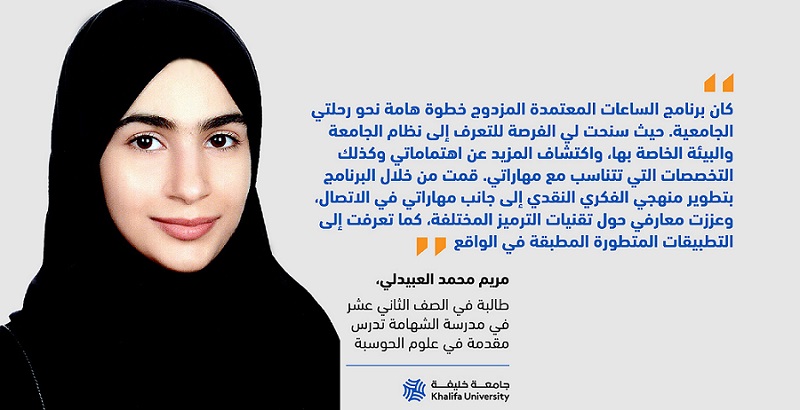
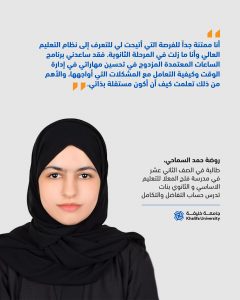
Khalifa University ‘s Dual Credit Program every Fall and Spring to give youth a head start in their higher education journey. Designed for students in Grades 11 and 12, these programs run for a full academic semester and allow students to earn credit for university courses. Students from the program, including Mariam and Rawda, think it’s a great way to get ahead and get a glimpse of what the KU experience has to offer.

Interested high school students can register until 7 July 2021 at
www.ku.ac.ae/outreach/programs

His Excellency Hussain Ibrahim Al Hammadi to Open Virtual 2021 UAE GSRC Organized by Khalifa University

Total of 354 Research Papers, Selected from 435 Submissions to be Presented at This Year’s Conference  


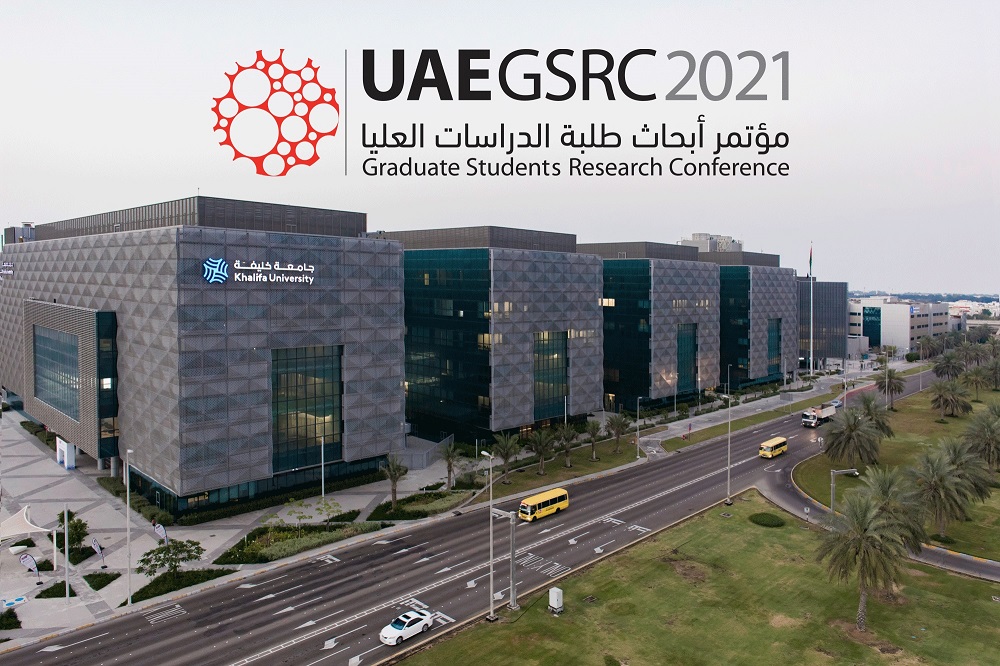
Under the patronage of His Excellency Eng. Hussain Ibrahim Al Hammadi, UAE Minister of Education, the virtual 2021 UAE Graduate Students Research Conference (GSRC), a platform that showcases scholarly research work and innovative ideas and projects in various fields of knowledge, will be inaugurated on Monday, 28 June 2021. The conference is being organized by Khalifa University of Science and Technology. To regsiter for the conference, please visit www.uaegsrc.ae


The 6th year of UAE GSRC will witness the presentation of 354 papers, selected out of a total of 435 submissions. Nearly 80% of the papers are from students in Engineering and Physical Science track followed by Clinical, Pre-Clinical, Health & Life Sciences track. The ‘Arts, Humanities & Social Sciences’, and ‘Business & Management’ have also attracted sizeable number of papers this year. The best papers will be recognized across all the tracks.


Addressing the gathering, His Excellency Hussain Ibrahim Al Hammadi, who is also Vice-Chairman of the Board of Trustees of Khalifa University, said: “Postgraduate research is one of the main drivers of knowledge-economy, as it contributes to finding innovative solutions to the various challenges faced by critical industries and sectors in the world in general, and the country in particular. Papers presented at the UAE GSRC by doctoral students for example, contribute to the development of knowledge that in turn helps in finding solutions to problems in various fields, thus enhancing the status of the UAE and its role in knowledge creation, benefiting various economic sectors.”


Research papers presented during the UAE GSRC contribute to the Fourth Industrial Revolution through projects in genetics, cancer research, and epidemiology, as well as in the most prevalent medical conditions such as diabetes and heart diseases. They also impact areas of economic and strategic importance such as renewable energy, sustainability, water desalination, nanotechnology, artificial intelligence and robotics, in addition to various research in the fields of education, and linguistics.


In his welcome note, Dr. Arif Sultan Al Hammadi, Chair, Steering Committee, 2021 UAE GSRC, and Executive Vice-President, Khalifa University, said: “Over the years, the GSRC has established itself as an exciting interdisciplinary academic event, which offers a platform to share the research being conducted at universities across the UAE, and their international partners. The number of papers submitted to 2021 UAE GSRC signifies the interest shown by students in the UAE in scientific exploration, and their keenness to undertake research that will lead to innovation benefiting the community.”


Dr. Al Hammadi added: “The conference will select the best papers for awards across various tracks. We look forward to learning about the success and innovations of these enthusiastic students as they progress in their respective careers.”


Clarence Michael
English Editor Specialist
27 June 2021

Khalifa University Launches 2021 Smart Mobile Application Contest for High School Students to Inspire Young Minds and Foster Innovation

SMAC Challenge Follows 14 Consecutive Years of Success  


Read Arabic story here.


Khalifa University of Science and Technology has announced the launch of 2021 Smart Mobile Application Contest. The 15th contest is targeting High School Students, and is considered an introductory course and competition on mobile applications development for students of Grades 9, 10, and 11. 


Themed ‘Creating Apps for Expo 2020’, the new edition of this technology challenge will run from 11-26 July 2021. Participating students will explore basic app technologies and learn how to create their own mobile apps using drag and drop programming blocks. 


A spin-off from Khalifa University’s Smart Mobile Application Contest (SMAC), the current competition for high school students widens its scope, while building on the success of the original challenge that has been organized for 14 consecutive years. 


Dr. Arif Sultan Al Hammadi, Executive Vice-President, Khalifa University, said: “The 2021 Smart Mobile Application Contest for High School Students aims to inspire young minds and foster innovation in mobile applications in the UAE and the region, giving them an opportunity to explore their creativity in technical areas. We hope students will come forward to participate in this technology competition and assess their own readiness to launch their future academic paths in research and innovation.” 


Participating students must address any challenge related to the upcoming Expo 2020 event, such as ‘reservation app to book for exhibitions’, ‘learning more about UAE culture and tourism attractions’, ‘EXPO for young kids activities’, and the ‘EXPO market’. 


The panel of judges will assess the entries based on originality and value of the idea (30%), implementation and functionality (40%), app quality (20%), and cultural focus (10%). Students must attend all five days of the short course sessions to be eligible to participate, and a team of two students will submit only one project. The theme and details of the competition will be announced on 15 July, while online live project demonstrations will be held on 19 July. Final judging and awards ceremony will be held on 26 July. 


The 2021 Smart Mobile Application Contest for High School Students aims to expand students’ intellectual curiosity, while helping them build their technical and soft skills through presentations, problem solving, teamwork, communication, social skills, coordination and time management. It will also seek to expand their awareness in computer science, coding and engineering in today’s world.


To know more about this competition, please visit www.ku.ac.ae/smac


Clarence Michael
English Editor Specialist
22 June 2021

Military Assistance as Political Gimmickry?

The motivation for Britain’s military assistance efforts in 1971 to the newly federated United Arab Emirates stemmed not from international interest, but domestic political in-fighting.


Military assistance continues to be a mainstay feature of foreign and defence policy activity of many major world powers today, and can take many forms. Assistance could involve training, advising, mentoring or introducing equipment, as well as building permanent training hubs and accompanying foreign forces on operations. The goal is invariably the same: build the recipient nation’s military capability for enhanced stability.


The effectiveness of this assistance has been examined but researchers have rarely investigated the motives for deploying advisors and trainers abroad beyond simply arguing it will have a beneficial outcome for the recipient nation and advance the national interest of the providing nation.


In 2018, Dr Athol Yates, acting head of KU’s Institute of International and Civil Security was invited by the UK’s Defence Science and Technology Laboratory (DSTL) to present a paper on the UK’s military assistance to the UAE from 1971 to 1975. DSTL is an executive agency of the Ministry of Defence, which seeks to maximise the impact of science and technology for defence and security. He presented this work at the 2018 Historical Analysis for Defence and Security Symposium.


This work led to a 2021 peer-reviewed publication in the journal Diplomacy and Statecraft. Dr. Yates, and Dr. Ash Rossiter, Assistant Professor, Institute of International and Civil Security are co-authors of the paper, which identified the international and domestic contexts within which foreign policy is determined. They explain that political considerations at the domestic level can influence a state leader’s decision-making at the international level.


In the 1971-75 UK-UAE case, Britain was not acting out of interest to the newly independent UAE, but rather its own short-term, domestic political interest.


“For centuries, various governments have sent their military personnel abroad to train, advise, and sometimes even lead the armed forces of foreign nations,” explained Dr. Yates. “This tool of statecraft is going through something of a renaissance today. But while traditional explanations naturally focus on the foreign policy and national security interests of the state that is sending their assistance, the case of the short-lived British Military Advisory Team (MAT) to the newly federated UAE after 1971 points to another possible motive.”


In their paper, Drs. Yates and Rossiter detail the intra-party politics in the UK that led to the British Conservative government of the time providing a military assistance package to the UAE for largely short-term, symbolic, domestic political reasons.


“In this case, intra-party politics in the United Kingdom also came into play”, said Dr Yates. “Although it is a single case, it points to the need for greater scholarly consideration being given to the domestic motives for policy decisions when it comes to the provision of military assistance.”


Britain’s withdrawal from the Gulf was announced by the then Labour Government in the UK, headed by Prime Minister Harold Wilson in 1968.  This decision was criticised by the then leader of the Conservative opposition, Edward Heath. He and other Conservatives. argued that withdrawal was wrong militarily, politically, and economically. Many in the Conservative Party also viewed it as ‘retreat from Britain’s world role.’


At the next general election in 1970, the Conservative Party was elected and senior advisors concluded that it was not in Britain’s interest to remain in the Middle East. Despite their vocal opposition to a Labour government decision, Heath’s government reversed its election pledge to stay in the Gulf.


Senior diplomatic figures recommended ways for Britain to maintain influence in the future UAE after 1971, including continuing to second military personnel to UAE armed forces, and to establish a permanent non-combat military contingent (the MAT), which could advise, train and assist UAE armed forces. The defence secretary in particular understood that while there was little military utility in the MAT, it would be politically useful. It would be a ‘token of continuing British interest’, while the first British ambassador to the UAE was more frank describing it as ‘a political gimmick.’


“The decision to send the MAT to the UAE was, primarily, a means by which the British government could stave off sharp criticism from fellow Conservative politicians that Britain’s leadership was cutting and running from its overseas responsibilities,” explained Dr. Yates. “The decision staved off internal discontent from members of the Conservative imperialist faction, which would have undermined the Prime Minister’s authority.”


Additionally, the United States was also encouraging Britain to maintain as much of its presence in the Gulf as it could, with the US seeing clear advantage in its ally’s influence in the Gulf.


“In September 1971, the MAT idea was presented to the UAE’s future president, Sheikh Zayed Al Nahyan and the future vice-present Sheikh Rashid Al Maktoum. It became apparent, however, that the MAT had limited appeal to the rulers but they agreed to its presence.” British military personnel subsequently established what would become the 90-man MAT in December 1971.


The initial expectation for the MAT was that it would facilitate a small number of military exercises over the winter each year, but by the end of 1972, it became clear that the MAT was over-sized and its personnel under-employed. However, due to at-home politics, the size of the MAT remained at its original size as the Conservative government needed it to remain symbolically large.


“Clearly, intra-party dynamics continued to drive decisions about the MAT,” said Dr. Yates. “The specific concern was that any reduction in the team’s size might attract criticism from certain members of Parliament, on the grounds that military presence in the Gulf was being eroded. However, by early 1973, the government accepted that MAT costs outweighed its benefits. Cutting its size needed to occur sensitively as the government was concerned by geopolitical and Conservative party member perceptions. The Foreign Office noted that a reduction needed to be achieved in “such a way as to avoid giving the impression that we are losing interest in the Gulf.”


In 1973, the MAT was discretely reduced to 52 personnel. In 1974, another general election in the UK saw the re-election of the Wilson Labour government, while significant financial difficulties in Britain required all departments to make heavy budget reductions. MAT was an easy target: from a financial perspective, ending the MAT would save over £300,000 per year, and from a military perspective, its end would release personnel needed for duty in Northern Ireland.


However, even for a Labour government, closing the MAT remained politically sensitive. To avoid criticism from the Conservative opposition and not to be seen as again abandoning Britain’s overseas responsibilities, the government simply decided to shut down the MAT without any public announcement. This ended Britain’s 25 years of having permanent land forces in the Emirates, something which started in 1951 with the formation of the Trucial Oman Scouts.


“It’s clear that short-term political factors drove the rationale for Britain offering military assistance to the UAE, with national interest and military utility being of little relevance,” said Dr. Yates. “If anything, Britain pursued such assistance for symbolic, intra-party political reasons, rather than any real belief that its assistance would actually build British or UAE military capabilities. This case is important for scholars and policy-makers as it calls for caution in accepting the assumption that advancing national interests always drives foreign military assistance. Sufficient attention must be given to domestic political drivers.”


Jade Sterling
Science Writer
21 June 2021

KU Students Win at EmiratesSkills Competition

The country’s largest skills competition, EmiratesSkills is a national event that challenges young people and introduces them to a huge variety of technical careers. Hundreds of students spent months learning their skills ahead of a three-day competition at ADNEC.


More than 500 students from across the country competed in 30 skill categories ranging from electrical installations and robotics to programming and aviation. They were supported and judged by a team of over 200 experts and 40 judging panels.


Seven students from Khalifa University participated in the competition; all placing in the top three positions in the respective categories in which they competed.


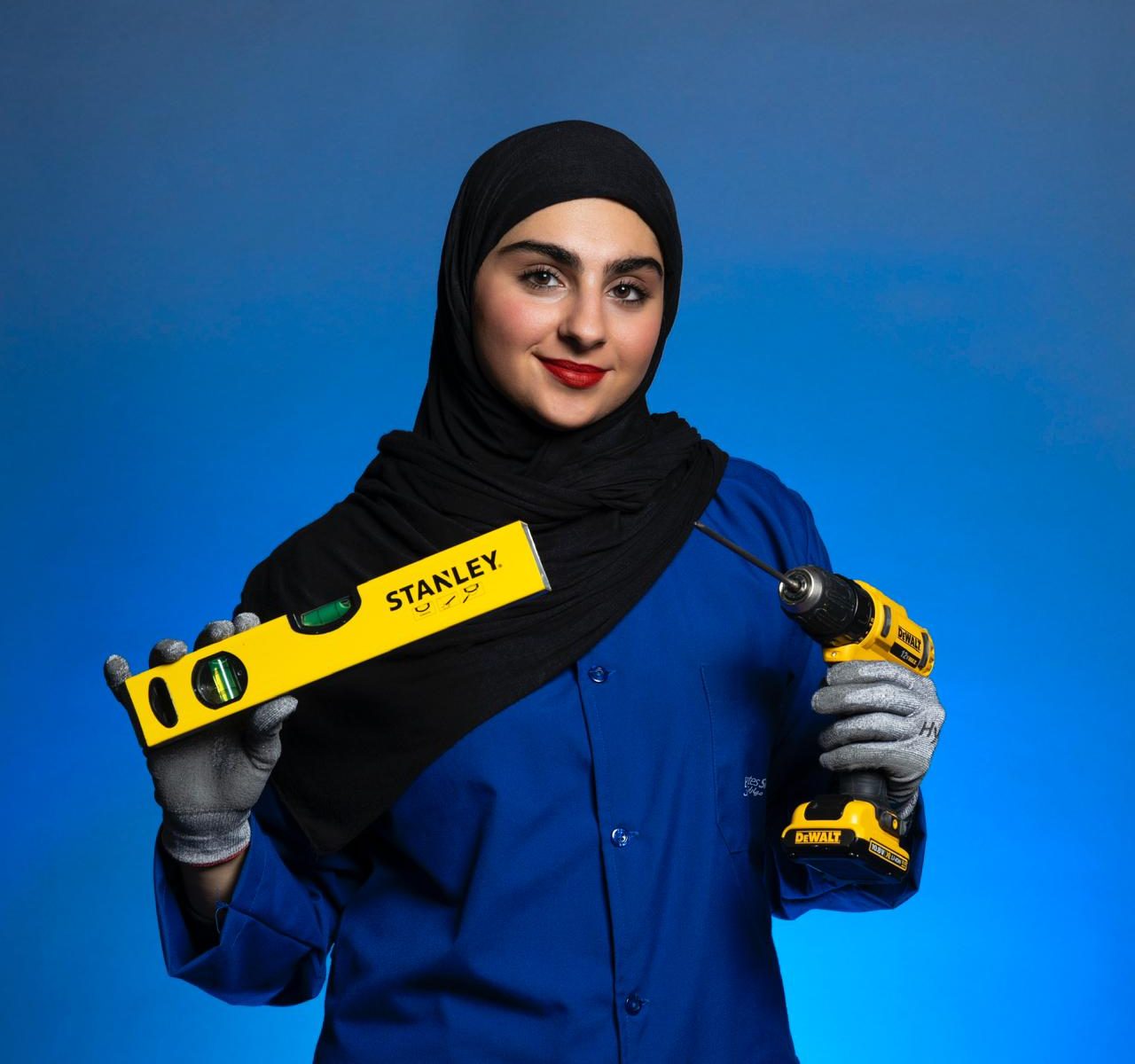
Khawla Mohamed Almarzooqi won Gold in Electrical Installations; Hanan Ahmed Alshamsi won Gold in CNC Turning; Noof Husamaldeen Alzaabi won Gold in Painting and Decoration; Abdulrahman Khalid Alshehhi won Silver in Electrical Installations; Meera Salem Alshoukari won Silver in Refrigeration and Air Conditioning; Mohammed Ayman Alsaeri won Bronze in Automobile Technology; and Sameeh Saeed Almaskari won Bronze in Electrical Installations. 

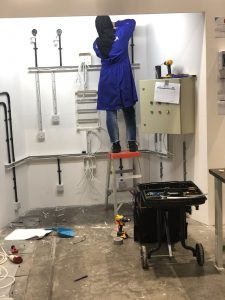
Khawla making electrical installations.

Khawla, BSc in Electrical Engineering, explains how the Electrical Installations skill category competition worked: “In this category, we were given a diagram of a complete electrical system. We had to mount the devices and the equipment on the walls based on the diagram. Afterwards, we needed to accurately mount all the equipment and all the devices in the correct places using the correct measurements. After mounting, we had to work on the wiring and the programming of the devices. We were expected to complete all the wiring for all the devices (outlets, light bulbs, and motors), the distribution board, and the control box within only 18 hours and 15 minutes. The grading was done based on a very rigorous marking scheme.”


Hanan, a BSc in Computer Science student, won first place in the “CNC Turning” category, which stands for Computer Numerical Control Turning. CNC Turning is used to produce the precise and interactive parts of complex products like a smartphone, airplane or automobile. 


Hanan was given a blueprint and had to program a computer using accurate inspection tools to fit the blueprint specification.  She then set up the CNC lathe on which materials turn around an axis at high speed, and where cutting tools driven by computer software are moved to produce the expected part with the cutting or clamping tools most appropriate to the material being used. She then sent the finished part to the assembly line with all other parts.


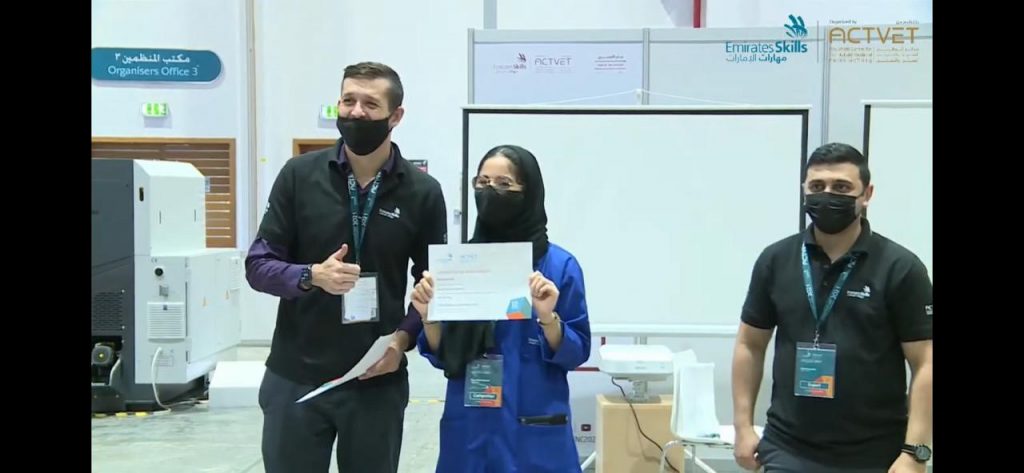
Hanan receiving her certificate.


Noof, a BSc in Cell and Molecular Biology student, won first place in the “Painting and Decorating” category.


“I have been training for a year. It took us (my team and I) a long time to accomplish this magnificent result, which required not only painting abilities, but also carpeting, decor, and sweat to create an ideal setting from the ground up for us the train,” Noof shared.

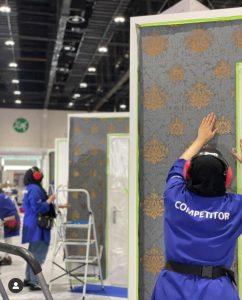
Noof installing wallpaper.


She explained how the competition was divided into four sections: wallpaper, main design, free technique, and speed competition.


“It was a really long week because I was painting 8 hours a day for 3 days continuously . Throughout the year, I was able to accomplish and improve a great deal, particularly during the Covid-19 break. And now I’m training for the WorldSkills competition.”

Noof receiving her medal.

Khawla, Hanan and Noof will now be eligible to apply for the 2022 WorldSkills competition in Shanghai, where they can test their abilities against the best of the best internationally. Hanan will also be competing in Euroskills, taking place in Austria this September.


The EmiratesSkills National Competition is the UAE’s premier event celebrating the outstanding Emirati talents in technical and vocational skills and inspires the young generation to get passionate about new trades, as well as embrace technology-based career pathways.


Erica Solomon
Senior Publication Specialist
20 June 2021

KU Students Learn about UAE Energy Sector at Total and Institut Francais Youth Hackathon

Six KU Master’s students participated in a Youth Hackathon hosted by TotalEnergies and the Institut Francais in the UAE focused on the evolution of the UAE energy sector. 


The Hackathon took place from 7 to 9 June 2021, and culminated with a final pitch ceremony that was held at Warehouse 421 in Abu Dhabi in the presence of His Excellency X. Chatel, Ambassador of France to the UAE, and Elias Kassis, TotalEnergies Country Chair in the UAE.


A total of 18 students from three universities, including Khalifa University, Sorbonne University Abu Dhabi and United Arab Emirates University, participated in the Hackathon. They were divided into three teams of six students. Each team was made up of students from different universities, backgrounds, and degree programs, and was assigned to study and develop a solution for one of three different energy sources –  gas and hydrogen, solar, and wind.


The KU students who participated were Huda Mohamed Alhashmi, MSc in Petroleum Engineering; Ahmed Khalid Alzaabi, MSc in Petroleum Engineering; Brenda Hernandez Corona, MSc in Sustainable Critical Infrastructure; Lamiaa Elsherbiny, MSc in Mechanical Engineering; Waleed Khaled Elayan, MSc in Health, Safety and Environment Engineering; and Ahmed Mahdy Yassin, MSc in Electrical Engineering. 


The solar team, which included Huda and Brenda, won first place for their proposed solution to the current challenges the region is facing when it comes to solar power activities. Their idea was to develop a startup that converts solar waste to life by recycling solar panels into many different raw materials and substances that can be used in a wide variety of sectors.


“I am extremely happy to be part of this amazing initiative. We had a great time exploring the opportunities and challenges associated with green/ renewable energy resources. We were lucky to be exposed to different scientific arguments, knowledge and discussions,” Huda shared. She also expressed gratitude to the KU faculty members who nominated the students to participate in this Hackathon.  


The three-day program began with general presentations about the future of energy from experts, followed by an ice breaking session to allow all participants to get to know each other.  


On the second day, teams were assigned an energy source and began developing ideas to address the challenges faced in each energy topic.  They were guided by expert instructors who helped them plan, organize and coordinate their ideas into beneficial and practical solutions.


On the third day, each group presented their solution in-person to His Excellency X. Chatel and Elias Kassis.


Ahmed, who was part of the wind energy team, said the experience forced him to think about how wind turbines would be placed in the UAE within the context of the country’s climate and environment, and what the necessary steps would be to maintain those turbines for a long period of time. 


“I learned the importance of a proper and concise planning process and how to organize one’s thoughts. I really enjoyed taking the challenge of coming up with innovative ideas with renewable energy in mind. The organizers did an amazing job in breaking the ice and engaging everyone enrolled,” he shared.


Waleed, who graduated with a BSc in Chemical Engineering from KU and is now pursuing his MSc in Health, Safety and Environment Engineering, developed a solution that would help the UAE adopt clean and sustainable energy by leveraging the UAE’s abundant supply of natural gas and splitting it into hydrogen and carbon dioxide. The hydrogen can be used as a sustainable fuel source, while the carbon dioxide would be sequestered using carbon capture and utilization (CCUS) technologies. 


The one-of-a-kind hackathon provided a unique opportunity for Khalifa University students to investigate the challenges and possible solutions facing the country’s energy transformation with experts in the energy field. Energy is a central thrust in KU’s research portfolio, with Masdar Institute focused on advancing solutions in renewable energy and Petroleum Institute focused on making traditional energy more efficient and sustainable.


Providing students with opportunities to collaborate with industry experts can bring significant benefits, from providing them with new perspectives to expanding their professional networks. Khalifa University’s Student Services Office is committed to supporting opportunities like this in order to maximize students’ academic experience.


Erica Solomon
Senior Publication Specialist
20 June 2021

Bringing Increased Security and Transparency to Online Auctions with Blockchain Technology

Blockchain technology can offer significant opportunities to online auctions via enhanced transparency, data integrity and data traceability. 


Online auctions bring customers from around the world to a seller and mitigate geographical barriers that would previously have stood in the way of an enterprising salesman. However, these online auctions typically require a third-party to act as an intermediary between buyer and seller to facilitate and maintain the integrity of the transaction. As a result, online platforms rely on human interactions for data integrity, security, transparency and traceability with potential bidders having to trust an auction organizer with ensuring that bids are legitimate and transactions properly settled.


To overcome this, a team of researchers from Khalifa University’s Industrial and Systems Engineering Department has investigated using blockchain technology—a distributed, immutable ledger of transactions organized as blocks and maintained by a community of users—to run online auctions. Ilhaam Omar, Research Associate, Haya Hasan, Research Associate, Dr. Raja Jayaraman, Associate Professor, Dr. Khaled Salah, Professor, and Dr. Mohammed Omar, Professor and Director of the KU Research Center for Digital Supply Chain and Operations Management (DSOM), published their research in Technological Forecasting and Social Change.


“Our team is actively researching the most pressing challenges in supply chain and logistics,” said Dr. Jayaraman. “Our work on blockchain-based auctions was inspired by a real industry problem from a UAE-based company offering a heavy equipment rental service through a competitive bidding process. However, the existing auction process lacks trust and transparency with results that cannot be audited or verified In addition, the role of third-party intermediaries causes significant information delays and a results in a costly process. Our proposed solution has broad applications in ecommerce and related service industries.”


The research team realized that Blockchain-based auctions can effectively remove intermediaries, thereby reducing transaction costs and ensuring trust among stakeholders. Their solution uses programmable Ethereum smart contracts hosted on the blockchain. These “contracts” are actually simple programs that can be used to automatically exchange information under predetermined conditions.


Blockchain technology offers an immutable and tamper-proof ledger of transactions as a shared database, validated by a wide community. Each record created forms a block, and as each block is confirmed by the community, it is paired up with the previous entry in the chain, creating a chain of blocks. The platform is decentralized, trusted, and secure, with tamper-proof records, logs and transactions. The actions enabled by smart contracts take the digital place of a third party and inherit the immutable and distributed properties from the blockchain; tampering with them becomes almost impossible.


Additionally, the blockchain-based solution would allow the seller to directly connect with many potential bidders without intermediaries, while the bidders would be able to monitor the auction process.


The team’s solution was tested on one type of auction where the highest bid is known throughout the bidding process. However, their design allows the platform to be applied to other auctioning types simply by altering the structure of the smart contracts.


They now plan to develop decentralized applications to fully automate the auctioning process. They also plan to develop more multipurpose smart contracts to cater to the broader needs and requirements of auctioneers and bidders.


“Blockchain is an emerging, disruptive, and transformational technology with incredible growth potential and impact,” said Dr. Jayaraman. “Our work, which is at the heart of the UAE’s blockchain vision that is articulated through the Emirates Blockchain Strategy 2021, will help save time, effort and resources while improving competitiveness and providing transparency and trusted transactions.”


Jade Sterling
Science Writer
13 June 2021


Khalifa University Ranks 183rd in 2022 QS World University Rankings

 Khalifa University has Become the First University from the UAE to be Placed among the Top 200 Universities in the World


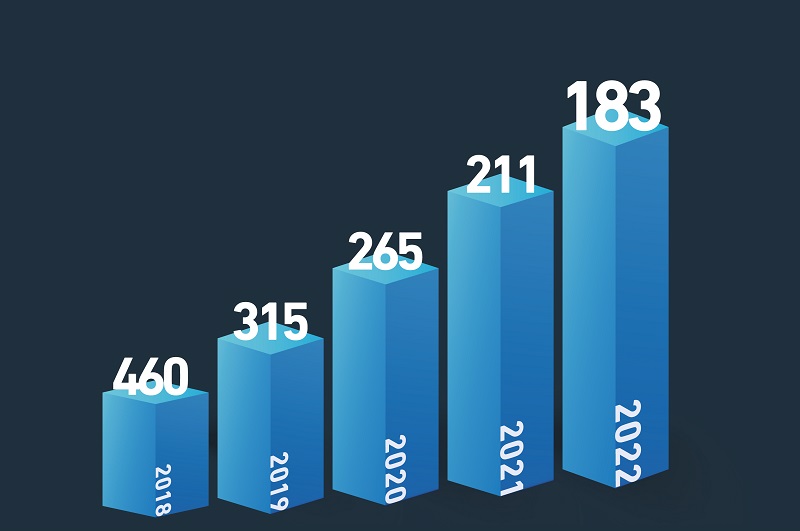
Khalifa University of Science and Technology today announced that it has reached the 183rd place at the level of world universities for the first time in the history of the country, according to the 2022 QS World University Rankings, one of the world’s most widely used basis for comparing universities across the globe, in terms of the level of education and the quality of research output, and scientific and professional capabilities of graduates.


With this, Khalifa University has become the first and only university from the UAE to be placed among the top 200 universities in the world.


His Highness Sheikh Hamed bin Zayed Al Nahyan, Member of the Executive Council of the Emirate of Abu Dhabi, and Chairman of Khalifa University Board of Trustees, said that Khalifa University’s latest milestone, to be ranked among the best 200 universities worldwide, is a global achievement and confirms the university’s continuing commitment to academic, research and scientific excellence in line with the UAE leadership’s vision and unlimited support.

His Highness Sheikh Hamed emphasized the important role Khalifa University plays in accelerating the UAE’s knowledge economy transformation by developing national cadres who are capable of leading the next stage of growth in vital sectors including science, technology, medicine and engineering, as they are the real valuable intellectual and human capital to the UAE.


His Highness Sheikh Hamed added that Khalifa University’s ranking in the 2022 QS World University is also a reflection of the efforts made by the University’s world-class faculty, who inspire and guide talented students to contribute to the innovation process in scientific research and discovery, and pursue innovative research with real-world applications for the benefit of the country.


Dr. Arif Sultan Al Hammadi, Executive Vice President in Khalifa University, said: “We are proud of this new achievement and significant milestone in Khalifa University’s journey, especially because that university was ranked only five years ago within the 451-460 range. Today, Khalifa University is the first from the UAE to be placed among the top 200 universities in the world. Khalifa University proved to be the fastest growing university under 50 globally. These achievements came as a result of support from the UAE’s wise leadership, who invest in the youth, as well as because of the efforts made by our distinguished faculty and researchers, who guide our students in academic and research excellence in multiple fields.”


This ranking is the latest recognition that Khalifa University is successfully pursuing its founding mission to become a global leader among research-intensive universities of the 21st century that produces world-class research with local relevance and international impact.


Khalifa University was ranked ‘very high’ in the ‘Research output’ category in the QS World University Rankings, which this year features 1,300 of the most prestigious universities in the world.


The QS World University Rankings assess each academic institution on six metrics, including its reputation amongst academics and employers. The criteria include Academic Reputation (40%), Employer Reputation (10%), Faculty/Student Ratio (20%), Citations per faculty (20%), and International faculty ratio/International student ratio (5% each).


Erica Solomon
Senior Publication Specialist
9 June 2021

Khalifa University Makes Top 200 of Global Higher Education Rankings in UAE First

Institution rose to 183rd in latest QS World University Rankings, as American and British colleges continue to dominate


Last year, for the first time, the region had a seat of learning in the top 150 in the world as King Abdulaziz University in Saudi Arabia reached 143rd spot.


Global higher education analysts Quacquarelli Symonds (QS) published the latest annual ratings on Wednesday, which was topped by the Massachusetts Institute of Technology.


This year QS World University Rankings assessed the world’s top 1,300 universities.


The universities are ranked on academic and employer reputation, citations for faculty, faculty-student ratio, international faculty ratio and international student ratio.


“Over the last five years, the United Arab Emirates has made highly impressive strides forward in the QS World University Rankings,” said Ben Sowter, director of research at QS.


Read the original article here: https://www.thenationalnews.com/uae/education/khalifa-university-makes-top-200-of-global-higher-education-rankings-in-uae-first-1.1237534