

Khalifa University Research Shows Increasing Trends in Summertime Temperatures over the UAE

Researchers from KU aim to characterize the weather features over the Arabian Peninsula and establish knowledge on their seasonal and annual variability.


Khalifa University researchers are gaining a deeper scientific understanding of the processes that affect the climate in the Arabian Peninsula. And with this new insight, they will be better equipped to simulate and project future changes in the region’s climate.


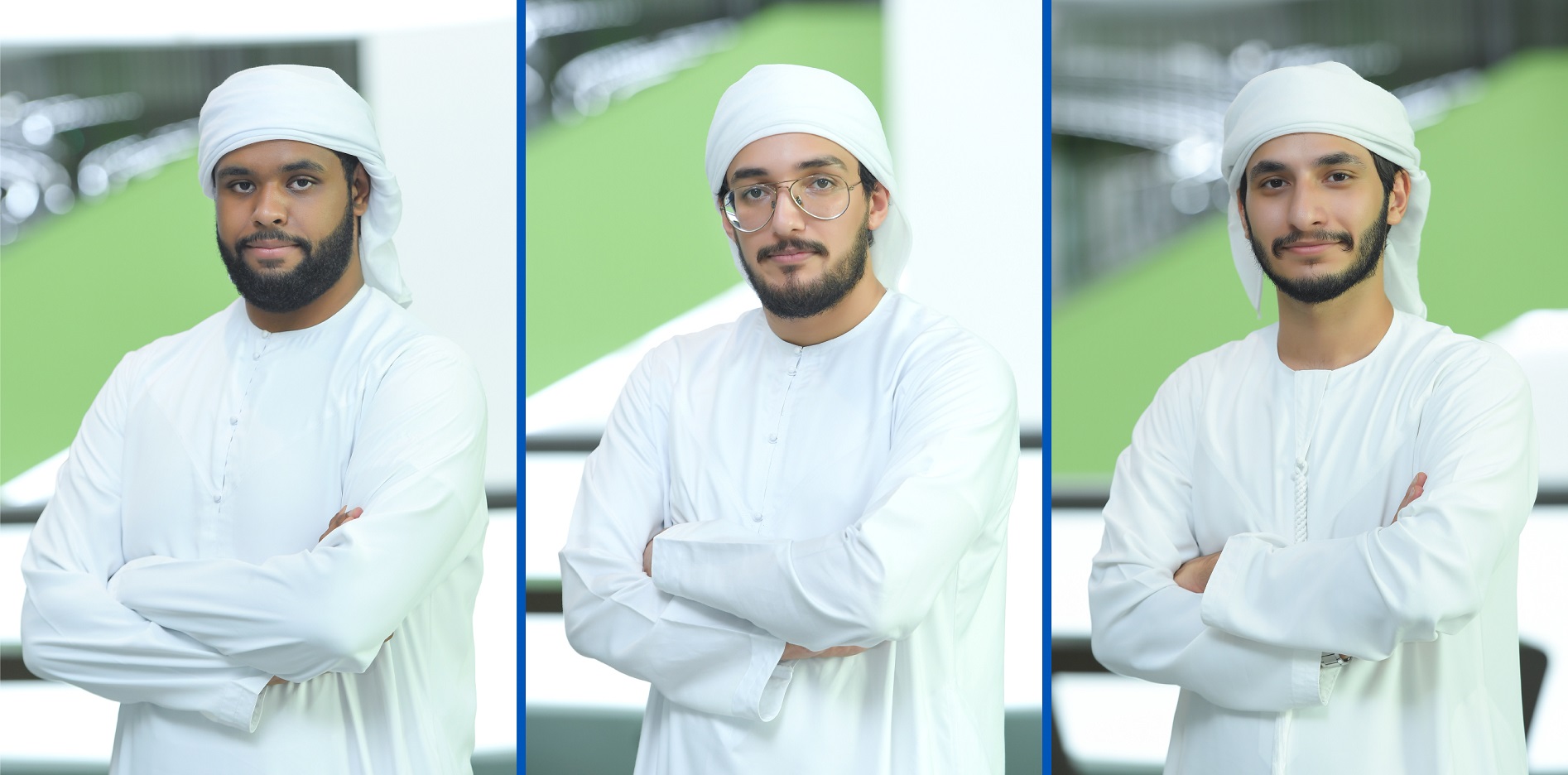
Dr. Ricardo Fonseca, Postdoctoral Fellow, Dr. Diana Francis, Senior Research Scientist and Head of the KU Environmental and Geophysical Sciences (ENGEOS) Laboratory, and Dr. Narendra Nelli, Postdoctoral Fellow, with Dr. Mohan Thota from the Indian National Centre for Medium Range Weather Forecasting, investigated two of the weather systems that are responsible for determining the climate of the Arabian Region: The Arabian Heat Low (AHL) and the Intertropical Discontinuity (ITD). The researchers published their findings in the International Journal of Climatology.


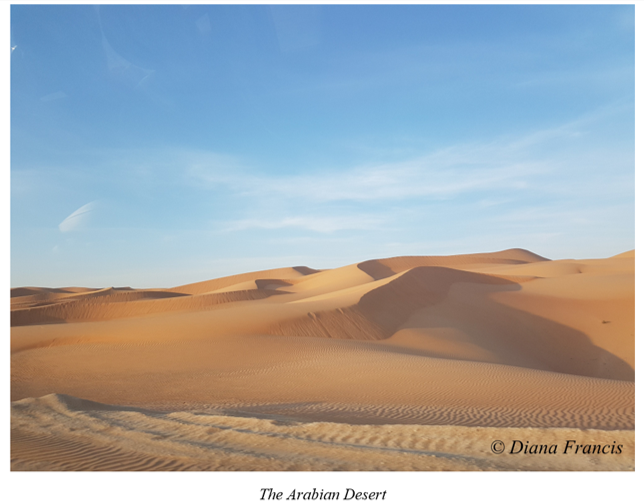
The AHL is an area of warm air close to the ground that develops inland as a result of strong surface heating by the sun, while the ITD is the boundary between the hot and dry winds from the desert and the cooler, moist winds from the Arabian Sea. Together, these systems play an important role in triggering summertime  moist convection in one of the driest places on Earth.


“Thermal heat lows and convergence zones between moist and dry air masses are ubiquitous features of tropical and subtropical regions,” explained Dr. Francis. “They impact the meteorological features in these regions, and cause the regions’ dust storms, convection, and rainfall.”


“Like other desert regions, the Arabian Peninsula sees a thermal heat low develop during the summer season, and with this, the movement of the intertropical front from the Arabian Sea to the inland areas.”  


The ITD is a well-known convergence line, marking the leading edge of the monsoon flow. It separates the moist monsoon layer to the south from the dry boundary layer to the north. The convergence along this front plays a key role in favoring the development of moist air over the UAE during summer.


“Several studies have been conducted over Africa on the variability and dynamic role of the ITD,” said Dr. Francis. “But despite being key elements of the regional climate and weather patterns, the characteristics of the AHL and the ITD over the Arabian Peninsula have not been established yet. This is what we aimed to do: investigate the variability of the AHL and ITD over different periods of time.”


With more data on how these weather systems interact in the region, scientists will be able to develop more accurate climate models, enabling them to better predict future changes in the region’s climate systems, which is critical information in light of a rapidly changing climate due to human-induced climate change.


The AHL is a deep thermal low that develops in response to strong surface heating, mostly occurring as a summertime feature. The researchers found, however, that the AHL coincides directly with the active and break periods of the Indian Summer Monsoon: increased levels of rain over the Arabian Sea and the Indian subcontinent cause greater warming over the Arabian Peninsula.


Like the heat lows studied over the Sahara Desert, the Arabian Heat Low presents a cycle as it moves across the desert. The AHL moves northwest towards the core of the Arabian desert over the course of five to 15 days, where it intensifies, before moving southeast and weakening near the Arabian Sea.


“We also noticed that the build up and subsequent decline over the summer months is rapid and sudden at both ends of the season,” said Dr. Francis. “Besides the annual march of the sun, this may arise from the fact that the majority of the rainfall in the region occurs in winter and early spring. Once the soil and the atmosphere are bone dry, the heat low can develop very quickly, and collapse just as quickly once the rains return.”


Linked to the seasonal variability of the AHL is the ITD, as the stronger the heat low becomes, the further the ITD is pushed northwards.


The ITD is located along the Arabian Peninsula coastline during the winter, but migrates northwards as the summer months approach. In the warm season, its position can fluctuate by as much as 10 degrees, reaching the Arabian Gulf and southern Iranian coastline at night. These daily fluctuations are roughly five to ten times larger than those seen over Africa, with the researchers determining that this is due to the location of the AHL, which is closer to the nearby seas than its equivalent over Africa.


The researchers also noticed the link between the daily cycle of the ITD and the daytime expansion of the AHL. As the AHL intensified, increased moisture would move inland and the ITD would move northwards. As the cooler moist air moves with the ITD, the heat low weakens, and the ITD shifts southwards again.


The researchers also considered the variability of the AHL over a period of 41 years. They found that the AHL exhibits a clear positive trend linked to the increase in surface and air temperatures in the region over the last few decades associated with global warming. Interestingly, they found that while the surface temperatures have been increasing throughout the region, the increase in temperature is more pronounced in the heat low region, and roughly 35 percent lower in the areas outside the AHL region.


“Both features play a crucial role in weather conditions in the Arabian Peninsula by modulating the atmospheric circulation at different altitudes,” explained Dr. Francis.


“The ITD helps in triggering dust storms and rainfall as convergence between the systems promote cloud development while also increasing turbulence near the ground, which helps lift dust into the air. Investigating how processes such as dust storms are modulated by the AHL and ITD is an area we’d like to research in the future.”


Jade Sterling
Science Writer
24 August 2021
President’s Memo │ July 2021│ Issue 58

Dear KU Community,


We have once again been in the limelight following our prime position in the inaugural 2021 Times Higher Education (THE) Arab Universities Ranking released recently. I am truly delighted to mention that we are top-ranked in the UAE, and 6th overall out of 125 institutions in the Arab region. Another remarkable achievement that proves our immense strength not only in academics but also in research and community-oriented initiatives. Congratulations to everyone who keeps contributing to the university’s consistently high accomplishments. Now we can confidently look ahead for the next milestone in international and regional rankings.
 

We are also proud that for the second successive year Khalifa University is contributing to the National Ambassadors Program ‘Estedad’. A total of 74 UAE national and 26 international students underwent a two-week training during summer to gain essential skills for this capacity-building initiative. This is a strong reflection of the kind of expertise and resources that we have and the critical role we can play in such national initiatives.


We have also received more accolades through our students. The Society of Petroleum Engineers (SPE) International Student Chapter Excellence Award for our SPE Student Chapter is an acknowledgement of its success in fulfilling the SPE’s mission through their programs and activities, especially during a pandemic-hit year. Congratulations to the SPE Student Chapter and all who worked tirelessly to achieve this recognition!


Congratulations also to the team of 21 students who won the top spot in verbal presentation for the first time during the Knowledge Event at the 42nd Society of Automotive Engineers (SAE) Collegiate Design Series Supermileage Competition for 2021, while retaining 6th spot overall in the Design Event, the same position won last year in Michigan, US. This is truly an international recognition and our students have been consistently demonstrating their talents and skills. My sincere thanks to the faculty members and technical staff who supported the team.


Thanks also to our faculty members and researchers who continue to publish in top-tier journals, participate in international conferences and workshops, and other online forums to keep Khalifa University in the spotlight, especially in academia, research and innovation.


The next issue of President’s Memo will be sent out on the week of 29 August. If you have any stories, news or achievements to share, please send them to communications@ku.ac.ae.


If you would like to access more of Khalifa University’s Research and News reports, click http://www.ku.ac.ae/news.


View this month’s memo here:


Yours sincerely,

Dr. Arif Sultan Al Hammadi
Executive Vice President
Khalifa University of Science and Technology


Five-Member Khalifa University Team Wins INJAZ UAE’s Company of The Year Award 2021 for Its Subscription Box Company ‘Ulbati’

 Student Team Successful at 12th Edition of National Company Program Competition


Khalifa University of Science and Technology has announced that a five-member team of Chemical Engineering graduates has won the ‘Company of The Year Award 2021 – University track’ for its subscription box company Ulbati, under INJAZ UAE’s flagship Company Program. 


The award was part of the 12th edition of the ‘National Company Program Competition’, which encourages students to use their entrepreneurial spirit to create their own start-up company. Nearly 200 students from five schools and four universities across the UAE participated virtually to compete for awards in various categories. 


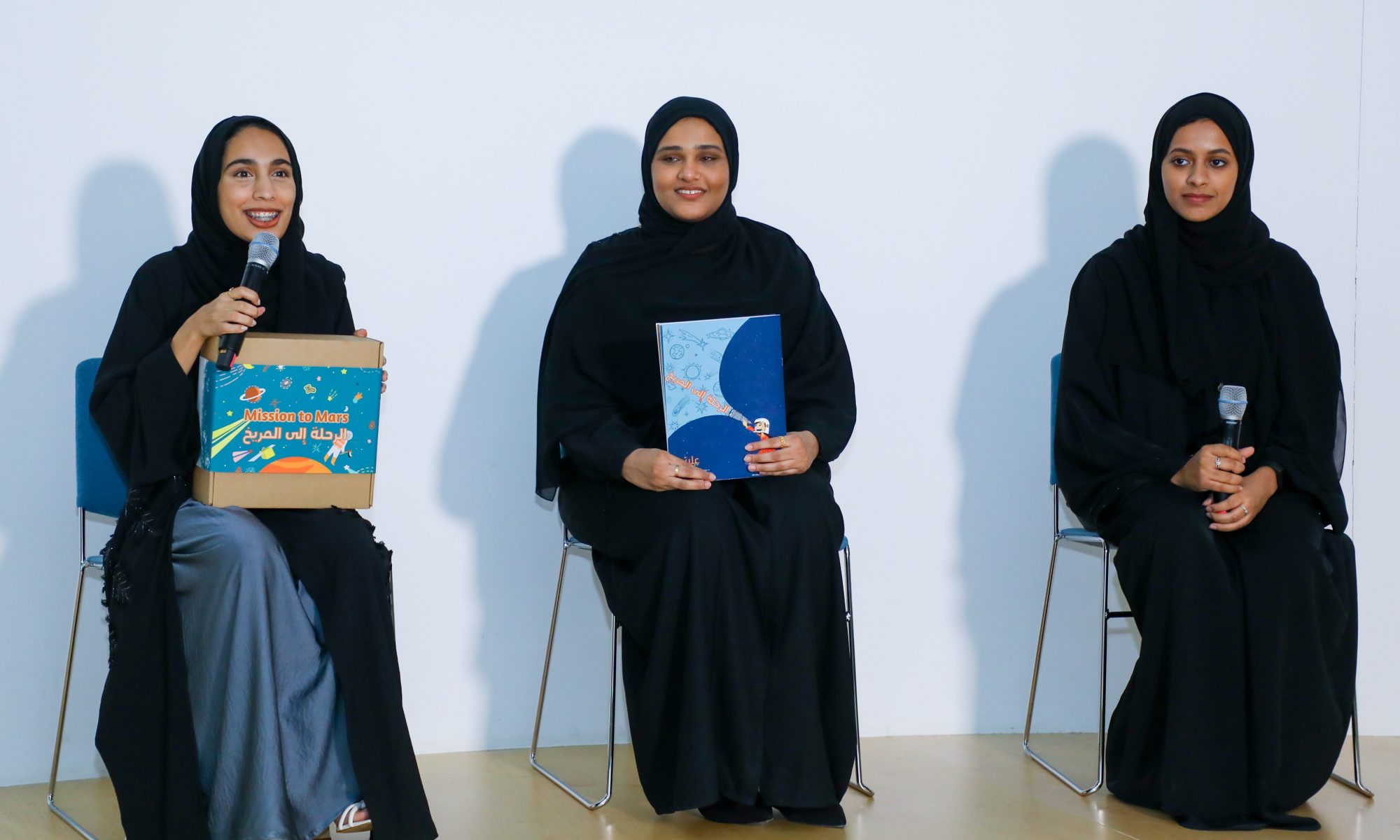
The Khalifa University team – Reem Almaskari, Fatema Alzaabi, Beshara Saad, Maha Al Seiari and Mariam Ahmed – won the award for Ulbati, the concept for a subscription box company. Created for kids, it is filled with activities themed around Emirati culture and achievements, as well as Islamic values. For every Ulbati box a child receives, 10% of the revenue is donated to Emirates Red Crescent to support students around the world.


Dr. Ahmed Al Shoaibi, Senior Vice-President, Academic and Student Services, Khalifa University, said: “The winning award for Khalifa University under INJAZ UAE’s flagship Company Program strongly illustrates that our students not only excel in research and scientific exploration, but also in entrepreneurial initiatives that aim to help the community through charity organizations. The Ulbati concept indicates the extent of our students’ commitment to sharing and giving back to the community, which is in line with the university’s mandate to build a diverse community of service-oriented, ambitious and talented individuals, through an environment that encourages and nurtures creative inquiry, critical thinking, and human values. We are delighted with the creative and commercial spirit of our students and we believe this award will encourage more students to explore entrepreneurship as an avenue to translate their knowledge into business ventures, offering valuable products and services.”


Reem Almaskari, CEO, Ulbati, said: “Ulbati promises to curate a fun, monthly-subscription box with enriching and entertaining lessons, across a variety of themes that would foster the love of learning among children. Moreover, we care deeply about moving forward sustainably and that is why we plan to implement it with different aspects such as culture, economics, and the environment.” 


Almaskari added: “The idea of Ulbati came to us with the outbreak of COVID-19 pandemic. Throughout the lockdown, we noticed our younger siblings being exposed to excessive screen-time, rather than on other value-added activities that can improve their knowledge and skills. So, we decided to curate this box filled with unique experiences around various themes and activities that will help children utilize their time in a fun and enjoyable manner, while equipping them with knowledge and let them experience an exciting and memorable childhood.” 


The team is looking forward to competing alongside other winners from the MENA region in the next stage. 


Razan Bashiti, Chief Executive Officer of INJAZ UAE, of INJAZ UAE, said: “Every year, we are in awe with our participants’ potential and capabilities. We are happy to offer them a platform to fully express their creative abilities and bring their ideas to life. The role of Khalifa University of Science and Technology in harnessing the talents of these students and securing opportunities for them is in line with our core values at INJAZ.  We are delighted to see community values as a fundamental pillar in the students’ project. Alongside their entrepreneurship aspirations and creativity, we are proud of their commitment to giving back to their community. We look forward to seeing the youth becoming the future leaders and entrepreneurs of tomorrow and are pleased to pave the way for them through the National Company Program Competition.”


Designed to enrich the learning experience of participating students, INJAZ UAE’s National Company Program provides a venue for students to bring their creative ideas to life by learning practical steps to start up their own entrepreneurial companies. 


The 2021 competition was hosted by INJAZ UAE, a member of Junior Achievement (JA) Worldwide and INJAZ Al-Arab, the world’s largest non-profit business education organization, with key collaborative partners such as Citi, Dubai Chamber, Accenture and ExxonMobil.


Clarence Michael
English Editor Specialist
18 August 2021

SCAD Concludes 1st Training Course of Young Fellows of Statistics

The Statistical Training Institute (STI) of Statistics Centre – Abu Dhabi has concluded the first course of Young Fellow of Statistics training program that was designed for Emirati students from the age of 15 to 18 years. The four-week program (from 27 June to 29 July) gave its participants a chance to take a virtual trip to Khalifa University where they knew about the subjects of statistics and data science.


The course provided an overview of SCAD’s key role that serves policy-making and development in Abu Dhabi. Also, it covers the roles and responsibilities of some local, regional and international statistics organisations in addition to an introduction to statistics as a science. Furthermore, the training program encouraged participants to engage in activities such as presentations on statistical projects planning, data collection, surveys versus polls comparisons, form designs, and data analysis. The participants learnt how to develop their leadership and presentation skills, and effective communication through e-learning platforms.


His Excellency Ahmed Mahmoud Fikri, Director General of Statistics Centre – Abu Dhabi, said: “This training program aims to raise awareness among Emirati pre-college students about the importance of statistics and data science. It encourages them to be the future data experts that their country needs.” He added: “these fields of study are fundamental and overlaps with other disciplines and other fields, such as the artificial intelligence which would be the engine of economic and scientific revolution today and in the future.”


The Director General said: “Developing the national statistical competencies is a strategic objective of the Statistics Center – Abu Dhabi.”


Khalifa University supports the training program by organising a virtual trip to the participants to encourage them to study data science and artificial intelligence, given the increasing demand in the labour market.


Read the full press release on the SCAD website

UAE high school pupils to learn about oil on ADNOC-sponsored course

Two-year programme run by Khalifa University will teach pupils about potential careers in oil and gas sector


A group of high school pupils in the UAE have started a new course designed to educate them on the country’s oil and gas sector.


The two-year Ro’ya programme is organised by Khalifa University and ADNOC, and aims to raise awareness among the pupils about petroleum engineering-related degrees and potential careers in the energy sector.


Dr Ahmed Al Shoaibi, senior vice president of academic and student services at Khalifa University, said he was delighted to partner with ADNOC.


“The Ro’ya summer programme is designed to provide students with the right perspectives as they look forward to planning and choosing their future academic course,” he said.


Read the full article here: https://www.thenationalnews.com/uae/2021/08/09/uae-high-school-pupils-to-learn-about-oil-on-adnoc-sponsored-course/ 

Inspirational Talk with Maryam AlHabroosh, Head of Mahali Program at noon

The Career Services Office hosted a virtual Inspirational Talk by Maryam AlHabroosh, Head of Mahali Program at noon, on Wednesday, 4 August.


Maryam AlHabroosh is an Emirati entrepreneur who holds a Bachelor’s degree in Mass Communications from Sharjah University and a Master’s degree in Advertising from Boston University. She takes pride in her role in helping small businesses grow online through noon’s Mahali program.


During a virtual ‘Inspirational Talk’ held earlier this month at KU, AlHabroosh introduced the technology company noon, a platform for buying and selling products, and the new services noon is rolling out to fulfill its mission to develop a 360-degree digital ecosystem and to become the go-to e-commerce business in the Arab region.


AlHabroosh discussed the growing trends of the e-commerce industry, highlighting how the Covid-19 pandemic has given the industry a significant boost. She also gave some key pointers to be considered when building a successful e-commerce business, and provided some seller success stories of business owners who worked with noon to boost their sales.


The noon Mahali program, which AlHabroosh heads, aims to help Emirati entrepreneurs to sell their products online.


She concluded her talk with an inspiring message, telling the students that they should never let fear or intimidation hold them back. She advised students to pursue their dreams, whether academically or a business, and to start with one idea at first to give that first idea a chance, so that other ideas can then grow.


With over 200 KU students in attendance, the Inspirational Talk was a tremendous success. 


Erica Solomon
Senior Publication Specialist
17 August 2021

KU Scientist to Lead Climate Data and Modeling Cluster of Newly Established UAE Climate Change Research Network

Climate change and its impact have been a growing concern worldwide. To continue and further enhance the UAE’s efforts in addressing the issue of climate change, the Ministry of Climate Change and the Environment (MOCCAE) has established the UAE Climate Change Research Network (CCRN). The Network brings together a group of committed climate change scientists and researchers from universities, the government, and other research entities to promote collaborations among scientists in the region working on the different challenges imposed by climate change. 


The Network is organized into 4 clusters spanning different topics of concern with the members identified based on their expertise. Khalifa University’s very own Dr. Diana Francis, Senior Research Scientist and Head of the ENGEOS Lab, has been appointed Lead of the Climate Data and Modeling Cluster in which there are more than 30 scientists spread over the different universities and institutions in the UAE. This cluster focuses on the local and regional climatic conditions, trends, and projections. These include temperature, precipitation, sea level, and extreme weather events such as heatwaves, flooding, storms, etc. 


“My role will be to foster the collaborations on these topics among all scientists in the UAE to come up with new ideas, new collaborative work and science-based solutions to the challenges related to climate change, all under the umbrella of the ministry and the CCRN,” Dr. Diana explained. 


As cluster lead, Dr. Diana will be responsible for coordinating agenda-setting, project design, and research activities within the cluster, as well as organizing cluster discussions, engaging other cluster members, and ensuring the delivery projects.


Dr. Diana heads the ENGEOS Lab at Khalifa University where research activities focus on studying natural processes and addressing environmental challenges at local and regional scales to propose sustainable solutions and support science-based strategies for stakeholders and governmental entities. 


“At ENGEOS lab, we work on several projects that are of particular relevance to the Climate and Modeling Cluster of the UAE CCRN. For instance, we work on the regional climate of the Arabian Peninsula and the UAE to characterize its main patterns and detect trends and variabilities. We also work on the link between the different components of the regional climate system, especially the link between the atmospheric circulation and air quality, meteorological phenomena (such as fog, dust storms, etc.). In addition to working on the climate of our region, we investigate the climate of Polar Regions such as Antarctica and the Arctic, where the footprint of climate change is clearly visible and changes there can impact our region via changes in the global atmospheric and oceanic circulation and changes in sea level due to ice melt. At ENGEOS, we perform these research activities by combining observational data and modeling techniques including machine learning and artificial intelligence,” Dr. Diana said. 


“I’m extremely proud and honored by this appointment, at the same time I’m well aware of the big responsibility that comes with it and will spare no effort to serve this community and this role as best as I can. I take this opportunity to extend my deepest respect and appreciation to all the CCRN members, the CCRN support team at the Ministry, and all my colleagues, partners and collaborators for their trust, confidence, and generous encouragement. I greatly look forward to support and work with the KU community toward a successful contribution from all of us at KU into this national effort.”


Ara Maj Cruz
Creative Writer
17 August 2021

“Can We Take a Picture with You?”: The Refusal Speech Act Between Emiratis and Tourists

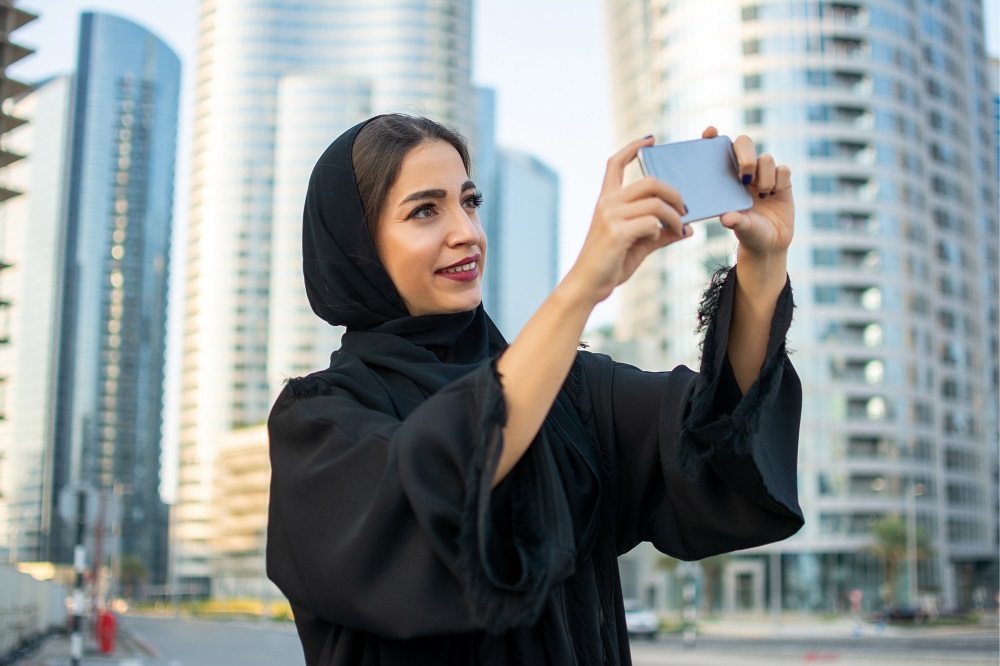
Research into how Emirati English speakers use language to refuse a request to take a photograph shows it’s not as simple as saying ‘no’. 


It’s never nice to have a request denied. But everyone needs to refuse a request every now and again, and there are various reasons why a person may say no. However, cultural diversity between speakers may mean that while one participant would be unaffected by a simple and direct ‘no’, another may need more from the refuser to save face in a potentially unpleasant situation.


Research on the ways Emirati English speakers refuse requests may be lacking, but Khalifa University’s Dr. Tanju Deveci, Associate Professor, and Dr. Jessica Midraj, Assistant Professor, both in the Department of English, are looking to change that with their latest investigation into how Emiratis say ‘no’ when responding to requests for photographs.


While the reasons for refusing may relate to social forces and cultural norms, the language used and the way Emiratis phrase their refusals is not as clearly researched. Dr. Deveci and Dr. Midraj asked 94 students how they would respond to a request for a photograph by strangers and published their research in the Russian Journal of Linguistics.


“Awareness of socio-cultural rules is essential for effective communication with people from different cultures,” explained the authors. “Not only does this awareness include social norms, but it also includes ways in which language should be used to achieve communication aims. Communicating with people from the same cultural background as us is usually easier than communicating with people from foreign cultures.”


While English is the most popular language used to communicate between people of different cultures and countries, it is not generally the meanings of words that cause difficulties. After all,


“Given the advances in technology and increased opportunities for international travel, we interact with people from foreign cultures more frequently than ever,” said the authors. “Differences between cultural norms still causes challenges. Our competence in a language largely depends on our knowledge of how that language is socially appropriate.”


Sociolinguistics covers the effects of any and all aspects of society on the way language is used. This includes cultural norms, expectations and context, and considers how social attitudes determine what is considered appropriate language use in a particular setting. For example, determining whether slang is appropriate in a conversation is a daily application of sociolinguistics. 


“Using language in socio-linguistically appropriate ways is particularly important in countries where English is predominantly used by people from different linguistic backgrounds for daily activities,” explained the authors. “One such country is the United Arab Emirates, with 88.52 percent of its residents being expatriates from various countries, not to mention the increasing number of tourists. Tourism adds to the existing diversity of cultures within the region, increasing the opportunity for people of different cultures to interact. However, this also brings language and culture-related challenges for the tourists, expatriates and Emiratis, requiring all parties to have intercultural communication competence skills alongside language skills.”


Intercultural communication competence (ICC) is the ability to communicate effectively and appropriately with people of other cultures and can be thought of as cultural awareness. Lack of awareness of cultural tendencies can create communication breakdowns. One such example is the refusal speech act, where one refuses a request made by someone else.


In linguistics, a speech act both presents information but performs an action as well. In their study with 94 Emirati English-speakers enrolled in university, the authors used the following example, where a tourist couple asks:


“Your national clothes look very interesting, and you look so nice in them! Would you mind if we have a photo taken with you?”


In the study, Emiratis’ use of the English language for the refusal speech act was investigated.


“The refusal speech act likely causes distress to the speaker,” explained the authors. “Likewise, a lack of awareness of an Emirati’s communication tendencies and preferred ways of language use may result in the non-Emiratis feeling uneasy and awkward.”


The participants in the study indicated that they would feel fairly comfortable talking to a tourist couple they have never met before but differences in gender appeared when responding to the request for a photograph.


Male participants indicated that they would feel more comfortable than the female participants accepting a request to take a photo. The results showed that 58.5 percent would accept the request, while 32 percent would reject the request and 9.5 percent would offer an alternative suggestion, essentially rejecting the initial request.


The influence of gender on speech acts of refusal varies depending on a multitude of sociocultural factors. Men may use more direct refusals, simply saying ‘no’, where women are more likely to employ ‘negative willingness’, saying things such as ‘Okay but only with my face covered’.


A considerably higher number of female participants indicated they would either reject the request or offer an alternative, with 31 percent of the refusal speech acts including a statement of regret, rather than a direct ‘no’. The female participants were also more likely to give a reason for their reluctance to be photographed, with five reasons related to tradition or culture. Additionally, only female participants used intensifiers in their refusals: ‘so’, ‘very’ or ‘really’ such as ‘I am really sorry’.


“It’s important to note that well over one-third of the participants stated they would either reject the request or suggest a condition, with female participants refusing more than male participants,” explained the authors. “Alternatives raised by the female participants included covering their faces or allowing the photo with the female tourist only. It is also important to note the avoidance by all participants of the negation word ‘no’ and their tendency to apologize to the requester.”


Refusals exist in all languages, but their performance differs across cultures. The authors suggest that in the UAE, using certain linguistic features to make the hearer feel at ease is common when refusing a request. Prompted by the urge to keep a tourist ‘interested and attached to the place visited’, a speaker is more likely to use positive politeness strategies, with men more likely to use a statement of regret, and women more likely to provide an excuse or a reason. This supports previous research that gender responses may be influenced by situational and sociocultural factors, however the lack of literature on Emirati language use prevents any stronger conclusions.


While the sample size for this study was small, the results show certain trends in language use by young Emiratis with a set of cultural values. More general research into the refusal speech act used by the Emirati population could consider different types of situations, age groups and social distance between speakers, which could provide more insight into the specific uses within the culture and across cultures.


“The refusal speech act can be a nervous event that every human will experience,” said the authors. “Saying no can be more formidable during exchanges with people from distinct cultures from our own. The fact that we are able to and required to interact with people from other cultures means we have to develop an understanding of the nuances of communication and appropriate responses so that everyone in the interaction can be comfortable.”


The study participants were students registered in the authors’ Introduction to Applied Linguistics classes. In involving the students in the research, the authors aimed to help them understand the course contents better, while also contributing to a greater understanding of Emirati utilization of the refusal speech act.


Jade Sterling
Science Writer
17 August 2021

Khalifa University Organizing Four-Day Fall 2021 Orientation for Newly-Enrolled Undergraduate, Post-Graduate and Medical Students

New Academic Programs Include Bachelor’s in Cell and Molecular Biology, and Earth and Planetary Sciences, Master’s in Aerospace Engineering, and PhD in Chemistry, Earth Sciences, Mathematics, and Physics  


Khalifa University has organized a four-day undergraduate and postgraduate Fall 2021 orientation program for the newly enrolled students for the 2021-2022 academic year, acclimatizing them with the learning process at the university.


From Fall 2021, Khalifa University is offering new bachelor’s programs in Cell and Molecular Biology, and Earth and Planetary Sciences, as well as a new Master’s program in Aerospace Engineering. In doctoral programs, Khalifa University now additionally offers PhD in Chemistry, Earth Sciences, Mathematics, and Physics.


The Fall 2021 Undergraduate Student Orientation is being held from 16-17 August, and the Fall 2021 Post-Graduate Student Orientation from 18-19 August. Senior Khalifa University leadership, deans of all three colleges, faculty members and administrative officials will interact with the students, offering details on the various academic programs, the state-of-the-art research and laboratory facilities, as well as the campus amenities, helping the students to familiarize themselves with the Khalifa University community.


Dr. Ahmed Al Shoaibi, Senior Vice-President, Academic and Student Services, Khalifa University, said: “Reflecting our status as a consistently top-ranked university in the UAE, the undergraduate and postgraduate orientation program for Fall 2021 is designed to welcome and facilitate a smooth transition of students into the Khalifa University community. The event provides an opportunity for the students and their families to understand the world-class learning environment we offer at Khalifa University, and we are delighted to welcome them into this vibrant community. We look forward to their fresh ideas and the energy they bring to our campus, because it is they who make us what we are.”


The two-day Undergraduate Student Orientation Fall 2021 features highlights of the various academic programs, and an overview of Career Services and Student Services, as well as the on-campus Health and Safety protocols. A live Q&A session offers students an opportunity to engage with the faculty and staff members to clarify details.


At the same time, the two-day Post-Graduate Student Orientation Fall 2021 will provide an insight into various research and development opportunities, an overview of intellectual property and innovation, details on the diverse research laboratories, as well as a briefing on the Environment, Health, Safety and Security protocols at the campus. A live Q&A session will help the students to seek more light on details of some of the processes and interact with the faculty and staff members.


Khalifa University currently offers 16 bachelors, 18 Master’s and three doctorate (PhD) programs, with the PhD in Engineering being offered across 12 concentrations, in addition to the MD program offered by the Khalifa University College of Medicine and Health Sciences (CMHS).


As mandated, Khalifa University seeks to provide quality manpower in terms of human capital to the strategic science and technology sectors of the UAE and the region. Khalifa University offers access to an array of significantly diverse research options in areas such as space systems, aerospace, nuclear energy, renewable energy, sustainability, hydrocarbon exploration and production, water and environment, robotics, biomedical engineering, artificial intelligence, data science and information security, as well as supply chain logistics.


Clarence Michael
English Editor Specialist
14 August 2021

IISE Student Chapter Honored with Gold Award


Khalifa University’s student chapter of the Institute of Industrial and Systems Engineers (IISE) was recently honored with the institute’s Gold Award – for the first time. The award is the highest honor in the professional organization’s University Chapter Recognition Program.


This award recognizes the chapter’s excellence in various areas such as student support, training events, field trips, public engagement and community service activities during the 2020-2021 academic year. The mission of the IISE student chapter at Khalifa University is to represent the industrial and systems engineering profession responsibly and ethically. Further, it aims to enhance the capabilities of all of its members and develop the next generation of industrial and systems engineers.


The following names are the 2020-2021 IISE officers of the Department of Industrial and Systems Engineering at Khalifa University. Congratulations to the team!


  • Khalid Jamal Hasan Ali Alhosani, President
  • Khaled Mohammad Toffaha, Vice President 
  • Mohamed Adel Omar Abdulla Alameri, Treasurer 
  • Rawdha Salah Ishaq Alattar Alawadhi, Secretary
  • Shamma Jamal Saif Fares Al-Ali, Officer 
  • Khadija Obaid Rashid Almughanni Alhmoudi, Officer 
  • Majid Salah Tayseer Talab Akhmais, Officer 
  • Saeed Sultan Mohammed Aldhaheri, Officer 
  • Dr. Mecit Can Emre Simsekler, IISE Faculty Advisor


Founded in 1948, IISE, the world’s largest professional society dedicated solely to the support of the profession, is an international, nonprofit association that provides leadership for the application, education, training, research, and development of industrial and systems engineering. 


Staff Report
16 August 2021

Khalifa University Researcher Investigates the Potential for Next-Generation Batteries

Lithium batteries are reaching technological maturity and metal-organic framework-based materials may be a long-term answer. 


Lithium-ion batteries (Li-ion) are everywhere. For the decades since their inception, they have been powering billions of devices including mobile phones, cameras, laptops, e-scooters and electric vehicles. This is due to their higher energy density and lithium being the lightest of all metals with great electrochemical potential. However, as demand for batteries grows, supply of lithium is struggling to keep up. Finding alternatives is becoming increasingly important.


Dr. Shashikant Patole, Assistant Professor of Physics at Khalifa University, has published a review paper investigating the potential of metal-organic framework (MOF)-based materials in batteries. With Dr. Anukul Thakur, Korea Institute of Materials Science, Dr. Mandira Majumder, College de France, Dr. Karim Zaghib, McGill University, and Dr. M. V. Reddy, National University of Singapore, the review paper was published in Materials Advances.  


“The compact structure of Li-ion batteries has contributed hugely towards revolutionizing electronic gadgets by adding features such as compactness, efficiency, flexibility, and mobility,” explained Dr. Patole. “Nevertheless, after four decades of intense research and advancement, Li-ion battery technology is reaching its stalling point, but the demand for higher energy density prevails.”


Some researchers are investigating ways to optimize current Li-ion systems by changing the cathode, anode and electrolyte materials, but the continued use of lithium in these types of batteries is becoming a major cause of concern due to the limited availability of lithium on earth. Additionally, lithium is commonly sourced from brine in an energy and water intensive process.


“The rapid expansion of Li-based batteries in various applications has made the cost of the raw materials increase steeply in recent years,” said Dr. Patole. “Employing systems with other charge storage mechanisms could be the answer.”


In their review paper, Dr. Patole’s team highlights the current challenges being faced by the development of metal organic framework (MOF)-based battery technologies, and possible ways to overcome these issues.


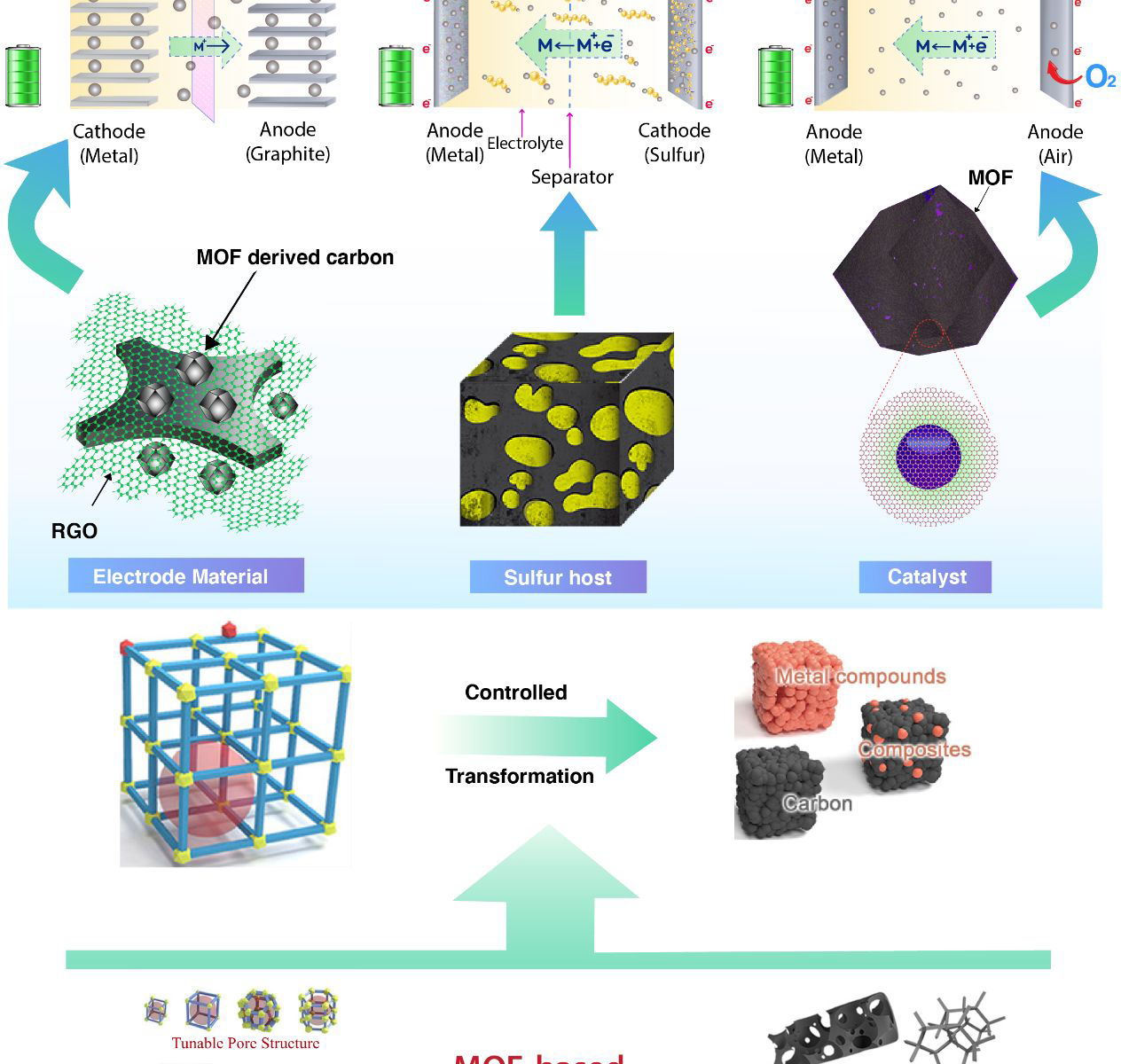
MOFs are known for their extraordinarily high surface areas with pores that are tunable and internal surface properties that can be adjusted to requirements. They can be made with abundantly available low-cost materials, such as sodium, potassium, magnesium and aluminium, for use in MOFs in batteries.


Metal ions are combined with organic linkers to provide endless possibilities of pore shape and size and physical properties of the resultant MOF. By altering the combination of ingredients, properties such as porosity, particle morphology, stability and conductivity can be tailored for specific applications, and this tunable conductivity is of particular interest to the research team.


MOFs have been shown to be useful not only as electrode materials but also as catalysts in metal-air batteries and sulfur hosts in metal-sulfide batteries.


“The pore features and pore size distribution are important attributes of any electrode material and play a vital role in imparting the desired properties to the MOF,” explained Dr. Patole. “MOFs or MOF-derived materials can act as both the anode and cathode in rechargeable batteries. Due to their large surface area, they can store charge effectively and are very promising materials in many types of batteries. For example, sodium-ion batteries are striking alternatives to lithium-ion batteries due to the cost-effectiveness and abundance of sodium.”


The team points out that advanced nanostructures such as MOFs can offer significant structural strength in harsh conditions, easy accessibility of reactants to the active sites, and effective electron transport pathways. Carefully designing MOFs is crucial to extend the adaptability of these materials for energy storage systems.


In spite of the significant progress made so far on MOF-based materials for battery systems, several challenges remain.


Designing the perfect MOF structure is no easy task, and transforming an MOF into an MOF-based material introduces further structural and architectural difficulties. Additionally, pure MOFs suffer from instability, which needs to be overcome for use in practical energy storage devices.


Although there are many challenges still to face, researchers are developing more advanced characterization techniques and a fundamental, in-depth understanding of the structure-performance relationship of MOF-based materials, and they expect to achieve the perfect MOF for practical energy storage devices in the near future.


Jade Sterling
Science Writer
15 August 2021

UAE temperatures likely to increase, but so will summer rainfall, say researchers

The Arabian heat low has intensified over the past 41 years, a trend thought to be caused by climate change


Climate researchers have predicted summer temperatures in the UAE will increase after they identified a strengthening of a key weather system associated with hotter air.


Scientists at Khalifa University of Science and Technology found the Arabian heat low has intensified and grown over the past four decades, a trend thought to be caused by climate change.


This low-pressure system is linked to the extremely high temperatures the Gulf region experiences each summer.


“This means that the region witnessed an increase in summer temperature extremes and this impacted larger areas,” said Dr Diana Francis of Khalifa University, one of the authors of a paper that details the research.


Read the original article here: https://www.thenationalnews.com/uae/environment/2021/07/25/uae-temperatures-likely-to-increase-but-so-will-summer-rainfall-say-researchers/