Prof. Minna Palmroth Gives Lecture on Space Sustainability at Main Campus

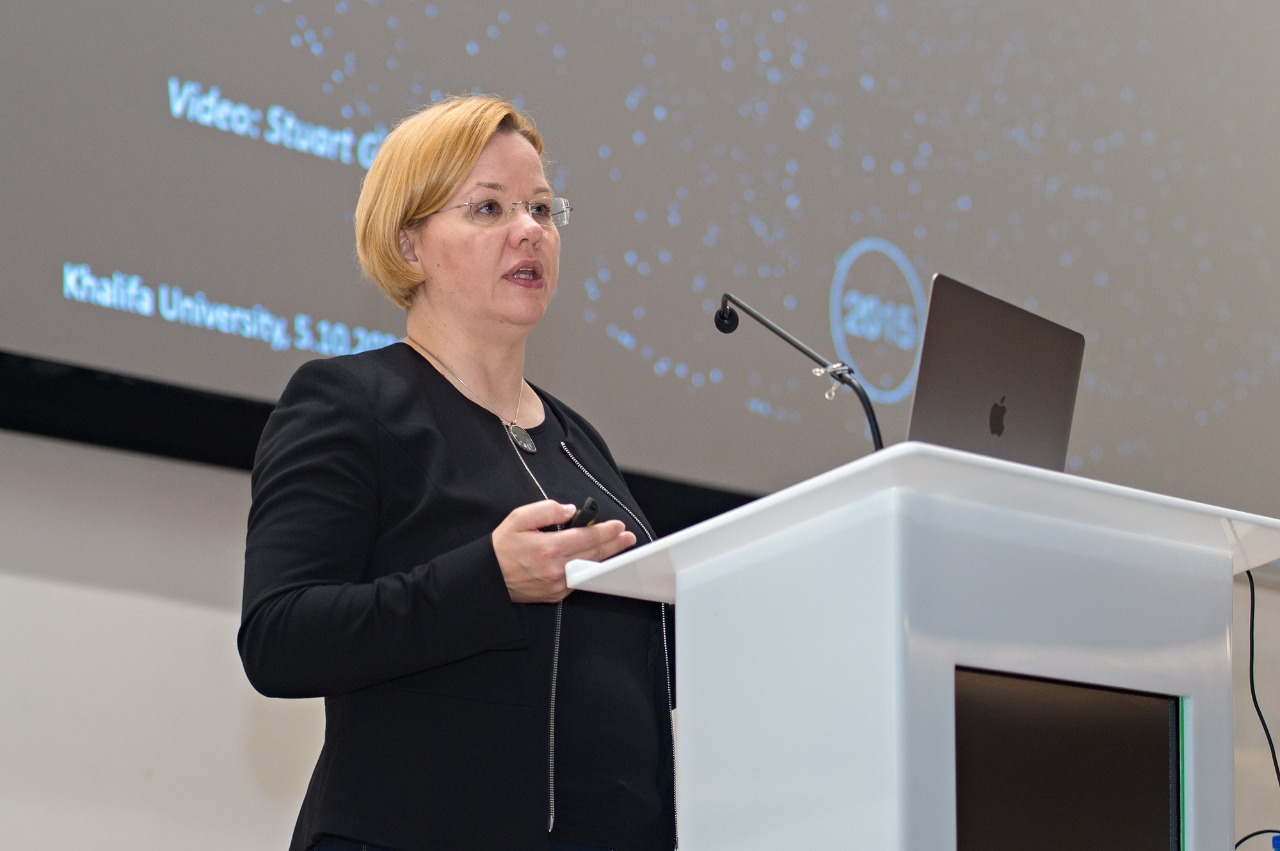
Space scientist Prof. Minna Palmroth gave an informative lecture at the KU Main Campus on Tuesday, 5 October on how she harnessed her passion in the field of sustainable use of space to became the Director of the Finnish Centre of Excellence in Research of Sustainable Space and the Principal Investigator of Vlasiator, the world’s most accurate space environment simulation.


During the lecture, which was attended by dozens of KU undergraduate and graduate engineering students, Prof. Palmroth shared insights into the Vlasiator program and the significant potential that High Performance Computing can have in space research.


She also talked about the need to make space research and technology sustainable, the valuable role of Citizen Science in space research, and the critical role of women in science.

Khalifa University Researchers Develop Next-Generation Electronic Tuning Device as New Building Block for Modern Computers


The ‘memimpedance’ device can control current flow in a circuit, and could make electronics like wearable sensors, flexible medical devices and biodegradable electronics more efficient


A team from Khalifa University has developed a novel electronic ‘memimpedance’ device that can act as a switch and induce tunable resistor and capacitor behavior simultaneously in an electronic circuit.


A resistor is an electrical component that regulates the flow of electrons in a circuit, while a capacitor is an electrical component that collects and stores electrical charge.


Memimpedance

The need to control electron flow is what gave rise to transistors, which are at the heart of all electronics today. Transistors are three terminal electronic switches that either permit or prevent electrons from flowing from one terminal to another based on the control provided by the third terminal, which serves as a gate. Other elements, including resistors and capacitors, also play a role in regulating current flow in electronics.


Enter memristors. Memristors are resistors with memory. They were physically realized for the first time in 2008, though they were conceptualized theoretically for decades before that, and have gained popularity for their potential use in computers.  They are simpler than transistors, smaller, use less energy, can alter their resistance and “remember” the most recent resistance they had. This means they have the potential to replace silicon-based transistors and could be used to create faster, more efficient computer chips that integrate memory with logic.


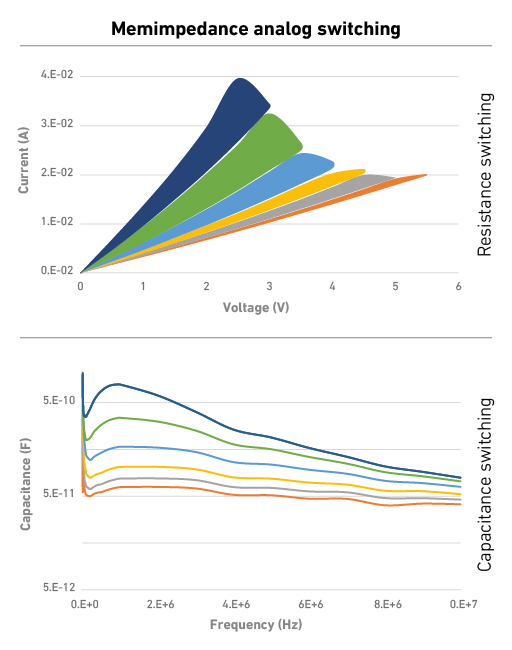
When memristor and memcapacitor behaviors happen simultaneously in the same device, it is called memimpedance. A memimpedance device, therefore, is designed to control, or tune, the memristor and memcapacitor behavior in an integrated circuit.


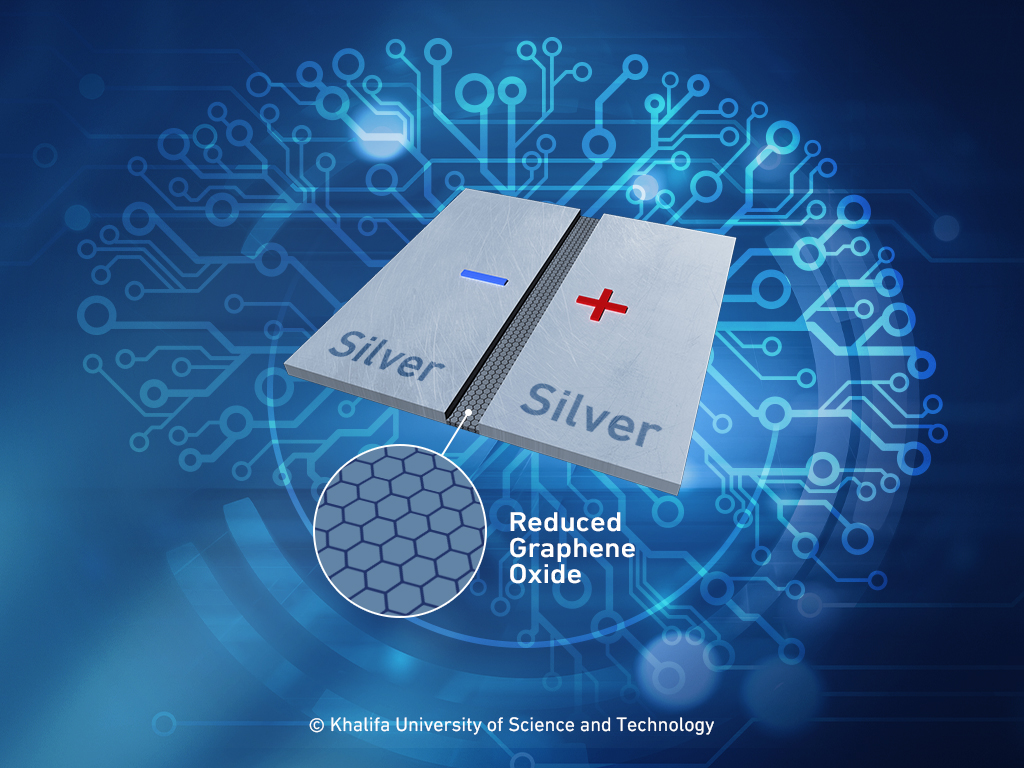
Dr. Heba Abunahla, Research Scientist in the Electrical Engineering and Computer Science Department at Khalifa University, and a team from the KU System-on-Chip Lab (SoCL), developed a memimpedance device made out of silver-reduced graphene oxide-silver that can tune the resistance and capacitance behaviors in a circuit.


Dr. Abunahla published her research in the journal Materials & Design, with co-authors Dr. Baker Mohammad, Professor, Dr. Yawar Abbas, Research Scientist, and Dr. Anas Alazzam, Associate Professor.


“Memimpedance has many advantages compared to resistance or capacitance only devices, especially its ability to tune the overall circuit impedance,” Dr. Abunahla said.


Circuit impedance measures how much a circuit impedes the flow of charge. As electrons move through a circuit, they collide with the internal structure of the conductor, which creates friction and slows them down.


The amount of resistance depends on the conductor’s material, shape and size, but conductors generally have low resistance to current. In addition to resistance, circuit impedance also considers capacitance, which is the ability of a component to collect and store electrical charge.


A device that can tune a circuit’s overall impedance would be particularly useful in applications like wearable sensors, flexible medical devices and biodegradable electronics.


Dr. Abunahla and the SoCL team successfully demonstrated that their memimpedance device would, when a suitable voltage was applied, tune the circuit resistance and capacitance concurrently.


They developed the memimpedance device with a unique structure using silver-reduced graphene oxide-silver.


“Using graphene-related materials as a switching material is a great asset due to their low cost and adaptability, and they are environmentally friendly,” Dr. Abunahla said.


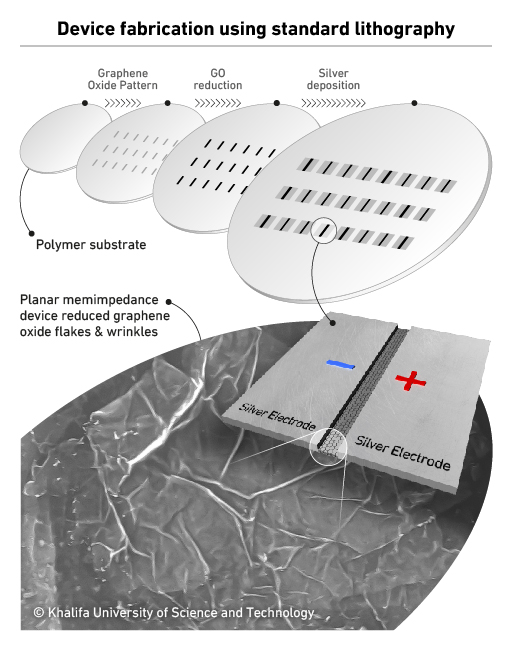
The team’s memimpedance device has a planar structure, meaning all the atoms of the molecule sit on a single two-dimensional plane.


“Fabricating the device with a planar design boosts its potential to be deployed in sensing applications, such as wearable electronics. The planar structure allows for a bigger surface area and better interaction with the environment, which increases the efficiency of the sensing unit,” Dr. Abunahla added.


The researchers fabricated the device on a flexible polymer substrate using a lithography process. They deposited the graphene oxide directly onto the polymer substrate, then immersed it in an acid to create a thin layer of reduced graphene oxide measuring around 60 nanometers thick. They then used a standard lift-off process to pattern a film of silver electrodes onto the substrate.


They intentionally selected a polymer substrate instead of a silicon-based substrate, which is traditionally used to make memristors, because silicon-based devices pose challenges when they are stacked together to create 3D circuits.


The KU memimpedance device, however, is well suited for stacking and to produce 3D integrated circuits, which can achieve better performance than traditional 2D circuits.


Using silver-reduced graphene oxide-silver in a planar structure, fabricated on a flexible substrate using a standard production process, makes the resulting device cost-effective and deployable in flexible electronics and many other potential applications


“This work will be a great asset for tunable emerging applications, especially for communication and AI systems,” Dr. Abunahla said.


Jade Sterling
Science Writer
6 October 2021

Khalifa Innovation Center Organizes ‘Innovation Open House’ on 5 October at Khalifa University Main Campus

Event Offers Researchers and Students An Entrepreneurship Forum to Interact with Professionals and Better Understand Insights into Establishing Deep-Tech Startups  


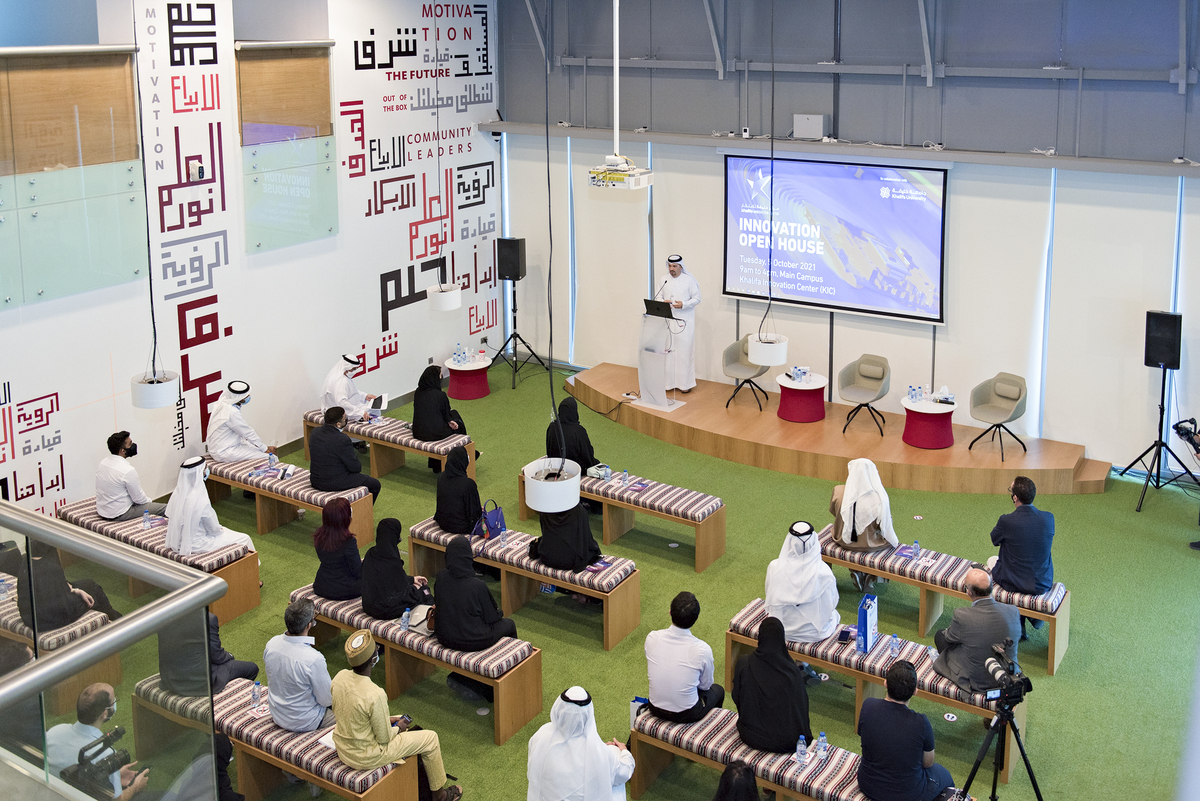
Khalifa Innovation Center (KIC – www.khalifainnovation.ae), a strategic partnership between Khalifa University of Science and Technology, Khalifa Fund for Enterprise Development, Tawazun Economic Council, Mubadala Investment Company, and Sandooq Al Watan, hosted an ‘Innovation Open House’ to enable students and researchers interact with innovation and intellectual property professionals to have first-hand insight  on how to protect inventions, prosecute intellectual property, deploy technologies and establish deep-tech  startups. 


The Innovation Open House titled ‘Make an Impact for a Better Life’ was organized by the Khalifa University Office of Technology Management and Innovation and the Khalifa Innovation Center at the Khalifa University Main Campus. It included panel discussions, inspirational talks, and parallel innovation clinics, as well as networking events. An impressive array of some of the most advanced technology patents from Khalifa University showcased some of the deep-tech startups in the KIC’s startup portfolios. 


Dr. Arif Sultan Al Hammadi, Chairman, KIC, and Executive Vice-President, Khalifa University, said: “The Innovation Open House provided a unique opportunity for university students and faculty members to have an overview on resources available to enable them commercialize inventions through formation of startups. They not only gained insight on how to translate their inventions into patents but also further understood and learned about programs available in KIC that would help with their journeys as entrepreneurs moving these inventions into successful startups.” 


Dr. Al Hammadi added: “This open house is also in line with our commitment to Abu Dhabi’s business and technology startup initiatives and incubators such as Hub 71, a flagship initiative of Ghadan 21, Abu Dhabi’s accelerator program for business in the capital. Our objective is not only to drive innovation but also to encourage commercialization of our research outcome that can contribute to the fast-expanding knowledge-based economy of Abu Dhabi and the UAE.”


Dr. Yehya Mohamed Al Marzouqi, Advisor to Tawazun CEO, said “The Innovation Open House is an ideal forum whereby the Tawazun Economic Council and our partners can demonstrate our commitment to building Emirati capabilities in multi-disciplinary R&D areas. Through the panel discussions we can also ensure participants have valuable insights on the best ways to incorporate applied research with practical application and then on to the next stage of actual development of industrial prototypes. Tawazun fully supports the creation of favorable conditions for the development of innovative, local solutions and the ability to take them to market.” 


Hind Baker, Director-General, Sandooq Al Watan, said: “Sandooq Al Watan was established with a clear mandate outlined by our wise leadership, to promote and support innovation and innovators, and provide talented UAE citizens with promising opportunities to thrive and accomplish great success.” 


“The ‘Innovation Open House’ organized by our partners at the Khalifa Innovation Center perfectly embodies this mission.” Baker continued. “It offers talented students and researchers a platform to interact with accomplished innovators and leading experts. This not only develops their innovation skills but also helps them draw on experiences and success stories for charting their own path to excellence.” 


“Our leadership has ambitious objectives for diversifying the UAE’s economy and rendering it more resilient in the post-oil era. Talented creative thinkers and bold, innovative ideas are essential for accomplishing our goals,” Baker asserted.


Dr. Sami Bashir, Director, Technology Management and Innovation, Khalifa University, said: “This Innovation Open House event was intended to address some of the questions inventors and entrepreneurs have and to provide some clarity on their paths to innovation from research discovery to a market product. Such platforms and events are critical to have insightful dialogue with inventors, entrepreneurs and partners or investors to materialize impact of our patents and startups.”


The event included panel discussions led by experts who shared first-hand information on the importance of intellectual property (IP), ways to establish a startup from scientific research, tips on navigating the innovation ecosystem in Abu Dhabi, and suggestions for attracting investors or customers. Inspirational talks were delivered by thought-leaders, inventors, and entrepreneurs who shared their experience on creating value and an impact out of scientific research. 


The open house included two parallel Innovation Clinics – ‘Intellectual Properties and Research Commercialization’, and ‘Establishing Deep-Tech Startups’. The clinics were intended to answer specific questions on handling IP while performing or commercializing scientific research, and translating ideas, patents and research results into successful startups. Participants interacted with peers, IP experts, startup mentors, inventors, researchers, and entrepreneurs. 


Clarence Michael
English Editor Specialist
5 October 2021

Sustainable and Cost-Effective Asphalt Mixture Developed by Khalifa University Researchers Laid on Abu Dhabi’s E30 Highway 

Project in Collaboration with Abu Dhabi Municipality for Testing of Five Different Asphalt Mixtures in Response to UAE’s Surface Transport Master Plan 2030  


Khalifa University has announced that a team of researchers at its Department of Civil Infrastructure and Environmental Engineering have developed a new asphalt mixture with recycled tires that can reduce the pavement’s environmental footprint and cost. This asphalt is already laid on a stretch of two kilometers of the traffic-heavy E30 Abu Dhabi–Al Ain Truck Road, for preliminary trials.


With the challenges posed by climate change and a rapidly growing population, there is a pressing need for more economically and environmentally sustainable asphalt mixtures that can withstand rising temperatures and a higher number of vehicles on the road. The energy required to extract, produce, and refine paving materials is a huge contributor to the carbon footprint of road construction.


The project aims to replace the proprietary and costly synthetic polymers used to produce Polymer Modified Bitumen (PMB) – a basic component of asphalt pavements used around the world today – with ‘crumb rubber’, which consists of rubber particles produced by grinding end-of-life tires. Only superior quality polymers are utilized for tire production, hence, despite its much lower cost, the resulting bitumen, called Crumb Rubber Modified Bitumen (CRMB), has mechanical characteristics similar to, if not better, than PMBs. 


Dr. Arif Sultan Al Hammadi, Executive Vice-President, Khalifa University, said: “Sustainability is a top priority for Abu Dhabi. We, at Khalifa University, are committed to supporting Abu Dhabi’s goal to reduce its carbon emissions, protect its environmental resources. Building sustainable pavements is an important way to achieve this goal, as it will minimize the use of natural resources, reduce energy consumption, cut greenhouse gas emissions and pollution, while improving road performance and supporting Tadweer’s goal to recycle 75% of the waste produced in Abu Dhabi by 2021.” 


Eng. Issa Mubarak Al Mazrouei, Executive Director, Infrastructure and Municipal Assets Sector, Abu Dhabi Municipality, said that this project comes under the existing partnership framework with Khalifa University, and its first fruits were the establishment of the National Center for Infrastructure Research. The NCIR aims to achieve the vision of sustainable development and supports innovation initiatives that provide environment-friendly solutions, based on scientific foundations and economic feasibility. Al-Mazrouei pointed to the launch of a new joint study with Khalifa University for updating and developing specifications and design standards for the asphalt mixtures that are suitable to the local environmental conditions and the natural materials available in the UAE.


The joint project team is led by Dr. Tom Skarpas, Professor and Chair, Civil Infrastructure and Environmental Engineering, Dr. Michele Lanotte, Assistant Professor, Dr. Jamal Elzarif and Eng. Saleh Hamed Al Jufri from the Abu Dhabi Department of Municipal Infrastructure and Assets.


Dr. Lanotte explained that about 650 tires can be recycled to build one km of single lane of a roadway. This technology can contribute significantly to the reduction of the UAE stockpiles of scrap tires, reduce the energy footprint of Abu Dhabi’s pavement and improve the performance of the local road network. Hence, pavements constructed with CRMBs are not only financially attractive but also environmentally-friendly since they provide a solution to the critical problem of tire disposal.


The project was initiated in response to the UAE’s Surface Transport Master Plan 2030, which aims to create conditions for sustainable road infrastructure development by using resources responsibly, minimizing pollution and preserving Abu Dhabi’s unique environment. 


Five different asphalt pavements were laid between October and November 2019 on the E30 Highway, with the support of the industrial partners Richmond Petroleum, Tarmac-Colas and Al Sahraa Group. Two asphalt mixes were designed with CRMB, two with a commercially available PMB and one with a traditional unmodified bitumen.


In Abu Dhabi alone, more than 7,000 tons of used tires were produced in 2018 and only partially recycled for the local rubber industry, which has necessitated a quick management solution to avoid the creation of an unmanageable amount of rubber waste. 


During construction, the field crews noticed that both asphalt mixtures containing CRMB exhibited greater ease of compaction compared to the other mixtures, which resulted in less or no use of some of the field compaction equipment that was instead necessary for the other mixtures. “The project outcomes are extremely optimistic since they lead to positive impacts on the work crews as well as the total cost and time of construction,” Dr. Skarpas said. 


The asphalt mixtures were sampled during construction and are currently under testing and evaluation at the Khalifa University Infrastructural Materials Laboratory. Various aspects of the mechanical response of CRMB-based asphalt mixtures like resistance to permanent deformation and fatigue cracking are currently being evaluated through the lab’s state-of-the-art testing equipment. The goal is to compare the response of CRMB asphalt mixtures to that of other locally available and currently utilized asphalt mixtures. 


The performance of the asphalt in the E30 highway will also be monitored under traffic conditions over the next few years under the joint supervision of the Abu Dhabi Municipality and the Khalifa University Pavement Engineering team. The outcome of this joint initiative will be the development of specifications for the Municipality for the implementation of the CRMB asphalt throughout Abu Dhabi. 


By leveraging a major waste stream in Abu Dhabi, Khalifa University is helping to prevent tires from piling up in landfills, while creating a high-value technology for more sustainable, economically viable roads in the UAE.


Clarence Michael
English Editor Specialist
4 October 2021

BASF Honors 10 Winners of Khalifa University’s YFEL Case Study Competition on ‘AI for Sustainable Farming’ Organized by EBTIC

Reward Workshop ‘CliftonStrengths Assessment’ Helps Winning YFEL Members to Dive Deep into Their Own Talents and Strengths


Khalifa University of Science and Technology today announced 10 members of Young Future Energy Leaders (YFEL) outreach program were honored at a special reward workshop for winning the 2021 YFEL Case Study Competition on ‘AI for Sustainable Farming’, conducted by the Emirates ICT Innovation Center (EBTIC). 


The 10 winning YFEL members included three UAE national students, one international student from Khalifa University, one young professional from Dubai Municipality, and five international members from Mexico, Colombia, the US, China, and Hong Kong. 


Dr. Arif Sultan Al Hammadi, Executive Vice-President, Khalifa University, said: “Our outreach programs and sustainability initiatives are designed to encourage wider participation by youth and professionals. We are grateful to BASF, partner of YFEL, for organizing CliftonStrengths, the reward workshop, and helping the YFEL winners to explore and augment their personal skills and talents. Also, EBTIC, one of our research centers, has played a commendable role in conducting this case study competition on machine intelligence in farming. We thank the partners and hope the 2021 YFEL members will continue with their progress in obtaining sustainable innovations as laid down by the UAE leadership.” 


The winners of YFEL Case Study Competition were evaluated by an elite panel of judges including Dr. Nawaf I. Almoosa, Director of EBTIC and Head of Smart Infrastructure Research; and Assistant Professor, Electrical Engineering and Computer Science, Khalifa University; Dr. Dymitr Ruta and Dr. Kin Danny Poon, Chief Researchers, EBTIC-Research. 


Dr. Ruta and Dr. Poon introduced the case study topic to the YFEL members, and engaged them in group discussions. The YFEL members were given six days after the initial introduction to find solutions and create innovative ideas. The winners were assessed by the judges for novelty, strength and robustness of the design, feasibility of the implementation plan and the analysis-backed efficiencies delivered to the farming industry. All indoor and outdoor solutions were accepted for evaluation, especially those energy-efficient sustainable solutions suitable for the arid climate in the Middle East. 


Industry studies indicate AI can provide farmers with real-time insights from their fields, allowing them to identify areas that need irrigation, fertilization, or pesticide treatment. Also, innovative farming practices like vertical agriculture may help increase food production while minimizing the use of resources. 


The 2021 YFEL Case Study Competition aimed to design a novel solution, system or process within a broad-minded smart farming domain that leverages technologies in artificial intelligence/machine learning/internet of things to provide significant measurable benefits compared to the equivalent currently used farming practices. 


BASF, world’s largest chemical company and YFEL program partner for over four years, organized the reward workshop ‘CliftonStrengths assessment’. CliftonStrengths, a web-based assessment of normal personality from the perspective of Positive Psychology, helps individuals to dive deep into their own talents and strengths. Developed expressly for the Internet, this tool helps explore what makes a person unique and the value this person can bring to a team or the workplace. 


EBTIC is a research and innovation center founded by Khalifa University, Etisalat and BT (British Telecom), and supported by the Telecommunication and UAE Digital Government Authority’s (TDRA) ICT Fund. 


Clarence Michael
English Editor Specialist
30 August 2021

Industrial Decarbonization via Hydrogen

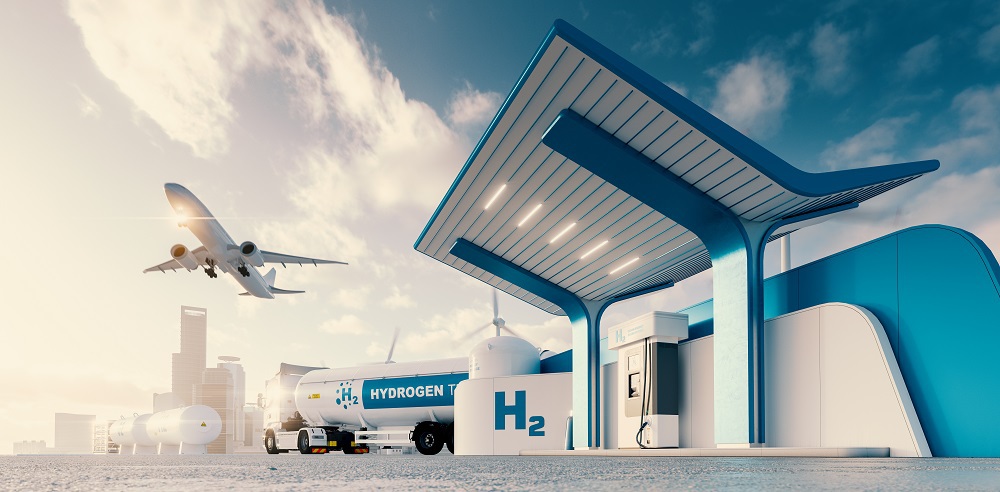
Hydrogen offers a potential solution to the problem of supporting more sustainable industries, but technical, economic, social, and political factors stand in its way, according to a new paper produced by an international team of experts from a variety of disciplines. 


Using decarbonized hydrogen, so-called green hydrogen, is an avenue to a low-carbon economy that is attracting renewed interest. Technological developments and cost reductions could allow hydrogen to contribute significantly to a decarbonized economy as a fuel and a feedstock. As a fuel, hydrogen offers considerable potential because it generates no carbon dioxide on combustion. As a feedstock, low-carbon hydrogen could replace high-carbon feedstocks in processes such as steel production.


At a critical juncture for the industry and global climate, Dr. Steve Griffiths, SVP Research and Development and Professor of Practice, offers a critical, systematic and interdisciplinary assessment of industrial decarbonization via hydrogen. Dr. Griffiths and his team reviewed more than 2,100 sources of evidence, referencing over 700 papers and studies, using a sociotechnical lens to examine hydrogen production and use across multiple industries. The work on hydrogen is part of a broader set of studies that the team has undertaken with support from the Industrial Decarbonisation Research and Innovation Centre (IDRIC) in the United Kingdom.


Team members were Dr. Benjamin Sovacool, University of Sussex, UK; Dr. Jinsoo Kim, Hanyang University, Republic of Korea; Dr. Morgan Bazilian, Colorado School of Mines, USA; and Joao Uratani, a research engineer also from Khalifa University.


Their review was published in Energy Research and Social Science.


“Hydrogen is increasingly being positioned as a key energy vector due to its versatility as a chemical store of energy for use in the power, buildings, transport, and industrial sectors,” Dr. Griffiths said. “More importantly, hydrogen is one of the key options for many decarbonizing industrial sectors, particularly those that require hydrogen as a feedstock for process chemistry.”


Hydrogen is the most common element in the universe but hydrogen atoms do not exist in nature by themselves. To produce hydrogen, its atoms need to be decoupled from other elements in resources like  water, plants or fossil fuels. The method by which hydrogen is produced largely determines its sustainability.


,” Dr. Griffiths said. “Its properties make it an excellent fuel but hydrogen requires considerable care in processing and handling. Further, transporting it long distances in a liquid form is currently very expensive.”


Although the use of hydrogen is somewhat limited in scope today, a very different future may be on the horizon. The industrial processes used to make steel, cement, ceramics, glass and chemicals all require varying amounts of high-temperature heat. For these sectors, hydrogen is one of the very few long-term options for replacing fossil fuels at large scale.


The use of hydrogen in shipping, particularly in the form of ammonia, is the major opportunity here.


However, the main challenge with scaling up the hydrogen-supply chain is to lower the costs of transporting it. The existing technologies for transporting and distributing hydrogen long distances in a volumetrically energy dense liquid form are still significantly more expensive than those of other fuels, such as oil and natural gas. Hydrogen, or one of its derivatives, particularly ammonia, may play a prominent role in such long distance transport. However, pipeline transmission of hydrogen gas is currently the economic means of moving hydrogen at large scale.


Compressed hydrogen could use converted natural-gas pipelines, or newly built ones, or even be co-transported with natural gas to partially decarbonize natural gas already used in the energy sector. A lack of dedicated global hydrogen pipeline networks is, however, a current challenge to be overcome if regional and national hydrogen trade is to be established. Once transported, hydrogen storage becomes the priority, but hydrogen’s low volumetric energy density can make it difficult to store. Fortunately, there appears to be no insurmountable technical barrier to storing hydrogen over the longer term in high capacity geologic formations like aquifers and rock caverns.


The final cost of hydrogen in international trade will depend on what it costs to produce and transport it, Dr. Griffiths said. “Connecting suppliers and consumers at the global level via the most cost-effective means will be a great challenge.”


Such considerations are particularly relevant for connecting global supply and demand. This said, sociopolitical factors could hinder hydrogen’s growing role in industrial decarbonization and so must also be considered.


The review paper considers the social and technical systems involved in making, distributing, and using hydrogen, with the authors accounting for institutional inputs, policy and regulatory frameworks, and financial and economic enablers. There are many socio-technical elements at play:


“Industry decarbonization via hydrogen will require policy mechanisms that stimulate both hydrogen supply and demand and support development of the necessary supply-chain infrastructure,” Dr. Griffiths said. “While policy toolkits can be built upon existing efforts targeting renewable-energy generation and use, specific hydrogen-targeted policy instruments will be needed.”


Further, policies can spur innovation, and dedicated funds will be required to support research and development in academia and industry.


In this context, dedicated hydrogen-research centers are appearing, and public-private partnerships for the demonstration and scale up of hydrogen technologies and projects can be found around the world. Regulatory and certification frameworks are emerging that cover the production, supply-chain and industrial-use elements of hydrogen at the national level. Internationally, seventeen standards had been published and fifteen more were under development at the time the paper was written. These standards cover most elements of the technical pathways for hydrogen production and use.


However, the degree to which countries have been able to implement regulation varies. National and regional regulatory bodies will need to adopt harmonized policy instruments to avoid being excluded from accessing international hydrogen markets. Additionally, the regulatory frameworks on safety and quality control will need to be particularly robust.


“The absence of comprehensive, national and international policy and regulatory frameworks for hydrogen adoption, particularly for  industrial systems, is a major challenge,” Dr. Griffiths said. “Despite increasing interest in hydrogen, policy support in the form of roadmaps, action and strategic plans is still not fully implemented on a global level.”


The future of hydrogen trade relationships will also rely heavily on geopolitics. The role that renewable hydrogen could play on the energy geopolitics stage remains to be seen. Particularly as transport costs are reduced, the importance of where resources are found will be reduced. Contrasting this to the geopolitical clout afforded to countries located on top of robust oil reserves suggests how global geopolitical dynamics could be affected.


“Whether countries will adopt particular roles in a hydrogen-economy transition is likely to depend on existing resources and infrastructure,” Dr. Griffiths said. “Some countries are more likely than others to lead the global markets in production capacity and export heavily, while others will focus on importation to meet demand. Countries that are more likely to import are already net energy importers under the current fossil-energy paradigm.” Industrial adoption of low-carbon hydrogen still faces a significant number of barriers. Regulatory and standardization instruments are perhaps the key means of driving rapid hydrogen utilization, according to the study authors, but support for R&D is also critical.


“Decarbonizing hydrogen is key to decarbonizing the chemical and refining industries, but it will also help decarbonize a number of other industries,” Dr. Griffiths said.


Applying decarbonized hydrogen across a wide range of sectors could benefit a large number of companies and economies. Of these, perhaps the most significant are the oil and gas firms that are increasingly facing calls to halt fossil-fuel production. As these companies look to diversify their portfolios, green hydrogen or hydrogen produced from fossil sources coupled with carbon capture, could be critical. Cutting the costs to achieve global industrial adoption of low-carbon hydrogen will require massive investment and scale, which oil majors could provide.


The authors noted that moving forward, the most ambitious targets for hydrogen use will require additional study, ranging from R&D to market stimulation, with further consideration of potential geopolitical ramifications and also further consideration of opportunities and challenges for hydrogen adoption in developing countries.


Most articles about hydrogen involve engineering and the natural sciences with social sciences representing a small fraction of total papers published. This suggests there is a lot of room to study in more detail the sociotechnical aspects of hydrogen use.


Jade Sterling
Science Writer
29 September 2021

More UAE Rain in the Springtime as Climate Change Impacts Local Weather Patterns

A Khalifa University team has found warming global temperatures may be making springtime rainfall last longer in the UAE, and possibly become more common. 


A team from the Khalifa University Environmental and Geophysical Sciences Lab (ENGEOS) investigated spring season rain in the UAE, finding a positive trend over the past 20 years. Meaning, more rain is occurring during the spring now than in previous decades.


To better predict and model these rainy days, the team characterized the atmospheric conditions that favor their occurrence and explained that springtime rain will be more likely in the future as the global climate continues to warm and the global water cycle accelerates.


Additionally, globally averaged rainfall has increased since 1950, with human influence likely contributing to this.


A warmer atmosphere can hold more water, noted Dr. Francis, the senior author on the study, meaning rainfall can last longer. While this can be beneficial to a region known for its lack of rain, it can also be detrimental, since much of the city infrastructure is not designed to handle large amounts of rainfall.


Dr. Narendra Nelli, Postdoctoral Fellow, Dr. Diana Francis, Senior Research Scientist and Head of the ENGEOS Lab, Dr. Ricardo Fonseca, Postdoctoral Fellow, Dr. Rachid Abida, Research Scientist, Michael Weston, Research Engineer, Dr. Youssef Wehbe, Graduate Research and Teaching Assistant, and Taha Al Hosary from the UAE National Center of Meteorology, analyzed 95 springtime rain events that affected the UAE between 2000 and 2020. They published their findings in Atmospheric Research.


These systems are known as mesoscale convective systems (MCS). An MCS is a cluster of storms that moves as a single system. For one to develop in a hyper arid environment like the UAE, a combination of factors ranging from local to regional scale is needed, including a steep temperature gradient on the ground between the land and the surrounding seas. If cold air from the sea meets hot air from the desert, there is potential for an MCS to form.


“In arid regions, MCSs account for most of the annual rainfall and are associated with heavy rain that can cause flooding, landslides, and associated disruption to daily life,” Dr. Nelli said. “Past extreme weather events over the Arabian Peninsula have had devastating impacts on the local population so understanding how they start and develop is crucial for better simulation and prediction of future events and impact.”


despite their large contribution to the total amount of rain per year. What’s more, Dr. Nelli said, they may occur more frequently under a warmer climate.


The study found that MCSs occurring in spring over the UAE are large-scale features of the global water cycle which drifts over the UAE, contrary to summertime MCSs which develops locally over the UAE.


The study highlighted that the duration of these springtime MCS is becoming longer and the resulting amount of rain larger.


A better understanding of what causes MCSs in a region known for its aridity is an important step toward accurately predicting them and benefit from their associated rainfall, especially as they are expected to become more frequent as the global climate changes, Dr. Nelli said. 


Jade Sterling
Science Writer
28 September 2021

Using Mathematics to Uncover the Mysteries at the Center of our Universe

Mathematical equations developed by Dr. Davide Batic, Associate Professor of Mathematics at Khalifa University, predict what may be at the center of the universe is not a Black Hole, but dark matter. 


Recent advances have captured the scientific imagination, with the first image of a black hole presented in 2019 and the 2020 Nobel Prize in Physics awarded to three physicists who proved the existence of a black hole at the center of our galaxy.


Now, Dr. Davide Batic has added to this research, publishing models that show the Nobel Prize-winning conclusion could be correct, but could also be wrong.


Dr. Batic, Associate Professor of Mathematics at Khalifa University, worked with D. Asem Abuhejleh, mathematics student at KU, and Dr. Marek Nowakowski at Universidad de los Andes, Colombia. They published their results in the European Physical Journal C.


Black holes form when the center of a very massive star collapses upon itself. As stars die, the nuclear fusion at their core runs out of fuel. This means the constant outward push that balanced the inward pull of gravity from the star’s own mass is gradually reduced. When there is no longer a balance, the star begins to collapse under its own mass. If it collapses into an infinitely small point, it becomes a black hole.


Roger Penrose, Reinhard Genzel and Andrea Ghez were awarded the 2020 Nobel Prize in Physics for their work in understanding black holes, demonstrating that they are an inevitable consequence of Albert Einstein’s general theory of relativity, and then finding them. While black holes’ potential existence was proved possible through general relativity, finding them was more complicated.


In 1965, Penrose used new tools in mathematics to prove that a star collapsing and turning into a black hole is possible. Then Genzel and Ghez provided the most convincing evidence to date of a supermassive black hole at the center of the Milky Way. They found that Sagittarius A*, the black hole in question, was tugging on the stars orbiting it, making them move in very unusual ways.


Their independent discoveries of a mass four million times more massive than the sun are considered the most convincing evidence of a black hole at the center of our galaxy.


“By observing the orbital motion of stars residing in the center of our galaxy, physicists determined that there must be a huge mass sitting at the galaxy core,” Dr. Batic said. “Because this feature was accompanied by other peculiarities in the star trajectories close to the galactic core, they concluded that this mass must be a huge black hole. However, we wanted to add an important aspect to their conclusion that they did not consider: the presence of dark matter in our galaxy.”


With dark matter, more is unknown than known. Dark energy comprises roughly 68 percent of the universe, with dark matter making up about another 27 percent. Everything else — every atom, every molecule, every bit of normal matter humanity has ever observed — adds up to less than 5 percent of the universe.


Unlike normal matter, dark matter does not interact with electromagnetic forces. It does not absorb, reflect or emit light, and its existence has been only inferred by the gravitational effect it appears to have on visible matter.


“Given a mass as big as the one estimated by Penrose, Genzel and Ghez, considering the star trajectories that they observed and taking into account that most matter in the universe is made of dark matter, can we always conclude that it’s a black hole at the galactic core?” Dr. Batic said. “The answer is: It depends! It depends on how you model dark matter.


“We discovered two scenarios: According to one model, there can be a fuzzy black hole at the center, while in the other model, there is no black hole at all, but a self-gravitating ultramassive object produced by dark matter itself.”


A black hole is a region of space where matter has collapsed in on itself and the gravitational pull is so strong that nothing, not even light, can escape. It is infinitely dense and can be billions of times more massive than the sun.


The edge of a black hole, the point of no return beyond which nothing can escape, is known as the event horizon, and anything that crosses the event horizon is carried toward the singularity at the center of the black hole.


Einstein’s general theory of relativity describes physics at a grand scale; however this theory breaks down when applied to what happens inside the singularity. At this point, quantum mechanics comes into play, describing nature at the smallest scales of atoms and subatomic particles. Unifying the two remains one of science’s greatest challenges.


“In theoretical physics, string theory is our best candidate theory, which brings together quantum mechanics and general relativity,” Dr. Batic said. “If we reimagine a black hole as a fuzzball, with no singularity and no event horizon but a big tangled ball of the strings of string theory, we can resolve the issue of reconciling the classical and quantum descriptions of a black hole.”


String theory says that the entire universe is made out of strings that vibrate in various complicated ways to create space, time and all the forces and particles we know. If a black hole is actually a ball of said strings, it wouldn’t look like a smooth featureless pit of gravity narrowing down to a single point, but instead a ball packed full of strings with a fuzzy surface. A fuzzball black hole would still be dense enough to affect the stars around it in the same way a conventional black hole would, with the same effects on spacetime and light, which is why Dr. Batic’s model can predict them.


However, when the model is tuned differently to include dark matter in the center of the galaxy, the outcome is very different, predicting a dark matter  “droplet,” which is self-gravitating with no central singularity.


A fuzzy droplet has no event horizon, no exterior. If a horizon develops, it is a fuzzy black hole. A dying star may be one way of producing a black hole, but black holes may also have been formed during the Big Bang: primordial black holes made from dark matter. These would be much smaller than the black holes we know, too small to have been produced from a star, and even smaller than our sun. Primordial black holes would also form binaries, where two black holes orbit each other, which Dr. Batic’s previous work has focused upon.


For now, scientists are yet to find a primordial black hole or a fuzzy droplet. But the math works, as evidenced by Dr. Batic.


Jade Sterling
Science Writer
23 September 2021

Looking Inside Nanocrystals with Advanced Imaging Techniques to Create New Catalysts


Understanding the role of the surfaces and internal structure of the nanocrystal will help researchers develop more effective and efficient catalysts for many important catalytic processes. 


A catalyst is a substance that can be added to a reaction to increase the reaction rate without being consumed in the process. They typically speed up the reaction by reducing the energy needed to activate the reaction or by changing the mechanism by which the reaction occurs. Catalysis is one of the pillars of the chemical industry, so developing effective and efficient catalysts for a wide range of uses is crucial.


Prof. Kyriaki Polychronopoulou, Professor of Mechanical Engineering and Director of the Khalifa University Center of Catalysis and Separation (CeCaS), used an advanced form of imaging to analyze the structure and electronic properties of an engineered nanoparticle that is considered one of the emerging candidates for use in catalysis.


With Dr. Yasser Al Wahedi, Assistant Professor, Dr. Vijay Wadi, Research Scientist, Xinnan Lu, and Marios Katsiotis, all from Khalifa University, the findings were published in Nature Communications. The Khalifa University team collaborated with researchers from Stockholm University in Sweden, the Greek National Center for Scientific Research, and the Korean Electron Microscopy Research Center.


This research was also selected by the editors at Nature Communications to be featured in an Editors’ Highlights webpage of recent research called ‘Materials science and chemistry.’ The Editors’ Highlights pages showcase the 50 best papers recently published in a particular area of science.


“Nanocrystalline materials have been a hot research topic thanks to their use in many important applications from catalysis, to energy conversion and storage, and drug delivery,” Prof. Polychronopoulou said.


This is particularly useful in catalysis, as scaling down the particle size increases the number of sites available for the reactions to take place, but also modifies the material’s electronic properties. Additionally, catalytic reactivity and selectivity can be enhanced by modifying the arrangement of the surface atoms.


The crystals in these materials must be grown through chemical reactions to create the desired structures, with the atoms, molecules and ions assembling into a crystal structure one after another on the growth surface. Once created, these materials are approximately half crystal and half interface, ready for use in many applications. For Prof. Polychronopoulou, that use is catalysis.  


.


However, the stability of Ni2P nanocrystals depends on their experimental synthesis conditions, and this dependence is not well understood. Prof. Polychronopoulou’s research found that when there is excess phosphorous during the synthesis, the nanoparticles come out with hexagonal rod-like shapes.


The underlying symmetry of the resulting crystals can be seen in the facets that appear on the surface. Facets are flat surfaces on geometric shapes: think of gemstones, which commonly have facets cut into them to improve their appearance by allowing them to reflect light. In grown crystals, the facets are a consequence of the material and the surface energy, as well as the general conditions under which the crystal formed.


An inherent challenge in using any material for catalysis is how to access the catalytic sites generally confined inside the structure. In producing Ni2P crystals, Prof. Polychronopoulou’s research combined chemistry with calculations to define the reaction parameters to grow the ideal crystal with the predicted facets and electronic structure.


“It is extremely difficult to manufacture nanostructured materials,” Prof. Polychronopoulou said. “Using advanced calculations, we predicted the structure of the crystals and experimentally verified the crystal facets and structure using nanocrystallography.”


Nanocrystallography is a technique used to analyze the diffraction patterns of a crystal targeted by a beam of electrons. After studying the nickel phosphide nanocrystals that Prof. Polychronopoulou grew using nanocrystallography, her team found that the nanocrystals comprised a variety of surfaces, with three primary facets exposed.


The team then used another advanced technique, known as solid-state nuclear magnetic resonance imaging, to probe the nanocrystal further and determine the distinct surface facets, while also experimentally proving that their calculations and predictions were correct.


Solid-state nuclear magnetic resonance spectroscopy is an atomic-level method to determine chemical structure, 3D structure, and dynamics of solids. It is sensitive to the structure and electronic environment at the atomic scale, and is able to distinguish between the surface facets and the interior of the nanoparticles.


“This is the first time that facet analysis of a transition metal nano-sized catalyst and the relevant electronic changes were experimentally verified, demonstrating that solid-state nuclear magnetic resonance nanocrystallography is an emerging tool in the study of metal nanocatalysts,” Prof. Polychronopoulou said. 


Jade Sterling
Science Writer
23 September 2021

Insights into 3D Printing of Hydrogels


Hydrogels aren’t new but conventional fabrication methods leave much to be desired in controlling their detailed structure and properties. A team of researchers from Khalifa University, led by Prof. TieJun Zhang, has investigated how 3D printing can produce hydrogel devices for myriad advanced applications. 


The soft, pliable and thin material that make up more than 90 percent of contact lenses prescribed in the United States are made possible by hydrogels: water-swollen polymeric materials that maintain a 3D structure.


But hydrogels have far more applications than just correcting vision: They are one of the most promising materials, revolutionizing many applications including artificial organs, drug delivery, soft electronics, and enhanced water evaporation and purification.


The 3D network of hydrophilic polymers that can swell in water while maintaining their structure is dynamic, tuneable, harmless to living tissue, biodegradable, and capable of encapsulating large amounts of water.


Recent advances in additive manufacturing — or 3D printing — allow hydrogel fabrication to overcome the limitations of conventional fabrication methods. 


Light-based stereolithography is one such additive manufacturing technique. A light source — a laser or projector — cures liquid resin into hardened plastic. When these resins are exposed to certain wavelengths of light, short molecular chains join together, polymerizing monomers into solidified rigid or flexible shapes. This technique is highly accurate and offers the sharpest details and smoothest surface finishes of all 3D-printing techniques. The main benefit, however, is its versatility.


Khalifa University PhD student Afra S. Alketbi investigated how curing and ink formulation affect the toughening or hardening of the 3D-printed hydrogels. Ms. Alketbi worked with Dr. Hongxia Li, Postdoctoral Fellow; Dr. Aikifa Raza, Research Scientist; Dr. TieJun Zhang, Professor of Mechanical Engineering; and Prof. Yunfeng Shi from Rensselaer Polytechnic Institute (RPI), USA. The researchers found that a hydrogel’s elasticity and pore formation highly depends on the exposure time, light intensity, and the associated degree of crosslinking. Their results were published in Soft Matter


When chemically crosslinked hydrogels are produced by stereolithography, the covalent bonding between the chains offers enhanced mechanical strength. However, this mechanical strength is also strongly related to the precursor solution — the 3D printer ”ink.” This dictates the mechanical properties and physical integrity of the resulting hydrogels, along with other physical properties such as how the hydrogels swell with water and their water content once swollen. The researchers also discuss how the addition of solvent to dilute the precursor solution or to allow for the direct print of hydrogels, when using water as the solvent, imposes a new set of challenges. Solvents can hinder the polymerization process and lead to reduced crosslinking and compromised structural integrity.


“This work provides new molecular insights into the relationship between processing and the resulting structure developed by stereolithographic-hydrogel printing.”


To better understand how solvents, the precursor solution, and the amount and intensity of light affect the production of hydrogels, the researchers used molecular simulation. In collaboration with Prof. Shi from RPI in the USA, they combined simulations with mechanical testing of tangible polymers to gain a molecular-level insight into the photo-crosslinked polymers produced by 3D printing.


Various computational methods were used to reveal key morphological features such as the molecular pores and the extent of curing, while swelling dynamics were monitored using environmental scanning electron microscopy. Their results show that the cross-linking density is vital to the physical properties and mechanical integrity of 3D-printed hydrogels during swelling and deswelling.


Light intensity and exposure time can influence photopolymerized polymers to exhibit different characteristics,  Ms. Alketbi said. “We found that the degree of curing is critical to the structure of the hydrogels produced,” she added, “and the strength of the cross-linking determines the hydrogel’s performance when swollen.”


The researchers also found that when hydrogels are prepared with low exposure to the light source, the molecular network can irreversibly collapse.


The video shows swelling and bending of hydrogel micropillars.


The team’s method of visualizing hydrogel swelling and bending behaviors at the microscale can also be used to characterize hydrogel devices and evaluate their performance in situ. The new molecular insights from this work will assist in developing hydrogels for further applications and can also be applied to other photo-crosslinkable polymeric systems. This work was supported by a 2019 Abu Dhabi Award for Research Excellence.


Jade Sterling
Science Writer
23 September 2021

We Need to Look Beyond Our Borders for Clean Air and Blue Skies


On the occasion of the 2021 International Day of Clean Air for Blue Skies, Dr. Diana Francis was invited to speak at a webinar titled ‘Air Quality Beyond Borders: Exchanging Best Practices in Air Quality Management.’


By Dr. Diana Francis


I was delighted to take part in this event to echo the voice of academia and the scientific community on the question of air quality and its link to climate change, but also to highlight the efforts and new insights we have for society.


Academia and scientific research play an important role in advancing our understanding of air quality and climate change. It also helps policy makers establish science-based strategies and gives them a way to assess the efficiency of those guidelines and strategies.


Since the beginning, Khalifa University has been very involved in research and development on the UAE environment in general, but especially in air quality R&D. 


Masdar Institute was established to develop science-based knowledge on air pollution and to provide guidance and recommendations to governmental entities on the best ways to improve the air quality in the UAE. This has been achieved by investing in both observational and modelling activities which involves faculties, research staff and students. 


Externally, Khalifa University has partnered with the key players in this domain in the UAE with projects and ongoing collaborations with several entities such as the Ministry of Climate Change and the Environment (MOCCAE) and the Environment Agency Abu Dhabi (EAD), with whom we have the privilege to work hand-in-hand to improve the air quality in the UAE.


For instance, the Environmental and Geosciences Lab (ENGEOS) at Khalifa University, which I head, is responsible for providing air quality forecasts for the entire UAE daily to the MOCCAE in order to be shared with the public and serve as guidance for vulnerable groups. ENGEOS is also working very closely with the EAD to assess the impact of air pollution on the country’s weather patterns – an indirect impact of air pollution but rarely accounted for in strategic plans.


We have found many key insights on air quality through our work at ENGEOS. For example, we found that air quality is season dependent, with poorer air quality observed during the summer. We also found that the main contributor to the particulate matter levels observed in the UAE is natural aerosols – dust! This makes sense in a desert nation, but there’s also polluted dust from when natural dust mixes with pollutants as it travels over a polluted area to account for. This plays into air quality across the UAE depending on the level of emissions in the countries around the Arabian Gulf. Given the wind patterns here, polluted dust can be transported to the UAE by the Shamal winds. It’s clear that pollution and climate have a very complex relationship and that achieving clean air requires advanced techniques to untangle this interaction.


We know that increasing temperatures can lead to increased concentration of pollutants in the atmosphere because of the chemistry involved, but as temperatures rise, our consumption of electricity goes with it. 


Higher electricity consumption means more emissions, which means more pollution. Then, the increased level of pollutants in the atmosphere impacts the climate by warming the atmosphere as the particulate matter, especially black carbon, absorbs the sunlight.  


Scientific findings and knowledge are actually the backbone of any directive and viable policy. Khalifa University is committed to communicating the scientific findings in the domain of air quality in order to provide science-based knowledge to policy makers and help them elaborate the most appropriate strategies to improve the quality of the air we breathe. As a concrete example, knowing that some of the pollutants are being carried to the UAE from outside the country helps us to better design the relevant strategies to cut local emissions. The composition of the pollutants in the UAE, natural versus man-made ones, their spatio-temporal variability, and other factors are all key information when it comes to establishing sound policies and applying them.


There is no doubt that regional collaboration on air quality among the Gulf countries is crucial. Air knows no borders and whatever is emitted somewhere at a given time it will end up in the atmosphere somewhere else eventually. A positive action toward cutting emissions at one place can be easily cancelled by no action in the neighboring country. This is a crucial aspect to improving air quality, requiring long term coordination and engagement from all parties.


Dr. Diana Francis is a Senior Research Scientist and Head of the ENGEOS Lab at Khalifa University. 

Student Biomedical Engineering Papers Accepted at EMBC

Two Khalifa University student papers have been accepted at the 43rd Annual International Conference of the IEEE Engineering in Medicine and Biology Society.


The EMBS conference will be held virtually from 31 October to 4 November and will cover diverse topics of cutting-edge research and innovation in biomedical engineering and healthcare technology.


Fitting the theme of ‘Changing Global Healthcare in the Twenty-First Century’, Dahlia Hassan investigated the efficacy of a model in determining how to help patients suffering from fainting, while Feryal Alskafi, MSc in Biomedical Engineering student, developed a model to identify emotions from bodily responses. Dahlia is currently a Teacher’s Assistant for Dr. Herbert Jelinek, Associate Professor of Biomedical Engineering, and will begin her Master’s degree in Spring 2022.


Heart Rate Model to Help Reduce Fainting

Vasovagal syncope is a medical condition that can lead to fainting. This is caused by a temporary drop in the amount of blood that flows to the brain from a sudden drop in blood pressure or a drop in heart rate. It is considered to be the most common cause of fainting that becomes even more common with age.


Patients with vasovagal syncope often undergo a self-training program at home to improve their condition. In the training program, the patients are asked to stand against a wall without moving, twice a day for up to 30 minutes. After a few weeks of doing this daily, the patients are given the ‘head-up tilt test’ to determine whether the standing practice helped decrease their symptoms.


In a head-up tilt test, the patient begins lying flat in bed and the bed is gradually tilted to a maximum angle of 80 degrees. Gravity causes blood to pool in the legs, resulting in a blood pressure drop above the patient’s center of gravity. Baroreceptors sense the decrease in blood pressure and cause an increase in heart rate. In healthy individuals, although the blood pressure initially increases, the heart rate quickly returns to normal. In syncope patients, the heart rate remains high. While useful for diagnosis, the head-up tilt test is time-consuming, not available in all clinics, and carries the risk of inducing cardiac arrest.


As an alternative to the head-up tilt test, Hassan proposed a new way of determining whether the self-training program can help patients with syncope. She developed a model that uses a patient’s electrocardiogram (ECG) data, which are electrical signals from the heart, to predict heart rate changes and determine the efficacy of the home-based training program.


The data from her model can be used by clinicians to assess whether extended periods of standing can help decrease the amount of fainting episodes the patient experiences based on subsequent five-minute heart rate recordings, without the need to perform a head-up tilt test.


While the model can be used to determine heart rate changes at any time of day, relying only on the heart rate as an input is limiting. Hassan plans to further her work by including blood pressure as a parameter for the model.  


Monitoring Our Emotions

Wearable sensors are already used to monitor health—heart rate sensors are commonly used to keep an eye on heart health and predict any adverse events. Further advances in sensors have also been used to recognize emotions using physiological signals. However, there is no universally accepted model for emotions, which Alskafi set out to change.


Emotions play a vital role in human behavior and psychology, exerting a powerful influence on processes such as perception, attention, decision-making, and learning. Emotions can be categorized by how they are felt, using valence, arousal and dominance. Valence is the positivity or negativity of an emotion; arousal is the level of excitement different emotions elicit; and dominance relates to feeling in or out of control in our response.


In healthcare, an individual profile that recognizes sources of stress, anxiety, depression or chronic diseases can be built by tracking emotions using wearable trackers. Alskafi recognized that while emotions are usually conveyed through body language and facial expressions, physiological manifestations of emotions could provide a more accurate representation. These are much harder to conceal and more difficult to manipulate when compared to body language, but some conditions cause people to present emotions differently. The physiological responses should be the same among all people as expression of emotions is shown through changes in heart rate, temperature and breathing patterns.


Alskafi fed these parameters into her model to classify physiological responses into different emotions. Anger and joy tend to be high arousal emotions, while sadness and reflection have low arousal levels. Fear and anger tend to be negative valence emotions, while joy has positive valence.


Her results found that the model performed best when it had fewer emotions to choose between, showing that the study can be used as a basis for further research in machine learning classification and algorithm development.


Jade Sterling
Science Writer
20 September 2021