Khalifa University appoints Provost Dr. Jay Noren

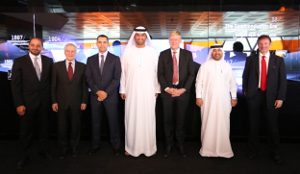
Khalifa University announced today the appointment of Dr. Jay Noren as the institution’s provost. Dr. Noren has a very long and distinguished career having held senior academic and administrative positions in the United States.  He has previously served as President of Wayne State University Chancellor of Minnesota State Colleges and Universities Provost of the University of Nebraska and Vice Chancellor at the University of Wisconsin-Madison.  He has over 35 years of experience in academia and also served as a Professor in Wayne State’s School of Medicine

Dr. Noren was also the Founding Dean of the College of Public Health at the University of Nebraska Medical Center in that role he was charged with the design and implementation of the college organization recruitment of new faculty and staff and the development of an expanded educational and research enterprise.

Khalifa University Students Travel Far and Wide

Khalifa University students have participated in over ten field trips and internships in the United States Europe and Asia over the last three months.

Student groups have recently travelled to  the United States and South Korea to conduct research and visit state of the art industry laboratories and manufacturing facilities while individual students headed off to participate in internships in France Germany the United Kingdom the United States Singapore and Turkey.

Khalifa University Students Head to France for Prestigious Internships

Khalifa University announced today that 10 of its students have accepted prestigious internships with top international companies in France.

The 10 UAE Nationals six men and four women will work for THALES MBDA SNECMA and Dassault. All of these are world leaders in the aerospace and defense fields.  The internships will last 45 days and focus exclusively on projects related to applications for the aeronautical and defense sectors.

Abu Dhabi Doubles Down on Semiconductor Research

The Advanced Technology Investment Company (ATIC) and the Semiconductor Research Corporation (SRC) announced the launch of the ATIC-SRC Center of Excellence for Energy Efficient Electronic Systems (ACE4S) to be hosted jointly in Abu Dhabi by Khalifa University of Science Technology and Research and Masdar Institute of Science and Technology. ATIC will dedicate over AED 17.5 million to the project over the next three years which will be matched collectively by Masdar Institute and Khalifa University for a total budget of more than AED 35 million. This funding will drive innovation in next-generation electronic systems ranging in applications from smart phones and medical devices to the Internet of Things.

ATIC, SRC, Masdar Institute and Khalifa University Join Forces for Center of Excellence in Microelectronics Research

Abu Dhabi, 29th May, 2013: The Advanced Technology Investment Company (ATIC) and the Semiconductor Research Corporation (SRC) today launched the ATIC-SRC Center of Excellence for Energy Efficient Electronic Systems (ACE4S), to be hosted jointly in Abu Dhabi by Khalifa University of Science, Technology and Research, and Masdar Institute of Science and Technology.

ATIC will dedicate over AED 17.5 million to the project over the next three years, which will be matched collectively by Masdar Institute and Khalifa University for a total budget of more than AED 35 million. This funding will drive innovation in next-generation electronic systems ranging in applications from smart phones and medical devices to the Internet of Things.

“The establishment of the ATIC-SRC research center is a significant milestone in the UAE’s drive to strengthen its knowledge-based economy ”said HE Dr. Sultan Al Jaber CEO of Masdar. “The research center will drive innovation cultivate our human capital and serve as a valuable platform for building strong industry ties between academia and industry. This collaboration between ATIC Khalifa University and Masdar Institute will contribute to the UAE’s establishment as a hub for semiconductor research. Such partnership models will be critical to our economic growth and global competitiveness within knowledge-intensive industries.  The research center’s establishment would not have been possible without the support of our visionary leadership who are committed to invest in securing the UAE’s long-term prosperity.”

“This center is a significant research milestone for Abu Dhabi the UAE and the region ” said Sami Issa Executive Director at ATIC. “ACE4S is a critical building block of our ecosystem strategy to help enable the development of homegrown talent in key areas of science and technology. Such talent development is essential as Abu Dhabi transitions into an innovation-based society as per the 2030 vision.”

“Over the past 30 years SRC has successfully helped establish numerous university research centers and distributed more than $2 billion dollars in research funds in the United States; ACE4S role as our first international center reflects significantly on the quality of research we pursue ” said SRC President Larry Sumney. “The ACE4S Center has been established with valuable industry guidance from companies such as GLOBALFOUNDRIES AMD Applied Materials Freescale IBM Intel Mentor Graphics Texas Instruments and Tokyo Electron (TEL) and will build on SRC-sponsored university research supporting 15 individual researchers in the UAE. Top semiconductor industry experts will oversee and serve as liaisons for each research task and SRC will productively guide the overall research while also promoting strong student engagement—enabling us to identify areas of greatest need and foster the move of innovations from lab to market.”

The center will be overseen by a partnership committee of high-level ATIC SRC Khalifa University and Masdar Institute representatives and will be directed jointly by Professors Mohammed Ismail of Khalifa University and Ibrahim Elfadel of Masdar Institute. The directors will oversee research across four targeted areas and work closely with a Technology Advisory Board (TAB) of representatives from industry-leading companies.

GLOBALFOUNDRIES will serve a special role on the TAB assigning Mohamed Lakehalas an Abu Dhabi-based industrial liaison to oversee design tape-outs to fabricationin GLOBALFOUNDRIES’ facilities worldwide. The liaison will also support design enablement deploying design-for-manufacture tools and in raising the level of local semiconductor expertise.

“As a research-oriented institution we are proud to be part of the ACE4S leadership and offer our expertise and research capabilities ” said Dr. Dr. Fred Moavenzadeh President Masdar Institute. “Our faculty will aim to develop microelectronic technologies with healthcare applications individually and in collaboration with their peerswithin the initial period of the center’s operation. These innovative products will include biosensor applications wearable devices and self-powered wireless body area networks (WBAN). We believe these applications will have a wide impact because of their energy efficiency and novel designs.”

“This partnership will transform the way we conduct research in nano-scale energy efficient systems-on-chips as it will help us educate and train a highly skilled workforce with relevant skills. This is a key element in driving innovation and entrepreneurship in the UAE’s semiconductor sector in line with the Abu Dhabi 2030 vision ” said Dr. Tod A. Laursen President of Khalifa University. “The involvement of the SRC and its member companies in center development will help create a world-leading institution with a sustainable university/industry collaborative research environment conducive to high-tech job creation and direct local and foreign investment.”

The center will focus on energy efficient devices with research in energy harvesting power management sensor technologies and wireless communications networks. The research will be conducted primarily at Khalifa University and Masdar Institute but with important involvement from UAE University American University of Sharjah and New York University Abu Dhabi.  Within the first three years ACE4S will seek to produce integrated prototypes with healthcare applicationsas well as knowledge and research relevant to safety and security aerospace water quality and the environment.

Supporting the transition of innovations to market the center will develop an aggressive Intellectual Property Management Plan (IPMP). The IPMP will include early identification of interconnected families of innovation arising from technical themes placing special emphasis on the integrated systems selected for demonstration at the end of year three.

ACE4S is a continuation of ATIC’s broader focus on cultivating a technology research ecosystem within Abu Dhabi. Additional programs supported in this vein include: the Twin-Labs research center a collaboration between Masdar Institute and Technical University of Dresden with support from the State of Saxony ATIC and GLOBALFOUNDRIES; the ATIC professorship chairs at UAEU and Khalifa University; the Masters in Microsystems degree in collaboration with Masdar Institute; and ongoing MEES research grants in collaboration with the SRC.

HH Sheikh Mohamed bin Zayed Visits Khalifa University

His Highness General Sheikh Mohamed bin Zayed Al Nahyan Crown Prince of Abu Dhabi Deputy Supreme Commander of the UAE Armed Forces and Chairman of Khalifa University’s Board of Trustees has said that the UAE under the wise leadership of the President His Highness Sheikh Khalifa bin Zayed Al Nahyan attaches great importance to education as a key pillar for development.

During a visit he made to Khalifa University’s (KU) campus in Abu Dhabi Sheikh Mohamed said the progress of a nation is not measured only by education but also by the quality and types of that education and by how research and development is impacting that progress.

EBTIC Organizes International iCampus Symposium on Smart Learning

Symposium will be under the patronage of HH Sheikh Hamed bin Zayed this will be the first time the event is held in the Middle East

Under the patronage of H.H. Sheikh Hamed bin Zayed Al Nahyan Chief of the Abu Dhabi Crown Prince’s Court and Deputy Chairman of Khalifa University’s Board of Trustee’s The Etisalat BT Innovation Center (EBTIC) announced today that it will host the upcoming iCampus Symposium on “Smart Learning” (IC’13) from November 24th to the 25th at Yas Viceroy Hotel.  IC’13 is being organized by EBTIC as part of the International iCampus Initiative in partnership with the Abu Dhabi Education Council (ADEC).  This is the first time the event will be held in the Middle East.

The central theme of the symposium is “Think Globally Act Locally – The big pICTure in Education ” and it will look at the overall needs and prevailing demands of the local region and will seek to address the issues created by the ever-changing ICT landscape.

The strategic aims of the event are: (1) to bring together industrial and academic experts (2) to disseminate forefront research & innovation (3) to position the event partners and sponsors as leading entities in educational technologies and/or services and (4) to align with the Abu Dhabi 2030 and UAE 2021 visions.

Some of the topics of interest to be discussed at the symposium are smart learning and teaching social/collaborative learning mobile learning the next generation educational environment the smart classroom cloud education ICT for smart education virtual classrooms and laboratories remote learning and teaching and smart educational technology.

For more information please visit: http://ic13.intelligentcampus.org/

His Highness Sheikh Hamed bin Zayed Al Nahyan Attends a Signing Ceremony to Establish AED 55 million Aerospace Research Center

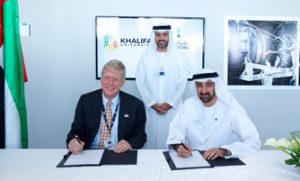
His Highness Sheikh Hamed bin Zayed Al Nahyan Chairman of the Abu Dhabi Crown Prince’s Court and Vice Chairman on Khalifa University’s Board of Trustees today attended a signing ceremony between Mubadala Development Company and Khalifa University to jointly establish a research center at the University’s campus in Abu Dhabi.

The AED 55 million project which will be named Aerospace Research and Innovation Center (ARIC) will have approximately 50 percent of the investment placed in establishing state of the art research facilities and capabilities with the remainder being invested in research and development (R&D) projects that are directly related to the needs of the aerospace industry in the UAE.

The agreement was signed by Homaid Al Shemmari Executive Director of Mubadala Aerospace Communications Technology and Defense Services and Professor Tod Laursen President of Khalifa University in the presence of senior representatives from Mubadala and Khalifa University.

Commenting on the signing Homaid Al Shemmari said:

“To make the aerospace industry in Abu Dhabi truly viable competitive and sustainable on a global scale two fundamental elements need to be addressed: building local “know-how” and creating an R&D ecosystem.  The signing of this agreement marks an important step on both these fronts as enablers fordevelopment and to grow the aerospace industry in UAE. Not only will the research center develop essential future technologies but it will also fill the skills gap in providing young Emiratis with essential training in aerospace and empower future talent. We are confident that Khalifa University is the ideal partner for us in this fieldand we are always looking to develop aspects of cooperation with them.”

Prof. Tod Laursen President Khalifa University commented:

“Aerospace has always been one of the key strategic research priorities for us at Khalifa University. The establishment of ARIC in collaboration with Mubadala is another important milestone towards producing regionally relevant research and providing the skills and human capital necessary for a sustainable aerospace industry in the UAE.”

The center is based on a shared 50:50 contribution model from Mubadala and Khalifa University covering a five-year term and will be directed by Prof. Wesley Cantwell who is an internationally recognized expert in composites and aerospace structures. The strategic direction of the center will be overseen by a senior management board comprised of members from both Mubadala and Khalifa University.

The center will initially focus on composite aerostructures and the automation of their manufacturing processes with the plan to expand in the future into other technical areas such as maintenance repair and overhaul (MRO) air transportation and other technologies to provide a pipeline of innovation in these areas.

“The initial technology focus areas have been identified through a Road-mapping process that considers the current and future state of the industry. Our goal is to create a research ecosystem that allows industry and academia to work together towards that future state ” commented Dr. Abdelqader Abusafieh Head of Research and Development-Mubadala Aerospace Communications Technology and Defense Services.

“This is a very important milestone in our growing portfolio of research programs that have national and international significance ” commented Dr. Mohammed Al Mualla Senior Vice President for Research and Development at Khalifa University. “I am delighted that Khalifa University is collaborating with Mubadalaand I am confident that this initiative will leverage the strength of our faculty and the quality of our students towards advancing the aerospace industry in the UAE and supporting the Abu Dhabi 2030 vision. This initiative will provide an opportunity for more than ten UAE national students to perform their senior design and Master and PhD thesis work within this advanced field of research and development.”

Khalifa University Hosts Members of British Parliament at its Abu Dhabi Campus

Seven members visited the campus to interact with students and learn about Khalifa University’s long term objectives

Khalifa University hosted seven members of the United Kingdom’s Parliament on Monday November 18th 2013. The members were given the opportunity to tour the campus with senior management engage with students and view the state of the art facilities and laboratories of the University.

The delegation included Members of Parliament (MP’s) Jackie Doyle-Price Henry Smith Andrew Stephenson John Leech Gemma Doyle Ian Lucas and Kevan Jones.  The MP’s visited Khalifa University in order to to learn about the University’s objectives and its long-term plans to give technical expertise to Emiratis in order to enable the country to diversify towards high tech industries. 

The MP’s visited the Etisalat BT Innovation Center (EBTIC) which is a specialized research center and the first of its kind in the region. EBTIC is based on a partnership between the UAE’s Telecommunications Corporation Khalifa University and British Telecom (BT). Since the Center was founded it has published more than 225 research papers in various scientific journals and has also submitted with Khalifa University over 18 patents which account for more than half the patents submitted by Abu Dhabi.

They also visited the UAE Advanced Network for Research and Education (ANKABUT) who briefed them on how they connect educational institutions using a state of the art high-speed network. This network connects UAE’s educational and research institutions to other networks located in the United States Europe and Singapore. This connection helps to facilitate the exchange of scientific information and research.

The delegation toured Khalifa University’s nuclear energy lab. The state of the art lab is being used by students to conduct experiments to measure the corrosion of materials under thermal stress and salt water.

The MP’s also visited the Robotics Research Center where they met with a number of researchers and students who briefed them on various types of ground and air robots which can be used in a number of ways including  geographical security and logistical support for multiple industries including border control and oil and gas supply lines.

The MP’s were given the chance to explore the Biomedical Engineering laboratory where they were briefed on a study being conducted on the movement of the human body which is being done in collaboration with labs in Europe. The study looks at how individuals who suffer from physical disabilities move in a three-dimensional space. They also visited the genetics lab where KU researchers are analyzing DNA and identifying the genes responsible for certain diseases including diabetes.

Finally the MP’s also reviewed projects by KU students including ones dealing with smart devices satellites and social networks for education research and wireless networks.

“We are honored by this visit from members of the United Kingdom’s Parliament ” said Dr. Tod Laursen Khalifa University’s President. “We’re pleased that they had a chance to review our students past and current research projects some of which have won a number of awards in competitions and forums both locally and globally. Khalifa University strives to be a world class institution as envisioned by the Abu Dhabi 2030 vision and our research and the accomplishments of our students and faculty demonstrate that and it was wonderful to be able to showcase those accomplishments to an international audience.”

Lockheed Martin Partners with Khalifa University to Improve Groundbreaking Analytics Tool

Lockheed Martin and Khalifa University announced today that they have signed a formal research partnership agreement aimed towards improving Lockheed Martin’s LM Wisdom® tool a customizable Web and social media analytics tool.

Representatives from the university and Lockheed Martin met at the Abu Dhabi Campus of Khalifa University for a signing ceremony on Wednesday in addition to meeting with the involved faculty and students.

The LM Wisdom® tool monitors and analyzes rapidly changing open source data such as newspaper feeds and social media content in near-real time and distinguishes noise from high value information. It captures cultural context trends sentiment and influence providing deeper situational awareness to customers.  The tool is especially beneficial to first responders security and law enforcement agencies.

The agreement will provide Khalifa University with funding over a period of two years during which time faculty and students will use computer engineering and other relevant techniques to perform comprehensive studies and analysis of the Arabic language and dialects. These analyses will help to build a detailed lexicon from which Lockheed Martin can build a Linguistic Feature Filter for LM Wisdom®.

“Big data analytics is one of the most important emerging research areas worldwide. We are very excited that our faculty and students will be engaged in this groundbreaking research jointly with an international industrial leader such as Lockheed Martin ” said Dr. Mohammed Al-Mualla Senior Vice President of Research and Development at Khalifa University. He added “This will no doubt enrich the experience of our faculty and students and will make their research of direct relevance to industry and the society. The research fits very well within the Security priority area of our strategic plan which is closely aligned with the Abu Dhabi 2030 vision.

“We are excited about this partnership not just for the present but for the potential follow-on work we may be able to continue with Khalifa University ” explained Bob Eastman vice president for Lockheed Martin’s Information Systems and Global Solutions. “Our partnership with the university is an investment in not only our future growth but in helping to build local talent pools with the UAE.”

Etisalat-BT Innovation Center organizes International Symposium on Smart Learning

Event is held under the patronage of HH Sheikh Hamed bin Zayed Al Nahyan

Under the patronage of H.H. Sheikh Hamed bin Zayed Al Nahyan Chief of the Abu Dhabi Crown Prince’s Court and Deputy Chairman of Khalifa University’s Board of Trustee’s the international iCampus Symposium on “Smart Learning” (IC’13) started today at the Yas Viceroy Hotel.  The symposium is being organized by the Etisalat BT Innovation Center (EBTIC) in collaboration with Khalifa University Ankabut and IEEE UAE Education Society and in partnership with the Abu Dhabi Educational Council (ADEC) the Abu Dhabi Centre for Technical and Vocational Education and Training (ACTVET) the Mohammed Bin Rashid Smart Learning Program and ICT Fund. This is the first time the event is being held in the Middle East.

Since its inception the event has been running in Europe and Asia. For this year the event is being held in Abu Dhabi the capital of the UAE in order to meet the needs of the local context and more importantly to align with the education pillar set out in the Abu Dhabi 2030 and the UAE 2021 visions.

The first topic of discussion for the day was “The Global Climate Change in Education ” and featured presentations on “SmartLearning Program: Snapshots of the Real Implementation” by Mr. Mohammed Gheyath Director General of Mohammed Bin Rashid Smart Learning Program in the UAE and “Delivering Knowledge and Fast Food in the 21st Century” by Prof. Rob Reilly IEEE Division VI Director-Elect and IEEE Board of Directors former President of IEEE Education Society and visiting scientist for the MIT Center for Educational Computing Initiatives from the USA.

Other topics covered included: “Smart Education in the Localized Context” which featured presentations by Prof. Chee-Kit Looi Founding Head of Learning Sciences Lab and Head of the Centre of Excellence for Learning Innovation and Professor in the National Institute of Education for Nanyang Technological University from Singapore and Dr. Abdullatif AlShamsi Managing Director of Institute of Applied Technology UAE.

“Abu Dhabi Education Council is pleased to support this very important symposium that deals with a subject of national importance ” said Dr. Arif Al Hammadi Executive Director of Higher Education at the Abu Dhabi Education Council (ADEC). “With the Abu Dhabi Vision 2030 and the UAE Vision 2021 all aiming towards creating  a knowledge-based economy it is absolutely critical to strengthen our education sector and ensure that the nation’s youth are educated and prepared for an increasingly competitive world.  This particular symposium is important because it makes a direct contribution to important national initiatives specifically on the issue of smart learning and the ability to merge technology with the learning process which is an area that the UAE is taking very seriously.”

“This has been an exciting day for EBTIC ” said Dr Mohamed Al-Mualla EBTIC Board Member and Khalifa University’s Senior Vice President of R&D. “We are proud to be able to organize this eventfor the first time in the UAE and to discuss issues of national importance with an impressive selection of speakers from around the world all coming together in one place to foster collaboration and disseminate forefront research and information.  I look forward to seeing the outcomes of this event and the advancements it will recommend for the education sector in the UAE. This event would not have been possible without the hard work of our local organizing committee and the generous support of our sponsors: Emirates Advanced Investments Group (EAIG) Tawazun ADEC; Polycom FVC; Springer and Tech Knowledge”.

For more information please visit: http://ic13.intelligentcampus.org/

Khalifa University Holds Conference on Modern Laboratories

Conference explored advances in technology and safety aspects of modern laboratories

Khalifa University held an conference on “New Dimensions for Modern Laboratories” in collaboration with Cytomed Middle East LLC on November 25th 2013 at the Jumeriah Hotel in Etihad Towers.

The conference looked at many aspects of the management of modern day laboratories including safety aspects in laboratory design the safety characteristics of laboratory furniture advances in optical and digital microscopy for industry applications exploring the latest tools for sophisticated analysis radioactive testing for industry applications quality assurance and quality control in radioactive testing laboratories the latest advances in radioactive testing technologies and the impact of real time monitoring on laboratory performance.

The conferences speakers came from a variety of international companies associated with the creation and maintenance of laboratories including Dr. A. Paul Ioannidis Vice President International Business for RJ Lee Group International who spoke on “Laboratory Accreditation Types and Requirements ” Mr. Lars Hauch Director of International Markets for Koettermann GmbH & Co KG Germany who gave insight into safety aspects in laboratory design and Mr. Michael Doppler Business Development Manager Industry DSA for Leica Microsystems Switzerland who looked at advances in digital micro imaging.

“We are very pleased to have held this interesting and informative event ” said Dr. Bayan Sharif Dean of Khalifa University’s College of Engineering. “As a leading technology and research driven educational institution Khalifa University possesses many state of the art labs that are dedicated to exploring everything from robotics to nuclear energy and safety and proper maintenance of these labs are among our highest priorities. We also continue to regularly update our labs with the latest technological advances to ensure that we provide world-class facilities for our students and faculty to pursue their research and obtain the highest quality of education possible.”

“It’s an exciting time for us as we continue to grow to become a hub of knowledge and innovation to the UAE industrial Market ” said Mr Heballah Habib – Director of Cytomed. “We must remain adaptable to new ideas and motivated and responsive to the constant changing world of modern science and technology. Our industrial market is confronting a time of many changes and we’re meeting them by continuously increasing our quality standards. The world of laboratories is an exciting area where scientific challenges demand us bring together inspired people in forums like this conference. Conferences like this one help to ensure our solutions remain at the cutting edge of todays and tomorrows technologies.”

How the UAE is Succeeding in Generating Cheap Solar Energy

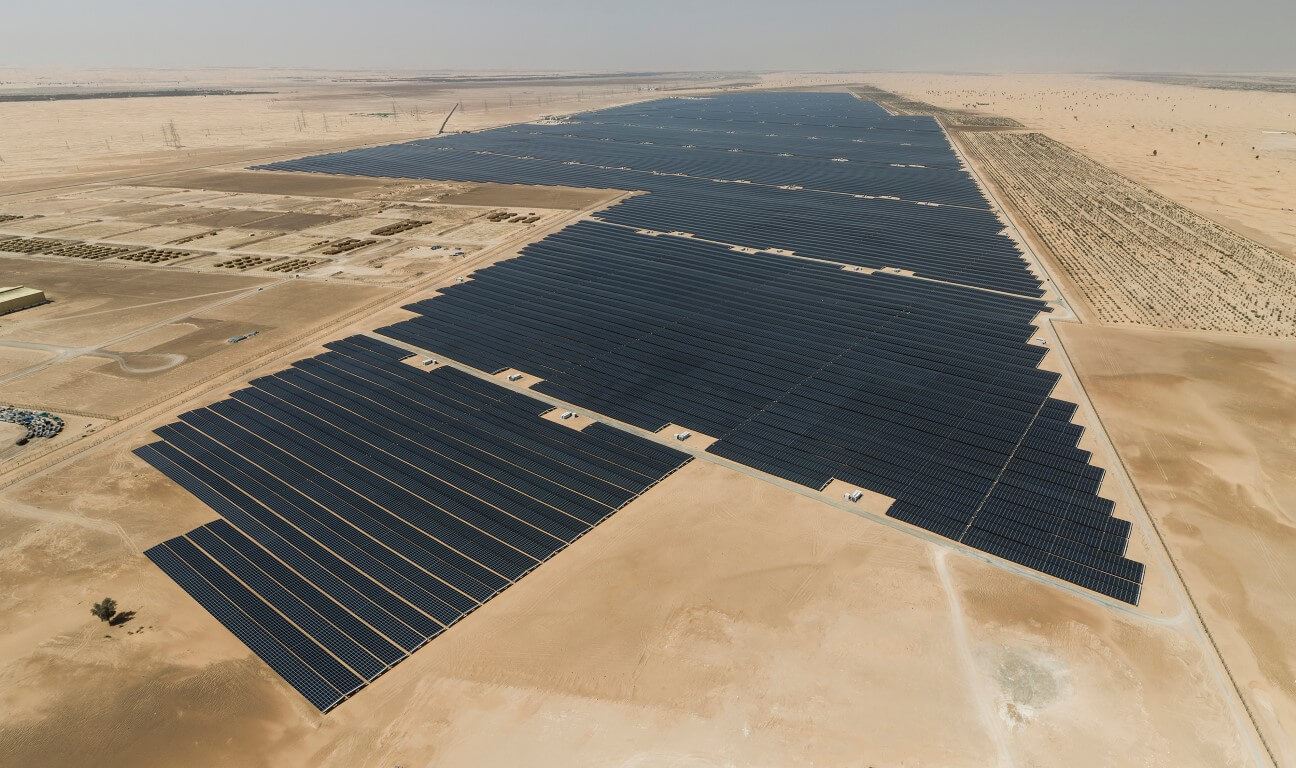
  • Noor Solar Power Plant in Al Dhafra region of Abu Dhabi, photo courtesy of WAM


Khalifa University’s Dr. Matteo Chiesa, Professor of Mechanical Engineering, and PhD student Harry Apostoleris, reveal how large solar plants in the UAE can sell unsubsidized electricity for under 3c/kWh and still turn a profit

When the Noor Abu Dhabi solar power plant was switched on in June, it became the cheapest operational solar plant in the world, and the third time within two years that the UAE has broken the record for cheap solar.

At 2.94 US cents per kilowatt-hour, Noor demonstrates that large-scale renewable energy can compete with fossil fuels, which today typically cost in the range of 4-6 US cents per kWh.

The significant cost decline in solar power has been driven primarily by technological innovation, but also innovation in project structuring and financing; a critical finding which was reported by Khalifa University’s Dr. Matteo Chiesa, Professor of Mechanical Engineering, and PhD student Harry Apostoleris in a paper published last year in the journal Nature Energy.

“We studied the different cost components of the Masdar/EDF-developed Mohammed Bin Rashid Solar Park Phase3 project, which will sell electricity for 2.99¢/kWh, and other large solar projects in the UAE and began to understand, piece by piece, how each of these cost components were reduced to the point that the electricity generated by these plants could be sold for under 3¢/kWh,” Apostoleris explained.

The UAE is the first country to breach the 3 ¢/kWh barrier. Many people assumed that the government put in large hidden subsidies to make the cost so low. In the US, Europe and other places, solar energy has historically been subsidized, either by a feed-in tariff or by tax incentives. But in these large UAE solar plants, the electricity is unsubsidized.

“We found that many factors played a small, but important role in bringing costs down. For example, the UAE’s utility companies signed long 25-years or more contracts to buy electricity from these solar power plants, which gives the developers more time to pay off the initial investment. The UAE was one of the first countries to make 25-year contracts standard for solar power plants, instead of the 15-20 year contracts more commonly seen in the past,” Apostoleris said.

The study also reports that certain costs, like construction and maintenance labor, are lower in the UAE than in European or US markets, where most cost studies are done. The plants also have a unique hybrid ownership structure – they are partly owned by the companies that built them, and partly by the utility – which allows some costs to be shared between the project developer and the utility company.

The two factors that reportedly had the biggest impact on driving costs down were the cost of solar panels and costs related to financing.

Thanks to mass production, a solar panel that would have cost US$500 at the beginning of this decade now costs less than US$100. Furthermore, the market has been flooded by massive manufacturing companies producing new solar panels as fast as they can.

“Developers in the UAE were able to take advantage of this buyer’s market to purchase huge amounts of hardware very cheaply, which greatly reduces the cost of building the plant,” Apostoleris said.

The project developers were also able to get large loans at low interest rates alongside major investments from state-backed companies, representing a true innovation in the financing and project structuring.

A follow-up paper, published in the proceeding of the 46th IEEE Photovoltaics Specialist’s Conference, and presented at the conference meeting in Chicago last month, focused on the financing packages that were given to the UAE’s solar projects.

“We developed a cost model to demonstrate that, under the given financing terms, the projects are profitable even when selling electricity for less than 3¢/kWh,” Apostoleris explained.

In the paper, the researchers suggest ways that other countries can follow the lead of the UAE by developing programs to support low-cost financing of large renewable energy projects.

“Many countries have a capability of issuing large state-backed loans to project developers or making direct investments in well-designed solar projects. Our aim in these two papers is both to show people how the UAE was able to produce the world’s cheapest unsubsidized solar energy, and to suggest ways that other countries can learn from our experience to support the continued expansion of solar energy,” Dr. Chiesa remarked.

Erica Solomon
Senior Editor
29 July 2019