

A Smarter Way to Protect Machine Learning from Tampered Data

A new technique can strengthen machine learning models against poisoning attacks and outperforms existing defenses

Learn how to protect ML from Tampered Data – Tune in now!


As machine learning systems become integral to industries from healthcare to cybersecurity, their vulnerability to training-time attacks has become a growing concern. One of the most insidious forms of these attacks is called poisoning and occurs when an attacker subtly modifies the training data to degrade model performance. One common trick is to flip the labels of data points — telling the system that spam is not spam, for example — so it learns the wrong patterns. 


A team of researchers from Khalifa University and the University of Milan has developed a new defense strategy to fight this. Instead of training one big model, they split the work among several smaller models, called an ensemble. But rather than splitting the data randomly, each data point is assessed individually for its susceptibility to attack and then routed appropriately. 


Prof. Ernesto Damiani and Dr. Chan Yeob Yeun, from Khalifa University’s Center for Cyber-Physical Systems (C2PS), with Nicola Bena, Claudio Ardagna and Marco Anisetti from Milan University, published their system in Computers & Security


Dr. Nilesh

“Machine learning models can be tricked by poisoned data. Our method checks which data points might be poisoned and reroutes them to protect the system. It’s a simple idea that makes machine learning much more secure.”

Prof. Ernesto Damiani, Khalifa University.


The system uses three signals to spot suspicious data: how close the data is to the decision boundary, whether it looks different from its neighbors, and how far it is from typical examples of its class. If a data point looks risky, the system can either spread it thinly across models or send it all to one model to contain the damage. 


Tests showed this method made machine learning models more resistant to attacks, especially when more of the data was poisoned. On certain datasets, it outperformed older methods that rely purely on random distribution. However, it worked best when the suspicious data was spread out evenly — in some cases where bad data clustered together, the method had limits. However, the technique runs quickly, and doesn’t require removing any data outright, which makes it practical for real-world use. 


Plus, their approach is efficient and scalable. Even as dataset sizes increased, processing times grew linearly, and the method remained faster than many existing filtering techniques. 


As adversarial machine learning threats evolve, the study demonstrates that proactive, risk-aware training processes can offer a powerful defense — shifting the paradigm from random redundancy to intelligent resilience. 


Jade Sterling
Science Writer

Khalifa University Launches Interdisciplinary MSc Program in Health Systems Management from Fall 2025

Graduates Equipped to Leverage Scientific and Technical Advancements through Enhanced Skills in Service Quality, Efficiency, and Agility


Khalifa University of Science and Technology today announced the launch of an interdisciplinary MSc program in Health Systems Management from Fall 2025, to help recent graduates and professionals gain essential technical and managerial skills for achieving higher levels of responsibility in public and private sector healthcare organizations.


The program offers in-depth expertise in systems thinking, data analytics, optimization, operational excellence, and digital health. It focuses on designing and managing modern, complex health systems, using systems approaches and management science principles. Students of this program will be equipped with the skills and knowledge to leverage scientific and technical advancements in healthcare with enhanced service quality, efficiency, and agility.


Professor Bayan Sharif, Provost, Khalifa University, said: “The MSc in Health Systems Management at Khalifa University is designed to support professionals at hospitals, government health departments, and clinics, while helping them to develop and oversee the policies and procedures that ensure smooth operations and quality of care. Our faculty experts train the students and help them achieve higher levels of proficiency in these areas. Graduates of this program will be equipped to effectively coordinate systems and policies, playing a role that goes far beyond basic administration, positively influencing patient care quality and the overall performance of health systems.”


The MSc in Health Systems Management program includes a diverse range of elective courses, delving into crucial aspects such as informatics, performance, quality, analytics, optimization, policy, and economics. It equips students with planning, organizing, and monitoring of care programs and services across an entire ecosystem. Within health systems, these professionals support communities by ensuring the efficient use of budgets, available resources, and investments in programs and services.


Graduates of this program will seek positions as senior business analyst, senior improvement consultant, health systems manager, and executive director for program management. From such positions they can ensure that factors such as staffing, budgets, records management, training and advancement, and available care services are managed in accordance with both the needs of patients and in line with an institution’s financial resources.


For students of this program, Khalifa University’s collaboration with various prestigious healthcare organizations and ministries in Abu Dhabi, UAE, and worldwide opens doors for internships and potential job placements.


Click here to read more about the new program.


Clarence Michael
English Editor – Specialist  

Designing Smart Catalysts to Unlock Green Hydrogen from Bio-Oil

The future of biofuel catalysis lies in precision-engineered single-atom alloys that efficiently convert bio-oil into hydrogen 


Learn How to convert bio-oil into hydrogen – Tune in now!


Hydrogen is poised to play a central role in the shift to a low-carbon future, especially when produced cleanly from renewable resources. While most hydrogen today is made from natural gas, bio-oil offers a sustainable, carbon-neutral alternative. The challenge is finding efficient, affordable, and durable catalysts that can convert bio-oil into hydrogen without fouling or degrading.  


Researchers at Khalifa University, including Prof. Lourdes Vega, Prof. Kyriaki Polychronopoulou, Dr. Seba AlAreeqi and Dr. Daniel Bahamon, collaborated with researchers from Johns Hopkins University, using advanced computational modeling to design such catalysts from the atom up. By simulating the behavior of nickel-based single-atom alloys (SAAs), the team identified a suite of bimetallic and trimetallic catalysts that could overcome longstanding issues in hydrogen production, including carbon buildup, instability, and low selectivity. They published their results in Nature Communications.  


Nickel is already widely used in hydrogen reforming due to its activity and low cost but it suffers from key limitations: it tends to form carbon deposits (known as coking) and it degrades over time. Noble metals like palladium and platinum perform better but are prohibitively expensive.  


SAAs – where individual atoms of one metal are dispersed in a host metal matrix – offer a way to combine the affordability of base metals like nickel with the performance of more active elements. The challenge is finding stable combinations that avoid clustering and retain activity under high temperatures.  


Dr. Lourdes

““By designing catalysts atom by atom, we’ve identified nickel-based alloys that offer a practical path to producing hydrogen from bio-oil – combining affordability, performance, and long-term stability.”

Professor Lourdes Vega, Khalifa University.


The research team used computational design tools to cut through the complexity, screening 26 potential dopant metals to find combinations that met the requirements. Of the bimetallic candidates that passed the initial screening, copper-nickel emerged as a particularly promising catalyst, showing strong hydrogen production and low coking tendencies. To further improve performance, the team also explored trimetallic systems, adding a third metal to harness synergistic interactions between co-dopants, leading to catalysts with finely tuned surface energies, hydrogen binding, and coke resistance.  


By using a computational approach, the researchers were able to bypass the slow, costly process of trial-and-error catalyst synthesis. They were also able to include economic criteria to prioritize scalable solutions. With real-world testing, the more promising candidates could become critical components of next-generation hydrogen infrastructure, transforming waste-derived bio-oil into a clean energy source.  


Jade Sterling
Science Writer
Khalifauniversity, in collaboration with the UAE Space Agency

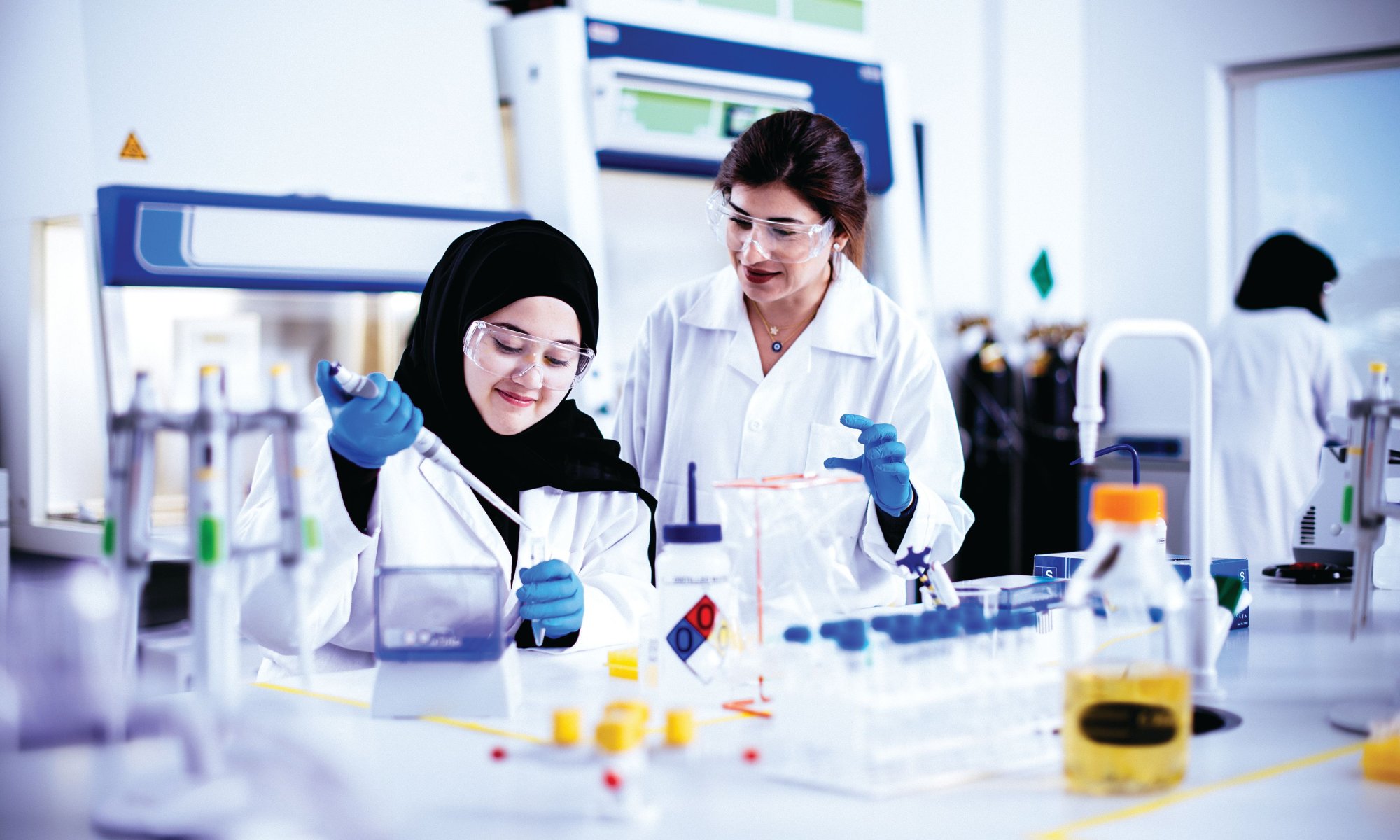
Khalifauniversity, in collaboration with the UAE Space Agency, has successfully designed, built, and tested the region’s first eco-friendly micropropulsion system for a 6U CubeSat, developed entirely in-house.

Fatima Alhammadi an Aerospace Engineering Researcher, explains how this innovative system offers a sustainable alternative to traditional chemical propulsion. It uses High Test Peroxide (HTP), a non-toxic propellant that decomposes into water vapor and oxygen.

Despite its compact 2U size, the propulsion module also houses five thrusters capable of five degrees of freedom (DOF) control—an advanced capability rarely seen in CubeSats.

This milestone supports the UAE’s commitment to advancing national and regional space technology capabilities.

تمكنت جامعة خليفة، بالتعاون مع وكالة الإمارات للفضاء، من تصميم وإنشاء واختبار أول نظام آمن على البيئة للدفع الدقيق للأقمار الصناعية المصغرة بحجم 6 وحدات على مستوى المنطقة، وجرى تطويره بالكامل داخل الدولة.

تشرح فاطمة حسن، الباحثة في كلية هندسة الطيران والفضاء، دور هذا النظام كابتكار بديل ومستدام للدفع الكيميائي التقليدي، إذ يستخدم البيروكسيد عالية التركيز، وهي مادة دافعة غير سامة تتحلل إلى بخار ماء وأكسجين.

يتسم نظام الدفع هذا بحجمه المدمج الذي لا يتجاوز 2 وحدة، إلا أنه يضم خمسة محركات دافعة قادرة على التحكم إلى مستوى يبلغ خمس درجات حرية، وهي قدرة متطورة نادرًا ما تتوافر في الأقمار الصناعية المصغرة.

يعتبر هذا النظام إنجازًا بارزًا يعزز حرص دولة الإمارات على دفع عجلة التطور في قدرات تكنولوجيا الفضاء محليًا وإقليميًا.

105 High School Students Conclude Estedad Summer 2025 Program at Khalifa University in Collaboration with UAE Ministry of Education

Participants  Gain Scientific Research, Innovation and Entrepreneurship, Enrichment and Technical Skills


A total of 105 students concluded their two-week virtual Estedad program, a selective summer initiative for high-achieving high school students in the UAE, hosted by Khalifa University in collaboration with the UAE Ministry of Education. The program  provided students with opportunities for academic and personal growth, while fostering scientific research and innovation and developing entrepreneurial skills and mindset.


Organized under the theme ‘Leading the Future Through Our Students’ from 14-24 July 2025, the Estadad program offered  three focused tracks – Scientific Research, Innovation and Entrepreneurship, as well as Enrichment and Technical Skills. Participants  engaged in hands-on workshops, team projects, and university readiness sessions to build future-ready skills in science, technology, and innovation. The participants – 78 UAE National and 27 international students – were shortlisted by the Khalifa University Outreach team based on stringent Ministry of Education criteria. Each track, led by experts, will have 35 students. 


The ‘Scientific Research Track’ was  led by Dr. Houda Majid, PhD researchers Ruba Islayem, and Marwa Ahmed who  provided students with hands-on training in scientific research across science, technology and engineering (STE) disciplines through structured modules and projects. The  participants learnt about developing a scientific research mindset, the hypothesis design and methodology, as well as data collection and analysis. They also gained insights into what intellectual property is and the road to commercialization.


Dr. Zainab AlAnsari and Dr. Seba Zakaria Al Areeqi  led the ‘Innovation and Entrepreneurship Track’ that  empowered students with innovation frameworks, design thinking, and entrepreneurial leadership. Participants learnt about ways to build creative confidence, insight generation, as well as ideation, journey mapping and prototyping, in addition to innovation leadership.


The ‘Enrichment Track’  was led by postdoctoral researchers Hamza Fiaz, Mughni Irfan Mohammed Abdul, and Mohammed Misbah Uddin  and helped  participants develop project planning, communication, collaboration, and engineering fundamentals through engaging activities. They also  learnt about design thinking and technical skills, team dynamics, and prototype development.


A General Requirements Strand (GRS) facilitated by Dr. Nooreya Alobeidli and Kholoud Elayyan  helped participants with an analysis of the Myers-Briggs Type Indicator (MBTI) personality assessment. They also  learnt about time management and study skills, critical thinking and communication, as well as essay writing and university readiness.

Alisha Roy
Science Writer

Five Khalifa University Alumni Featured among UAE’s Most Influential Cybersecurity Leaders

Five Khalifa University alumni have been recognized by the UAE English daily Khaleej Times among the ‘UAE’s Most Influential Cybersecurity Leaders 2025’ inaugural list honoring CISOs and security heads, who contribute to secure UAE’s digital infrastructure against growing challenges. These alumni stand as testimony to the knowledge sharing and leadership development that characterize the academic journey at Khalifa University.

These Khalifa University alumni include:

  • Spring 2002 Electronics graduate Jasim Fardalla M.A. Al Awadi, Chief ICT Officer (Acting), du (Emirates Telecom),
  • Spring 2005 Computer Engineering graduate Waleed Al Mesmari, President – Space & Cyber Technologies, EDGE Group,
  • Spring 2013 Information Security graduate Eman Abdulghani Al Awadhi, Vice-President, Network and Cyber Security, Expo City Dubai,
  • Spring 2014 International & Civil Security graduate His Excellency Mohamed Al Kuwaiti, Head of Cyber Security, UAE Government, and
  • Fall 2019 PhD graduate in Engineering, Dr. Ebrahim Hamdan Saif Al Alkeem Alzaabi, currently the National Risk and Policy Director with the Executive Office of Anti-Money Laundering and Counter Terrorism Financing.

Source: Khaleej Times

Examining the Historic April 2024 Rainstorm in the UAE Through the Lens of Climate Change

How human activity and climate change made the UAE’s record-breaking flood 30 times more likely


In April 2024, the United Arab Emirates was hit by the most intense rainstorm ever recorded in the country’s history. Over 250mm of rain fell in just 24 hours — more than the annual average in some regions — paralyzing cities like Dubai and causing massive infrastructure damage. A new study published in npj Climate and Atmospheric Science dissects the event’s causes and consequences and provides compelling evidence that climate change made such a storm significantly more likely. It also calls for better forecasting, climate-informed urban planning, and improved flood defenses to reduce the risks from future extreme weather.


The research team, led by Dr. Diana Francis, identified several overlapping meteorological phenomena behind the storm. A potential vorticity streamer, a Red Sea Trough, and an upper-level jet stream all converged to transport warm, moisture-rich air from the Arabian Sea into the lower atmosphere over the UAE. Sea surface temperatures in the region were up to 2C above the 20-year average, providing the fuel for deep convection and heavy rainfall.


Using climate simulations, the researchers estimate that human-driven climate change made the April deluge 30 times more likely to occur. Although the increase in intensity is less certain, the frequency change alone is statistically significant. What was once a 10,000-year event is now likely to recur every few centuries and could become even more frequent in the future.


The flooding exposed sharp contrasts within urban environments. High-resolution satellite data revealed that damage was greatest in densely populated and heavily developed areas of Dubai and Abu Dhabi. City planning, proximity to the coast, and inadequate drainage infrastructure played key roles in shaping local flood impacts. While some neighborhoods remained accessible, others were effectively cut off for days.


Beyond cities, the storm left an unexpected ecological mark. Satellite observations in the months following the rain showed a dramatic increase in vegetation across the desert. Areas that were barren in 2023 were visibly green by June 2024, with some regions seeing vegetation cover increase by over 100 percent. This short-term greening of the desert highlights how rare rain events can temporarily transform arid landscapes.


The researchers conclude that while climate change did not necessarily intensify the April 2024 storm, it did make it far more likely. Combined with rapid urbanization and current infrastructure, the changing climate sets the stage for future problems unless proactive adaptation measures are taken.


Jade Sterling
Science Writer

Khalifa University Launching Cooperative Education from Fall 2026 across Engineering, Computing, and Biomedical Engineering

Program Bridges Academic Learning with Practical Experience and Career Exploration


Khalifa University of Science and Technology today announced it will be launching Cooperative Education (Co-op) courses from Fall 2026, integrating academic learning with practical hands-on experience in engineering and computing fields.


Each co-op semester spans 6 months, with the first earning 2 credits, while eligibility criteria include those with a CGPA of 3.25 and a minimum of 75 credits to apply and 90 credits to start. Students who would like to enroll need to demonstrate full-time commitment, compliance with guidelines, and completion of 26 weeks with the assigned organization, either on-site or in offices.


Professor Bayan Sharif, Provost, Khalifa University, said: “The launch of the co-op course reflects our strong commitment to helping students acquire additional skills during their campus life. It integrates academic studies with work experience, alternating periods of study and work, involving a partnership between students, institutions, and employers. Khalifa University is proud to initiate such an arrangement that facilitates employability, and financial support, even as employers gain access to talented students, and reduced recruitment costs, while contributing to workforce development. This course also serves as part of our mandate to support the UAE’s knowledge-economy transformation.”


The co-op program helps students apply classroom knowledge to real-world engineering challenges through meaningful, supervised work placements, gain essential workplace skills, and explore potential career paths. Elements of co-operative education programs build quality into program delivery, while offering an enriched understanding of a student’s academic program through practical application.


Through the competitive co-op placement process, students develop the ability to assess their skill level, prepare a polished résumé, and to even go through the interview process successfully. Moreover, through their work experiences, students can develop and refine employability skills, gain an understanding of career opportunities in their areas of study and workplace realities.


The co-op program assists in cultivating professional skills including communication, teamwork, and problem-solving, while offering exposure to the expectations and culture of the professional arena. It facilitates exploration of career interests and industry sectors, while enhancing employability through practical experience and networking.


KU Explorer

The Space Technology and Innovation Lab is propelling Khalifa University to the forefront of space exploration, one CubeSat at a time. 

In the heart of the United Arab Emirates, a team of visionary researchers is pushing the boundaries of space technology and innovation. Khalifa University’s Space Technology and Innovation Lab (KUSTIL), led by former NASA scientist Professor Sean Swei, is spearheading projects that promise to revolutionize space exploration. From conquering the removal of space debris to taking previously earth-based activities, such as pharmaceutical research, into space, KUSTIL is tackling some of the most pressing challenges in space science with ingenuity and determination. 

Abu Dhabi High School Students Explore Particle Physics at CERN Masterclass Hosted by Khalifa University 

Over 300 High School Students Utilize Real CERN Data at Khalifa University 


The mysteries of the subatomic world came alive at Khalifa University as 350 students from more than 40 high schools across Abu Dhabi participated in the CERN International Masterclasses: Hands-on Particle Physics, an immersive, global initiative that gives students a genuine taste of particle physics through analysis of real data from the world’s largest scientific experiments at the CERN-Large Hadron Collider (LHC) in Geneva, Switzerland. 


The event highlighted Khalifa University’s physics curriculum and research activities, as well as the exceptional undergraduate and graduate opportunities, including the academic program, scholarships, collaborative and multidisciplinary projects that involve students in international experiments, and possible summer internships at CERN.  


Students were divided into small teams to work with collision data from the ATLAS experiment using friendly software tools to reconstruct the Z-boson path. Through this analysis, they identified elementary particle signatures, reconstructed invariant masses, and gained direct insight into how physicists probe the fundamental constituents of matter via the recorded LHC proton-proton collisions.  


The CERN International Masterclasses included remarks by Professor Mahmoud Al-Qutayri, Associate Provost, Academic Operations, Professor Ehab Fahmy El-Sadaany, Dean, Engineering and Physical Sciences, and Professor Mauro Pereira, Head of the Department of Physics from Khalifa University. Professor Fernando Quevedo from NYUAD and the University of Cambridge, provided an inspiring overview of particle physics, tracing the evolution of the Standard Model of elementary particles and highlighting the open questions that drive today’s searches for new phenomena at the LHC.  


Dr. Rachik Soualah, Assistant Professor, Physics and the KU-ATLAS team leader, delivered a presentation in which participants traced the journey from theoretical calculations to the experimental realms of high-energy physics. He explained how collision events at colliders are recorded, reconstructed, and analyzed, and what the plans for the future of the ATLAS detector are, from precision measurements and beyond, in addition to the plans of expanding the LHC’s discovery potential. 


Another session of the scientific program included Dr. Issam Qattan, Associate Professor, and Dr. Arjen Van Vliet, Assistant Professor, Physics, who highlighted Khalifa University’s physics curriculum and research activities. Participants joined an international video conference with peers from Egypt, Slovakia, and Brazil and particle physicists from the global CERN Masterclasses based in Geneva. All students from the participating institutions compared their obtained results, discussed data interpretations, and encountered firsthand the collaborative energy powering today’s scientific achievements. 


Professor Mahmoud Al-Qutayri said: “Physics provides the foundational principles that inform every scientific inquiry and technological innovation. From the algorithms that drive data science in business analytics to the biophysical models used in medical research, physics cultivates the analytical mindset and problem-solving skills which are essential across all disciplines. At Khalifa University, we prepare students to excel not only as physicists, but as versatile leaders in any field they choose to pursue.” 


Professor Ehab El Sadaany said: “The participants not only mastered real CERN data but also saw one of the possible ways that can help answer the universe’s deepest questions. The study of Physics is the engine of innovation that drives the technologies we rely upon every day, from medical imaging and renewable energy to telecommunications. It ignites curiosity in young minds and equips them with the tools to transform the discoveries of today into the breakthroughs of tomorrow.” 


Alisha Roy
Science Writer

Khalifa University PhD Student Wins Best Review Paper Award for Influential Work on Sustainable Consumption Behavior


Global Recognition for Paper Decoding Why People Choose or Avoid Living Sustainably


Khalifa University PhD student Shayaan Syed, Engineering Systems and Management program, Management Science and Engineering, has received 2024 Best Paper Award for Review Paper from Resources, Conservation & Recycling Advances, a top Scopus-rated journal in the field of sustainability.


The review paper titled, Decoding sustainable consumption behavior: A systematic review of theories and models and provision of a guidance framework, is co-authored by Shayaan Syed and Khalifa University faculty advisors Dr. Adolf Acquaye, Associate Professor, Management Science and Engineering, Dr. Malik Khalfan, Associate Professor, Management Science and Engineering, as well as Professor Theresa Obuobisa-Darko, Head of Management Studies, Ghana Communication Technology University, Ghana, and Professor Fred Yamoah, Professor of Business and Society, Buckinghamshire New University, UK. 


The review paper consolidates over a decade of research to understand the theoretical foundations and factors influencing sustainable choices, including social norms, intentions, and behaviors. 


The award recognizes the study’s outstanding scholarly merit and significant impact in shaping how researchers and policymakers understand sustainable consumption behavior and the choices people make around buying, using, and disposing products in environmentally friendly ways. A committee of editors and board members selected the paper for the top award, which was presented in June 2025. 


Dr. Adolf Acquaye said: “This award-winning review unpacks the complex and multi-faceted landscape of theories and models used in sustainable consumption research and practice, and offers a unified framework to guide future studies. Shayaan Syed’s achievement reflects the department’s growing reputation for research excellence in sustainability, circular economy, and responsible innovation. The recognition highlights the importance of robust theoretical grounding in addressing global environmental and consumption challenges.” 


Shayaan Syed said: “The research lays the essential groundwork to navigate sustainable consumption behavior for my PhD research, which focuses on decoding the barriers and enablers of sustainable consumption behavior in the UAE using a multistakeholder and machine learning approach. By synthesizing and unifying diverse theoretical models, the paper provides strategic direction necessary for developing data-driven and context-specific interventions and policies that can drive sustainable behavior change at both individual and institutional levels.”


Out of the 17 UN Sustainable Development Goals (SDGs), SDG 12, “Responsible Production and Consumption”, aims to promote resource efficiency, waste reduction, and minimization of environmental impacts across the entire lifecycle of goods and services and so more broadly support a comprehensive vision that balances economic success, social well-being and environmental protection.


Alisha Roy
Science Writer