
- Admissions
- Academics
- Research Office
- Student Life
- News & Events
- Outreach
- About

After obtaining his PhD degree from the Mechanical and Aerospace Engineering Department of UCLA in 1986, Dr. Dimitris Goussis joined the Department of Mechanical and Aerospace Engineering at Princeton University until 1992. He then returned to Greece, where he joined the faculty of the Mechanical Engineering Dept. at the University of Patras and then the faculty in the Mechanics Section of the School of Applied Mathematical and Physical Sciences at the National Technical University of Athens. He joined Khalifa University in 2016.
The major focus of Dr. Goussis' work is the development of algorithmic methodologies for the acquisition of the essential physical understanding, by analyzing mathematical models that simulate physical phenomena, with applications in the fields of combustion, biology, pharmacokinetics and mechanics. He has been a member of the organizing committee of the Int. Conference on Numerical Combustion and currently serves in the organizing committee of the Int. Workshop on Model Reduction in Reacting Flows. He has participated in a number of research projects funded by the European Commission, NASA, etc.
He is a Fellow of the Combustion Institute
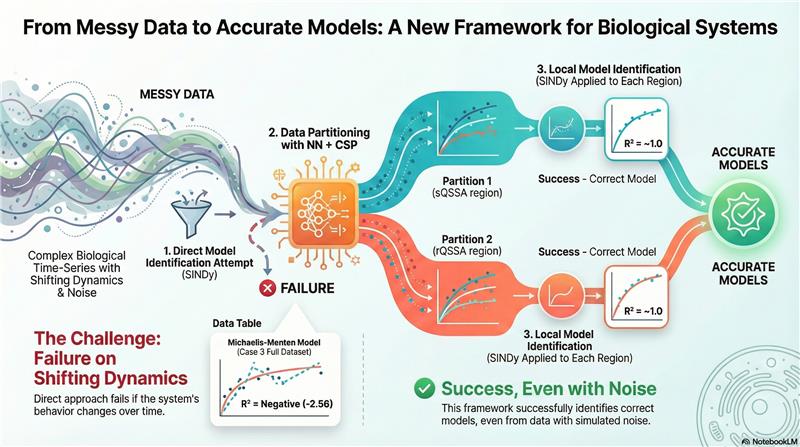
Model generation from available data
https://doi.org/10.1371/journal.pcbi.1013193
A data-driven framework that integrates the Sparse Identification of Nonlinear Dynamics (SINDy) method, the multi scale analysis algorithm Computational Singular Perturbation (CSP) and neural networks (NNs) for accurate system identification.
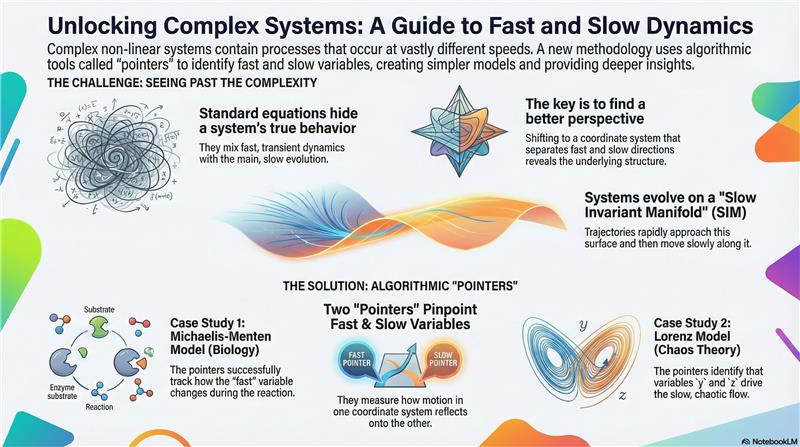
Unlocking Complex Multi-scale Systems
https://doi.org/10.1016/j.cnsns.2025.108858
Simple algorithmic tools identify the fast and slow variables in a given multiscale model, thus facilitating (i) the construction of reduced models and (ii) the design of novel pathways for controlling complex systems across diverse scientific disciplines.
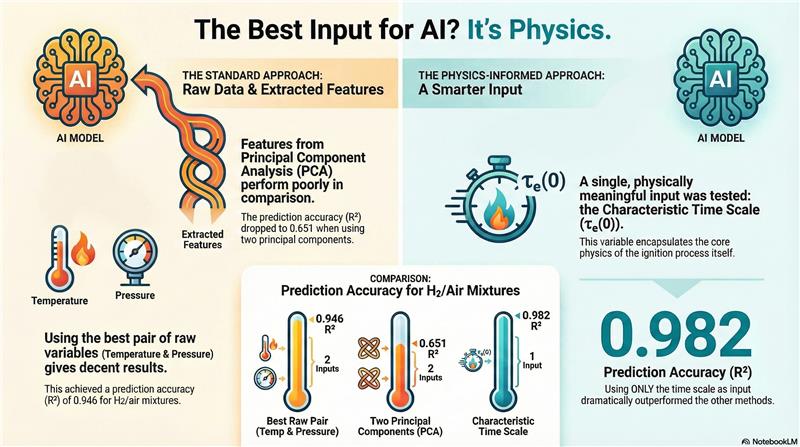
Feature selection for Machine Learning algorithms
https://doi.org/10.1016/j.egyai.2023.100273
Physical quantities that characterize the process allow for better accuracy as inputs, when compared to the independent variables that define the process under investigation or the dependent ones that are produced by feature extraction algorithms.
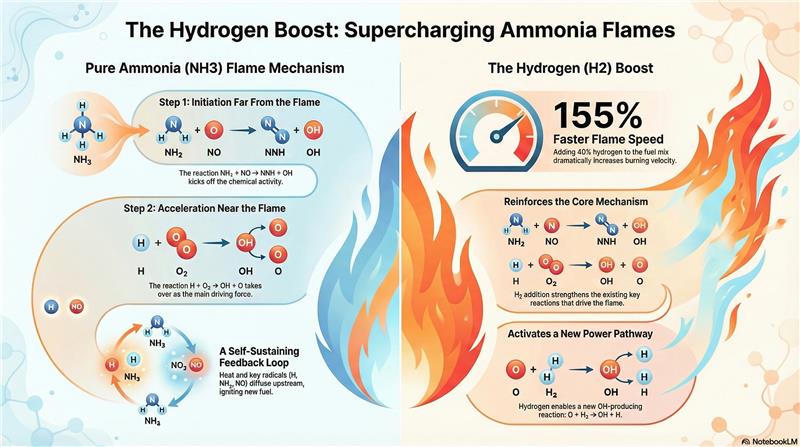
Mechanism of ammonia flame propagation
https://doi.org/10.1016/j.ijhydene.2024.06.289
Investigation of the physical mechanisms, involving chemical reactions and transport processes, that control the evolution of ignition phenomena, like those met in gas turbines and compression ignition engines.
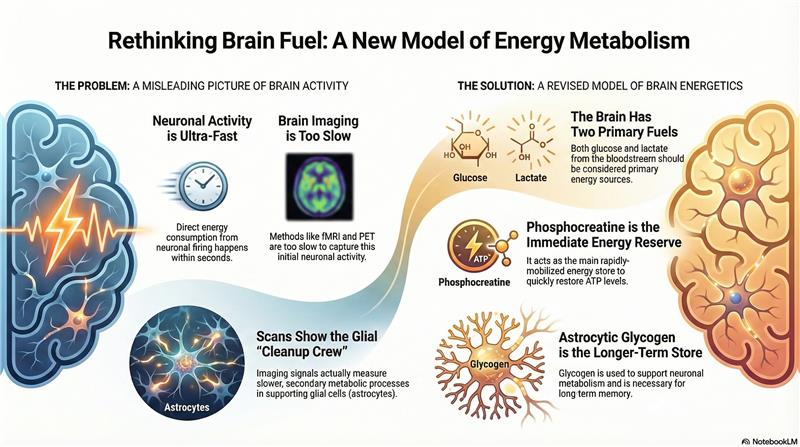
Human brain energy metabolism
https://doi.org/10.1371/journal.pcbi.1013504
Identification of functional periods during and after synaptic activation, along with the related central reactions and metabolites controlling the system’s behaviour within those periods. Investigation of the role of both oxidative and glycolytic astrocytic metabolism in driving the brain’s metabolic circuitry.
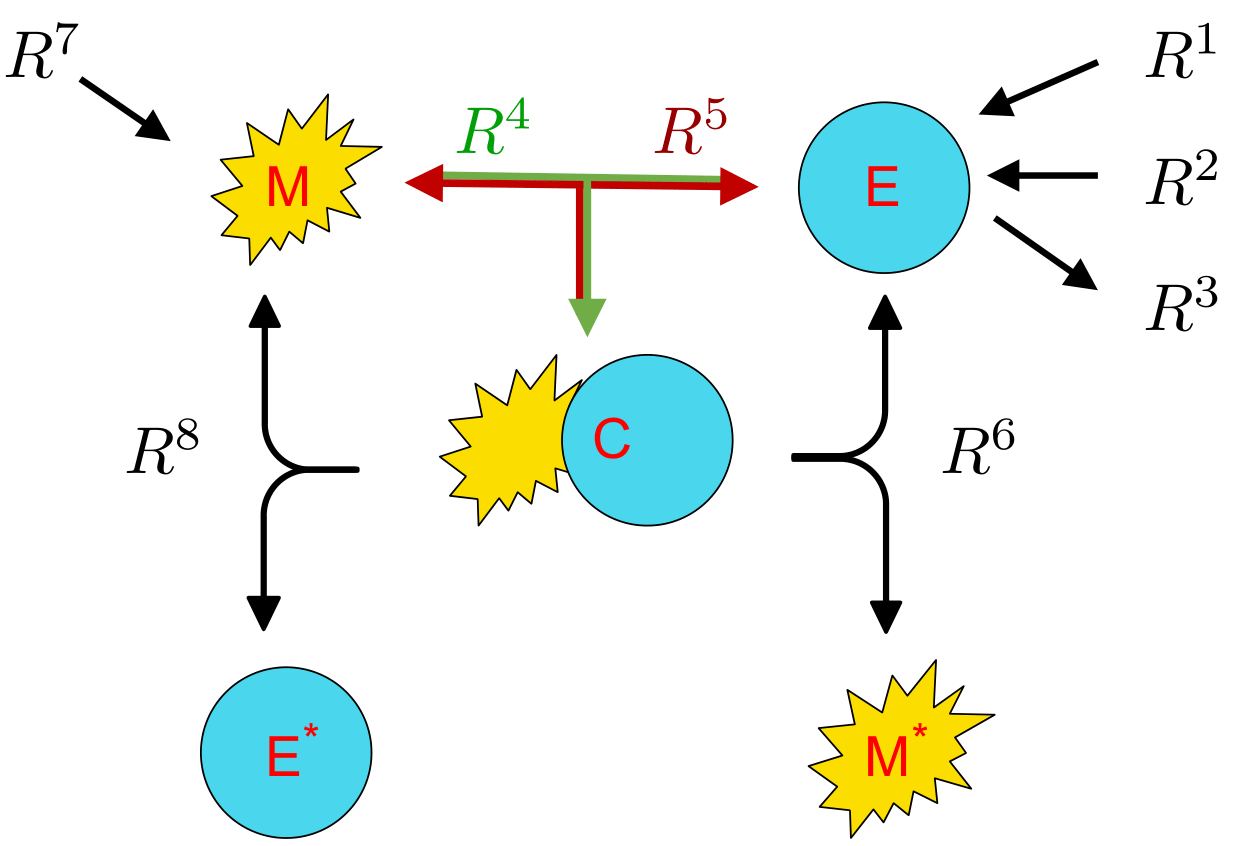
Patterns of tumor-immune interaction and their dynamics
Early stage tumor–immune system interactions frequently result to enduring, slow-evolving states associated with tumor dormancy, angiogenesis or metastasis. These interactions are investigated, by classifying all possible trajectories and by identifying the dynamics that characterize the emerging trajectory patterns.
The analysis leads to the identification of a rich set of interventions, many of which are consistent with the approaches for adaptive and extinction therapies for cancer treatment.
The major focus of Dr. Goussis' work is the development of algorithmic methodologies for the acquisition of the essential physical understanding, by analyzing mathematical models that simulate physical phenomena, with applications in the fields of combustion, biology and pharmacokinetics. He has been a member of the organizing committees of the Int. Conference on Numerical Combustion and the Int. Workshop on Model Reduction in Reacting Flows.
He has participated in a number of research projects funded by the European Commission, NASA, DoE etc.