- Admissions
- Academics
- Research Office
- Student Life
- News & Events
- Outreach
- About

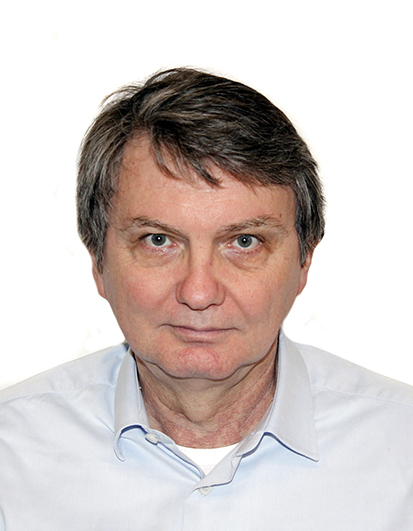
Antonio Cammi graduated (cum laude) in Nuclear Engineering from the Politecnico di Milano (PoliMi, Italy), where he also obtained his PhD (cum laude) in Science and Technology of Radiations. He began his academic career at PoliMi, where his research focused on nuclear engineering, particularly reactor dynamics.
His work combines reactor physics, thermal-hydraulics, control methods and machine learning in a multiphysics framework. He studies next-generation nuclear reactor designs, with projects on Gen IV reactors, control methods for power plants, and analysis tools for new reactors. His research methods include multiphysics models, reduced-order approaches, machine learning, and object-oriented code development.
At PoliMi, he contributed to build the Dynamo labs, home to two research setups: Dynasty (DYnamics of NAtural circulation for molten SalT internallY heated) and eDynasty (extended DYNASTY). These loops study natural circulation patterns when heat sources are spread throughout the fluid. His experimental work extends to several research centers in Italy: he runs tests at the SIET laboratories (Piacenza, Italy), studying thermal-hydraulics in steam generators, at the TRIGA reactor of the University of Pavia (Italy) measuring neutron flux, and at the ENEA research center (Brasimone, Italy) working on liquid metals and remote maintenance.
In recent years, his research has grown to include machine learning for reactor dynamics and neutrino studies through the JUNO collaboration. His work also extends to fusion technology through the DEMO project.
His academic record includes more than 400 peer-reviewed publications. As a teacher, he has delivered more than 3600 hours of classes at PoliMi (Italy), ENSTA (France), and CentraleSupélec (France). His teaching covers nuclear plant design as well as Dynamics and Control of Nuclear Plants. His course on Experimental Nuclear Reactor Kinetics combines theory with hands-on reactor work at the TRIGA reactor of the University of Pavia (Italy). Advanced topics include Calculations Code methods and Nuclear Reactors Simulations.
Throughout his career, he has guided more than 100 master's students and 32 PhD candidates. His research method joins mathematical theory, computer modeling, and laboratory work to nuclear science and technology.