

Masdar Institute to Showcase Its Contribution to Sustainable Innovation at WFES 2012

Expert Faculty and Research Students to Drive Discussions at Various Workshops and Seminars

Abu Dhabi-UAE: 7 January, 2012– Masdar Institute of Science and Technology, an independent, research-driven graduate-level university focused on advanced energy and sustainable technologies, today announced its top officials, the faculty and research students will showcase its contribution to sustainable innovation at various workshops and seminars during the World Future Energy Summit (WFES) 2012.

Organized under the patronage of His Highness General Sheikh Mohamed bin Zayed Al Nahyan, Crown Prince of Abu Dhabi and Deputy Supreme Commander of the UAE Armed Forces, and hosted by Masdar, Abu Dhabi’s multi-faceted renewable energy company, the fifth edition of WFES will be held from 16-19 January at the Abu Dhabi National Exhibition Centre (ADNEC). The event will gather the world’s most influential leaders in renewable energy, including heads of state, policy makers, government officials, business leaders, and academics to discuss, promote and debate the challenges and solutions to the world’s energy requirements.

Masdar Institute serves as an academic magnet to attract scientists, researchers, and technology businesses to build the science and technology cluster that will be a source of innovation and human capital in sustainable technology. As a research-driven institution that has consistently registered several milestones since its inception, Masdar Institute will mark its participation through actively driving discussions at the workshops, training sessions, seminars and panel discussions.

Dr Fred Moavenzadeh, President of Masdar Institute of Science and Technology, will lead a panel discussion titled ‘Building a robust R&D Infrastructure in Abu Dhabi’ on Day Two. Experts from academia, industry and government will discuss the role that each sector should play in developing such infrastructure to facilitate the UAE’s economic transformation, as well as the steps the country needs to implement to bring in innovation in this area.

The first day of the event will witness Dr. Toufic Mezher, Professor – Engineering Systems and Management, addressing on ‘Innovation and Technology: The use of Renewable Energy Scenarios for Decision Making’.

Among the round-table discussions on the first day, Dr. Mahieddine Emziane, Associate Professor at Masdar Institute, will speak on ‘Solar Energy for the Built Environment in GCC: Challenges & Opportunities’, while Prof Adel Gougam, Assistant Professor – Material Science & Engineering, will speak on ‘Photovoltaic Technologies for UAE and GCC – is Si Based Technology Viable? Technology Perspective’ on the second day.

Some of the key presentations that will be offered by Masdar Institute faculty will include a session on ‘Masdar Institute’s Role in Shaping the Future Energy Landscape’ by Dr Steve Griffiths on Day Two. A session on ‘Electron Microscopes at Masdar Institute’ will be offered by Amal Al Ghaferi, Assistant Professor, Materials Science and Engineering, on the same day.

Dr. Nikolaos Koukouzas, Deputy Director of Centre for Research and Technology Hellas/ Institute for Solid Fuels Technology and Applications(CERTH/ISFTA), Greece, will lead a session titled ‘Communication Assisted Electrical Micro grids and Smart grids adapted to highly Distributed Renewable Energy Sources’ on 18 January, while Fonkwe Fongang Edwin, Electrical Power Engineering – Research Assistant at Masdar Institute, will drive discussions on ‘Design and Implementation of a Single Phase Grid-Interactive Module Integrated Converter with Maximum Power Point Tracking’ on 19 January. A special session on ‘Scholarship Opportunities’ at Masdar Institute to be presented by Reem Orfali, Student Enrolment Manager, is scheduled for the closing day.

Additionally, Kenan Jijakli, research assistant at Masdar Institute, and Shamma Al Jaberi, Master’s student, will introduce the panel of speakers for a session titled ‘Human Capital Needs of the Renewable and Advanced Energy Industry: Where do Opportunities Exist’. The students will also lead the Careers Seminar at Masdar Theater and a networking reception.

On 15 January, Dr. Steve Griffiths, Executive Director of Institute Initiatives and Professor of Chemical Engineering at Masdar Institute, will lead a workshop on Solar PV that is titled ‘Striving for Grid Parity – the Importance of R&D in a fast evolving industry’. The workshop is being organized at Masdar Institute in collaboration with First Solar, leaders in the manufacture of PV solar modules and a premier provider of comprehensive PV solar systems.

Dr Fred Moavenzadeh, President of Masdar Institute, said: “The World Future Energy Summit in Abu Dhabi is one of the world’s leading events in clean energy and future technology that gathers top global leaders for intense discussions on this emerging industry. As an academic institution that is focused on research in advanced energy and sustainable technology, Masdar Institute will enthusiastically participate and actively lead debates at various sessions.

“The fifth edition of WFES, themed ‘Powering Sustainable Innovation’, is even more significant as the topic has enormous relevance to Masdar Institute. With our expert faculty members and research students, our participation will reflect the extent of our involvement in sustainable innovation. We are confident the wider community will acknowledge the key role played by Masdar Institute in making clean energy solutions accessible to all and we thank the country’s leadership for making these achievements possible.”

Established as an on-going collaboration with the Massachusetts Institute of Technology (MIT), Masdar Institute integrates theory and practice to incubate a culture of innovation and entrepreneurship, working to develop the critical thinkers and leaders of tomorrow. With its world-class faculty and top-tier students, the Institute is committed to finding solutions to the challenges of clean energy and climate change.
 

MIT President Dr. Susan Hockfield Visits Masdar Institute


Abu Dhabi-UAE: 2 January, 2012
– Dr. Susan Hockfield, President of the Massachusetts Institute of Technology (MIT), visited the Masdar Institute of Science and Technology, an independent, research-driven graduate-level university focused on advanced energy and sustainable technologies.

Dr. Hockfield was received by Dr Fred Moavenzadeh, President, Masdar Institute. During her tour of the sustainable campus, Dr. Susan Hockfield was briefed on the progress of the research projects that are being conducted within the academic complex. She was also offered an overview of the institute’s achievements across various disciplines during her interaction with the students and faculty members.

Dr. Susan Hockfield was among the group of world leaders and prominent speakers that headlined the Eye on Earth 2011 Summit and Exhibition in Abu Dhabi. She is also a jury panelist for the US$4-million Zayed Future Energy Prize (ZFEP) that seeks to identify, recognise and reward innovation, leadership, long-term vision and impact on renewable energy and sustainability.

Masdar Institute Faculty Highlights Role of ICT in Intelligent Urban Transport Systems

Dr. Sgouris Sgouridis Shares Research Outcomes on Intelligent Transport Systems

Abu Dhabi-UAE: 27 December, 2011 – Masdar Institute of Science and Technology, an independent, research-driven graduate-level university focused on advanced energy and sustainable technologies, today announced Dr. Sgouris Sgouridis, Assistant Professor – Engineering Systems and Management, shared his research outcomes on intelligent transport systems (ITS) at a seminar in Dubai.

Dr. Sgouris Sgouridis participated in a workshop on ‘Intelligent Urban Transport’, offering updates from his current research and exchanged expertise with other stakeholders on ITS in the region. Organized by the Chair Management of Network Industries MIR, Ecole Polytechnique Fédérale de Lausanne (EPFL) and the EPFL Middle East, the workshop identified the role of ICTs in making transportation systems more efficient.

Over 15 senior and high profile participants from the UAE, GCC region and Switzerland attended the event that was held in Dubai.

In sustainable transportation, Dr. Sgouridis’ scope of research covers areas including ‘commercial aviation sustainability’, ‘personal rapid transit systems’, ‘biofuel deployment and assessment’ through integrated seawater agriculture systems.

Dr. Sgouridis said: “Only through efficient vehicles and reduced vehicle use could we achieve sustainability. Energy efficiency and conservation increase fuel economy can be achieved for two billion cars from 30-60 miles per gallon (mpg) through the right size of the car with the right power. At the same time, decrease car travel for two billion 30-mpg cars could be possible by urban design, mass transit and telecommuting.

“One of the most effective ways of combating climate change would be to improve specific aspects of our everyday interaction with the environment; transportation is a case in point. Carpooling for 20km with someone already driving to where you are going instead of taking your own car can save energy to the tune of 108 MJs. Use of bikes or even walking whenever possible makes a huge difference in saving energy.”

The transport sector globally is the single highest energy consumer (around 19%) producing around a quarter of the world’s CO2 emissions. Although road transport accounts for 75% of worldwide transport CO2 emissions according to the International Energy Agency (IEA), aviation and shipping are rapidly catching up. However, the global aviation industry today contributes around 2.1% of CO2 emissions and initiatives in the use of alternative fuels for air transport are beginning to really take off.

Dr. Sgouridis added: “In Abu Dhabi, Masdar City began a year-long electric vehicle pilot project with Mitsubishi Heavy Industries to look into the feasibility of having a point-to-point transport system. If successful, the scheme could not only have major implications for the future of road transport at Masdar City but for the Middle East region at large. The driverless personal rapid transit (PRT) pod cars are also being piloted at the sustainable city and the results have been encouraging.”

The workshop in Dubai also aimed to explore how intelligence can be embedded into transportation systems, how ICTs can help improve the governance of transportation systems, and analyze how intelligent systems can be used to make the community more actively participate in governance.

Established as an on-going collaboration with the Massachusetts Institute of Technology (MIT), Masdar Institute integrates theory and practice to incubate a culture of innovation and entrepreneurship, working to develop the critical thinkers and leaders of tomorrow.  With its world-class faculty and top-tier students, Masdar Institute is committed to finding solutions to the challenges of clean energy and climate change.


Masdar Institute Organizes Seminar on Global Sustainability Megatrends and Future Technologies

Expert from Norway’s DNV Research Predicts Major Changes in Fossil, Renewable and Nuclear Energies, Power Systems and Shipping

Abu Dhabi-UAE: 25 December, 2011 – Masdar Institute of Science and Technology, an independent, research-driven graduate-level university focused on advanced energy and sustainable technologies, today announced it organized a seminar on the ‘Technology Outlook 2020’ report to highlight future technologies in four main areas – fossil, renewable and nuclear energies, power systems and shipping.

Addressed by Dr. Thomas Mestl, Project Manager at Det Norske Veritas’ (DNV) Research and Innovation Unit, the workshop at the Masdar Institute’s futuristic Knowledge Centre was attended by more than 20 members of the faculty, students and post-doctoral researchers. The event was part of Masdar Institute’s initiative to host international thought-leaders and opinion-makers in advanced energy and clean future technology to motivate today’s students and adequately prepare them to be able to face tomorrow’s challenges.

The ‘Technology Outlook 2020’ report by Elisabeth Harstad, Managing Director of DNV’s R&I Unit, aims to exchange views and stimulate discussions about global sustainability megatrends and possible future technologies towards 2020 that could have significant impact in the energy and maritime sectors.

Dr Joe Cecchi, Provost, Masdar Institute, said: “Masdar Institute frequently hosts renowned thinkers and top corporate leaders to share their expertise with today’s graduates. Dr. Thomas Mestl’s experience in the research field makes him one of the distinctive experts who could effectively illustrate the role of research and its relevance to various industries. The seminar on the ‘Technology Outlook 2020’ report offered the participants fresh perspectives on what future holds for the humanity if technology continued at the rate of today’s rapid advancement. We are confident the students will immensely benefit from the predictions in the report and will dovetail their research suitably to meet the requirements resulting from the growth in various technologies.”

Dr. Thomas Mestl has been working with the DNV Research and Innovation for almost 15 years, mainly in the area of information and computer science. He has been involved in the preparation of various Technology Outlooks since 1999, and was the project leader for Technology Outlook 2020 as well as the previous one. Dr. Mestl has a Ph.D. in Mathematics and a degree in Precision Engineering.

Dr. Mestl said: “DNV believes that seven global megatrends will affect technology developments towards 2020. These trends include out of balance populations that is set touch 7.5 billion, a global economy that continues to move away from dollars and euros to Asian currencies, old structures of governance that struggle with new challenges, predictions that Moore’s law may still be valid beyond 2020 in information technology, energy industry that may see a decade of transition towards low-carbon, natural resources that are under increasing stress, and climate change.”

According to Moore’s law, the price of computing power keeps falling approximately 50% every 18 months.

The trend descriptions are based on DNV’s interpretation of a wide variety of material from sources outside DNV. The report foresees that the seven megatrends have an enormous potential for impacting on the development and uptake of new technologies.

Dr. Mestl added that technological evolution is more likely than technological revolution, but technology may be used in new areas like nanotechnology that will be important for developing renewable energy. Information and Communication Technology is set to permeate all technology, he added.

The Technology Outlook 2020 report predicts that increasingly more advanced subsea oil and gas production systems will be used for separation and boosting, and drilling, while intervention technology will diversify, apply smarter monitoring and increase efficiency. It has also forecast that unconventional oil and gas, mainly dominated by shale gas, will form a sizeable ratio of the energy mix, while future refineries may face stricter emission requirements, and have to be far more ‘intelligent’ then they are today.

Among the renewable sources of energy, the report predicts that while the size of onshore turbines will remain in the 3MW range, offshore turbines will increase to 10MW. Onshore turbines will probably be tailored for each specific location/terrain, while offshore turbines will be installed further from shore, requiring new solutions with respect to access and maintenance. The report also states that with the arrival of cross national super grids, offshore transmission grids will bring wind energy to onshore, while smart grids and managing variable output due to integration of renewables will all be part of the solutions for tomorrow’s needs.

According to the Technology Outlook 2020, the development of thin-film photovoltaics (TFPV) will bring solar power generation costs down to US$0.2/W by 2020, which will drive solar roof installation from 10 million in 2009 to 100 million rooftops by 2020. Also, crystalline PV, currently enjoying 80-90% market share, will increase its efficiency to an estimated 32%, while passive solar building design can decrease energy costs for heating, cooling, or lighting by 20-50%.

Concluding the presentation, Dr. Mestl said that the future will witness the application of more environmentally friendly fuels such as LNG and biofuels to some degree. While N-energy may initially struggle to get wider public acceptance, hybrid electric ship, which is described as ‘the Prius of the Seas’, may become a reality in commercial shipping by 2020.

DNV Research and Innovation is the strategic research and innovation arm of DNV, focusing on new knowledge and services with a time horizon of about five years.  The unit executes research and innovation within six strategic research themes – energy, maritime transportation, ICT, bio risk, arctic and multifunctional materials and surfaces.

DNV (Det Norske Veritas) is an independent foundation established in 1864 with the purpose of safeguarding life, property, and the environment in Norway to inspect and evaluate the technical condition of Norwegian merchant vessels.

Established as an on-going collaboration with the Massachusetts Institute of Technology (MIT), Masdar Institute integrates theory and practice to incubate a culture of innovation and entrepreneurship, working to develop the critical thinkers and leaders of tomorrow. With its world-class faculty and top-tier students, Masdar Institute is committed to finding solutions to the challenges of clean energy and climate change.


Masdar Institute Praised for Molding New Generation of Specialists in Sustainable Energy and Advanced Technologies

Institute of Applied Technology’s Director General Dr. Abdul Latif Al Shamsi Lauds Role of Masdar Institute at Workshop on Education

Abu Dhabi-UAE: 24 December 2011 – Masdar Institute of Science and Technology serves as a pioneer in molding a new generation of specialists in renewable and clean energy in addition to building a distinctive scientific research in this vital sector, according to Dr. Abdul Latif Al Shamsi, Director-General of Institute of Applied Technology, Abu Dhabi.

Dr. Al Shamsi’s remarks were part of his presentation titled ‘Governmental Education in the UAE’ during a workshop that was organized by Masdar Institute of Science and Technology, an independent, research-driven graduate-level university focused on advanced energy and sustainable technologies. More than 30 students and faculty members attended the event that is part of Masdar Institute’s initiative to host renowned experts in various fields for knowledge sharing.

Speaking on the Abu Dhabi Government’s initiative to implement an integrated system for education development, Dr. Al Shamsi said it would increase technology education by 40% and create graduates capable of contributing to innovation in renewable energy.

Dr. Abdullatif Al Shamsi said: “Abu Dhabi’s integrated developed plan is being implemented in cooperation with all educational institutions that aim to develop a general curriculum. This is designed to build a new generation of talented UAE nationals specialized in engineering and technology, especially in renewable energy, that is required to build a knowledge-based economy in the country.

“The Institute for Applied Technology is currently focused on integrating its work with Masdar Institute and other educational institutions to provide the industrial enterprises with high-tech graduates who will have all the ingredients to be creative in the fields of technology, engineering and renewable energy. Masdar Institute of Science and Technology already serves as a pioneer in molding a new generation of specialists in renewable and clean energy.”

Masdar Institute currently offers eight diverse post-graduate programs in highly specialized areas of advanced energy and sustainable technology fields with adequate options for research and innovation. The number of awarded research projects during the year has touched 110 and they cover areas including water, environment and health, future energy systems, microsystems and advanced materials, and other ancillary fields.

Dr. Al Shamsi stressed on the need to increase the percentage of students in technology education by 40% at the high school level, which will strengthen the foundation in the secondary education development plan, and result in shaping qualified and talented UAE nationals with the capability to build a knowledge economy and meet the objectives spelt out in Abu Dhabi’s Vision 2030. He also pointed out that the plan needs to include three major learning streams to choose at the middle school level. These include an education program in high schools, a secondary technical school program, and academic programs at secondary schools.

Dr. Al Shamsi said: “The proposed education system will strengthen the academic programs for high school graduates, so that students are adequately trained in acquiring workplace skills to support the technological and industrial development in the country. The special technical programs could be offered at technical colleges and polytechnic institutes to prepare students for higher diploma in various technological and technical disciplines, with opportunities to complete their academic track whenever they could.”

Dr Al Shamsi has established a school system of seven campuses located across the UAE. Under his leadership IAT achieved the Southern Association of Colleges and Schools Council on Accreditation and School Improvement (SACS CASI) system accreditation, to become the first secondary school to obtain this prestigious official recognition outside the US. He also led the efforts to establish higher learning institutions such as the Abu Dhabi Polytechnic, Al Ain International Aviation Academy, and Fatima College for Health Science in Abu Dhabi and Al Ain.

Dr. Abdullatif Al Shamsi holds a Ph.D from the Duke University, US. He received his Master’s and Bachelor’s degrees from Boston University.

Established in collaboration with the Massachusetts Institute of Technology (MIT), Masdar Institute integrates theory and practice to incubate a culture of innovation and entrepreneurship, working to develop the critical thinkers and leaders of tomorrow.  With its world-class faculty and top-tier students, the Institute is committed to finding solutions to the challenges of clean energy and climate change.
 

Research Hub test 5

 ribeye biltong turducken ground round ball tip. Ribeye capicola pork belly brisket ham hock pancetta, landjaeger frankfurter

Rump corned beef shankle spare ribs brisket hamburger, capicola bacon. Meatball doner pancetta ribeye, fatback jowl porchetta sausage ground round frankfurter brisket cow t-bone ham hock pork. Venison spare ribs sausage porchetta beef ribs tongue pig ball tip. Pork belly sausage hamburger pastrami brisket bresaola pancetta tongue.

Brisket short ribs leberkas ball tip pork belly chuck shoulder andouille bone frankfurter filet mignon beef fatback. Prosciutto kielbasa venison shankle brisket pork turkey doner.

Frankfurter flank beef ribs pancetta. Pastrami pancetta prosciutto leberkas doner venison fatback tongue pork loin corned beef. Tongue swine pastrami, pork chop sirloin ribeye tenderloin brisket tri-tip landjaeger biltong hamburger pork short ribs boudin.Tongue pork short ribs pork loin. Tri-tip rump porchetta hamburger short loin, chuck pancetta fatback pig biltong filet mignon sirloin. Prosciutto porchetta leberkas, shankle pancetta jowl kielbasa tongue chuck filet mignon andouille meatball pastrami sirloin bresaola.

  • Brisket fatback ham hock porchetta doner rump tri-tip.
  •  Swine fatback strip steak beef jow hankle sausage chuck
  • Pork belly pork loin, brisket beef bresaola pancetta
  • Chuck bacon spare ribs t-bone cow, bresaola beef kielbasa drumstick ground round beef ribs.

Andouille boudin pork loin fatback biltong turducken chicken pastrami. Ham hock bresaola pancetta, beef ribs tongue sausage kielbasa spare ribs chicken filet mignon sirloin pork boudin tri-tip. Pig corned beef hamburger spare ribs, turducken t-bone fatback brisket tri-tip. Beef ribs bresaola venison filet mignon pancetta ground round. Chicken pancetta landjaeger prosciutto, shankle t-bone andouille porchetta jerky short ribs kielbasa bacon ham sausage tongue. Shank salami jerky flank corned beef, meatloaf spare ribs hamburger shoulder tongue doner jowl short loin ground round. Flank spare ribs boudin t-bone filet mignon short ribs jowl capicola ham, shoulder meatball landjaeger andouille rump pork belly. Jerky ham leberkas ground round, landjaeger pig meatloaf ball tip corned beef flank pork loin meatball sausage. Sausage corned beef fatback spare ribs pork belly ground round shoulder turkey pancetta capicola drumstick.

Research Hub test 4

 tenderloin landjaeger, ribeye biltong turducken ground round ball tip. Ribeye capicola pork belly brisket ham hock pancetta, landjaeger frankfurter

Rump corned beef shankle spare ribs brisket hamburger, capicola bacon. Meatball doner pancetta ribeye, fatback jowl porchetta sausage ground round frankfurter brisket cow t-bone ham hock pork. Venison spare ribs sausage porchetta beef ribs tongue pig ball tip. Pork belly sausage hamburger pastrami brisket bresaola pancetta tongue.

Brisket short ribs leberkas ball tip pork belly chuck shoulder andouille bone frankfurter filet mignon beef fatback. Prosciutto kielbasa venison shankle brisket pork turkey doner.

Frankfurter flank beef ribs pancetta. Pastrami pancetta prosciutto leberkas doner venison fatback tongue pork loin corned beef. Tongue swine pastrami, pork chop sirloin ribeye tenderloin brisket tri-tip landjaeger biltong hamburger pork short ribs boudin.Tongue pork short ribs pork loin. Tri-tip rump porchetta hamburger short loin, chuck pancetta fatback pig biltong filet mignon sirloin. Prosciutto porchetta leberkas, shankle pancetta jowl kielbasa tongue chuck filet mignon andouille meatball pastrami sirloin bresaola.

  • Brisket fatback ham hock porchetta doner rump tri-tip.
  •  Swine fatback strip steak beef jow hankle sausage chuck
  • Pork belly pork loin, brisket beef bresaola pancetta
  • Chuck bacon spare ribs t-bone cow, bresaola beef kielbasa drumstick ground round beef ribs.

Andouille boudin pork loin fatback biltong turducken chicken pastrami. Ham hock bresaola pancetta, beef ribs tongue sausage kielbasa spare ribs chicken filet mignon sirloin pork boudin tri-tip. Pig corned beef hamburger spare ribs, turducken t-bone fatback brisket tri-tip. Beef ribs bresaola venison filet mignon pancetta ground round. Chicken pancetta landjaeger prosciutto, shankle t-bone andouille porchetta jerky short ribs kielbasa bacon ham sausage tongue. Shank salami jerky flank corned beef, meatloaf spare ribs hamburger shoulder tongue doner jowl short loin ground round. Flank spare ribs boudin t-bone filet mignon short ribs jowl capicola ham, shoulder meatball landjaeger andouille rump pork belly. Jerky ham leberkas ground round, landjaeger pig meatloaf ball tip corned beef flank pork loin meatball sausage. Sausage corned beef fatback spare ribs pork belly ground round shoulder turkey pancetta capicola drumstick.

Research Hub test 3

landjaeger, ribeye biltong turducken ground round ball tip. Ribeye capicola pork belly brisket ham hock pancetta, landjaeger frankfurter

Rump corned beef shankle spare ribs brisket hamburger, capicola bacon. Meatball doner pancetta ribeye, fatback jowl porchetta sausage ground round frankfurter brisket cow t-bone ham hock pork. Venison spare ribs sausage porchetta beef ribs tongue pig ball tip. Pork belly sausage hamburger pastrami brisket bresaola pancetta tongue.

Brisket short ribs leberkas ball tip pork belly chuck shoulder andouille bone frankfurter filet mignon beef fatback. Prosciutto kielbasa venison shankle brisket pork turkey doner.

Frankfurter flank beef ribs pancetta. Pastrami pancetta prosciutto leberkas doner venison fatback tongue pork loin corned beef. Tongue swine pastrami, pork chop sirloin ribeye tenderloin brisket tri-tip landjaeger biltong hamburger pork short ribs boudin.Tongue pork short ribs pork loin. Tri-tip rump porchetta hamburger short loin, chuck pancetta fatback pig biltong filet mignon sirloin. Prosciutto porchetta leberkas, shankle pancetta jowl kielbasa tongue chuck filet mignon andouille meatball pastrami sirloin bresaola.

  • Brisket fatback ham hock porchetta doner rump tri-tip.
  •  Swine fatback strip steak beef jow hankle sausage chuck
  • Pork belly pork loin, brisket beef bresaola pancetta
  • Chuck bacon spare ribs t-bone cow, bresaola beef kielbasa drumstick ground round beef ribs.

Andouille boudin pork loin fatback biltong turducken chicken pastrami. Ham hock bresaola pancetta, beef ribs tongue sausage kielbasa spare ribs chicken filet mignon sirloin pork boudin tri-tip. Pig corned beef hamburger spare ribs, turducken t-bone fatback brisket tri-tip. Beef ribs bresaola venison filet mignon pancetta ground round. Chicken pancetta landjaeger prosciutto, shankle t-bone andouille porchetta jerky short ribs kielbasa bacon ham sausage tongue. Shank salami jerky flank corned beef, meatloaf spare ribs hamburger shoulder tongue doner jowl short loin ground round. Flank spare ribs boudin t-bone filet mignon short ribs jowl capicola ham, shoulder meatball landjaeger andouille rump pork belly. Jerky ham leberkas ground round, landjaeger pig meatloaf ball tip corned beef flank pork loin meatball sausage. Sausage corned beef fatback spare ribs pork belly ground round shoulder turkey pancetta capicola drumstick.

Research Hub test 2

 Pork tenderloin landjaeger, ribeye biltong turducken ground round ball tip. Ribeye capicola pork belly brisket ham hock pancetta, landjaeger frankfurter

Rump corned beef shankle spare ribs brisket hamburger, capicola bacon. Meatball doner pancetta ribeye, fatback jowl porchetta sausage ground round frankfurter brisket cow t-bone ham hock pork. Venison spare ribs sausage porchetta beef ribs tongue pig ball tip. Pork belly sausage hamburger pastrami brisket bresaola pancetta tongue.

Brisket short ribs leberkas ball tip pork belly chuck shoulder andouille bone frankfurter filet mignon beef fatback. Prosciutto kielbasa venison shankle brisket pork turkey doner.

Frankfurter flank beef ribs pancetta. Pastrami pancetta prosciutto leberkas doner venison fatback tongue pork loin corned beef. Tongue swine pastrami, pork chop sirloin ribeye tenderloin brisket tri-tip landjaeger biltong hamburger pork short ribs boudin.Tongue pork short ribs pork loin. Tri-tip rump porchetta hamburger short loin, chuck pancetta fatback pig biltong filet mignon sirloin. Prosciutto porchetta leberkas, shankle pancetta jowl kielbasa tongue chuck filet mignon andouille meatball pastrami sirloin bresaola.

  • Brisket fatback ham hock porchetta doner rump tri-tip.
  •  Swine fatback strip steak beef jow hankle sausage chuck
  • Pork belly pork loin, brisket beef bresaola pancetta
  • Chuck bacon spare ribs t-bone cow, bresaola beef kielbasa drumstick ground round beef ribs.

Andouille boudin pork loin fatback biltong turducken chicken pastrami. Ham hock bresaola pancetta, beef ribs tongue sausage kielbasa spare ribs chicken filet mignon sirloin pork boudin tri-tip. Pig corned beef hamburger spare ribs, turducken t-bone fatback brisket tri-tip. Beef ribs bresaola venison filet mignon pancetta ground round. Chicken pancetta landjaeger prosciutto, shankle t-bone andouille porchetta jerky short ribs kielbasa bacon ham sausage tongue. Shank salami jerky flank corned beef, meatloaf spare ribs hamburger shoulder tongue doner jowl short loin ground round. Flank spare ribs boudin t-bone filet mignon short ribs jowl capicola ham, shoulder meatball landjaeger andouille rump pork belly. Jerky ham leberkas ground round, landjaeger pig meatloaf ball tip corned beef flank pork loin meatball sausage. Sausage corned beef fatback spare ribs pork belly ground round shoulder turkey pancetta capicola drumstick.

Research Hub test 1

beef cow meatloaf. Pork tenderloin landjaeger, ribeye biltong turducken ground round ball tip. Ribeye capicola pork belly brisket ham hock pancetta, landjaeger frankfurter

Rump corned beef shankle spare ribs brisket hamburger, capicola bacon. Meatball doner pancetta ribeye, fatback jowl porchetta sausage ground round frankfurter brisket cow t-bone ham hock pork. Venison spare ribs sausage porchetta beef ribs tongue pig ball tip. Pork belly sausage hamburger pastrami brisket bresaola pancetta tongue.

Brisket short ribs leberkas ball tip pork belly chuck shoulder andouille bone frankfurter filet mignon beef fatback. Prosciutto kielbasa venison shankle brisket pork turkey doner.

Frankfurter flank beef ribs pancetta. Pastrami pancetta prosciutto leberkas doner venison fatback tongue pork loin corned beef. Tongue swine pastrami, pork chop sirloin ribeye tenderloin brisket tri-tip landjaeger biltong hamburger pork short ribs boudin.Tongue pork short ribs pork loin. Tri-tip rump porchetta hamburger short loin, chuck pancetta fatback pig biltong filet mignon sirloin. Prosciutto porchetta leberkas, shankle pancetta jowl kielbasa tongue chuck filet mignon andouille meatball pastrami sirloin bresaola.

  • Brisket fatback ham hock porchetta doner rump tri-tip.
  •  Swine fatback strip steak beef jow hankle sausage chuck
  • Pork belly pork loin, brisket beef bresaola pancetta
  • Chuck bacon spare ribs t-bone cow, bresaola beef kielbasa drumstick ground round beef ribs.

Andouille boudin pork loin fatback biltong turducken chicken pastrami. Ham hock bresaola pancetta, beef ribs tongue sausage kielbasa spare ribs chicken filet mignon sirloin pork boudin tri-tip. Pig corned beef hamburger spare ribs, turducken t-bone fatback brisket tri-tip. Beef ribs bresaola venison filet mignon pancetta ground round. Chicken pancetta landjaeger prosciutto, shankle t-bone andouille porchetta jerky short ribs kielbasa bacon ham sausage tongue. Shank salami jerky flank corned beef, meatloaf spare ribs hamburger shoulder tongue doner jowl short loin ground round. Flank spare ribs boudin t-bone filet mignon short ribs jowl capicola ham, shoulder meatball landjaeger andouille rump pork belly. Jerky ham leberkas ground round, landjaeger pig meatloaf ball tip corned beef flank pork loin meatball sausage. Sausage corned beef fatback spare ribs pork belly ground round shoulder turkey pancetta capicola drumstick.

UAE Military History Takes to the Stage as KU Professor Publishes New Research

Dr. Athol Yates, professor teaching civil security, security technology and internal security, discusses extensive research on the history of the UAE military and his upcoming book.

While civil security is a responsibility for every country, there are some unique challenges faced in the Middle East and by the UAE in particular. When KU launched the Master’s program in International and Civil Security, the mission was to impart a deep understanding of these threats and develop in students the knowledge and skills to address them.

There was just one problem:

“When I came to Khalifa University in 2013 to teach civil security (called homeland security in the US), all the course material was on the US and the UK,” explained Dr. Yates. “This made it uninteresting for our students.”

“So for the last six years, I have been building up material on security in the UAE, which I use in my classes now,” said Dr. Yates.

Like any country, the UAE has had its share of criminals, accidents, natural disasters and “downright weird incidents,” as Dr. Yates calls it. Having found few academic accounts of the civil security history in the UAE, Dr. Yates and a team of volunteers turned their attention to historic media coverage, scouring newspapers from the earliest days of the UAE. The book Catastrophes, Crashes and Crimes in the UAE covers a selection of the most fascinating stories from publications like the Gulf Weekly Mirror, Abu Dhabi News, and more which are now defunct.

“I now use this book as a primer on the types of security incidents and disasters which the UAE has faced in the past,” said Dr. Yates. “The second book in this series will soon be ready for printing.”

Catastrophes, crashes and crimes are one aspect of civil security well covered by the degree program at KU and disaster response strategies are crucial for the continuing safety of the residents here. Natural disasters can be unpredictable yet require immediate response — while the UAE is fortunate enough to not regularly face the earthquakes, cyclones and tsunamis assaulting other countries, having a stout and comprehensive response strategy is imperative to the nation’s security should something occur. Research involving Dr. Yates and his colleagues at the KU Institute of International and Civil Security takes a multidisciplinary approach to addressing both the potential disruptions to the national infrastructure for food and water supply and the safety and security of its people and government.

Beyond the risk of natural disasters, there are some delicate security issues in the region: political tensions, warfare, weapons of mass destruction, and terrorism plague the globe and pose a unique threat to the nation. The UAE is one of the safest countries in the region, with the national agenda index in 2018 finding 96.1 percent of the population feeling safe and secure. Keeping the people safe is an issue of national importance.

Integral to this mission is the UAE military.

“The last three years have seen me focusing on UAE military history,” continued Dr. Yates. “This has led to me being invited to give talks on it, such as at the National University of Singapore (NUS).”

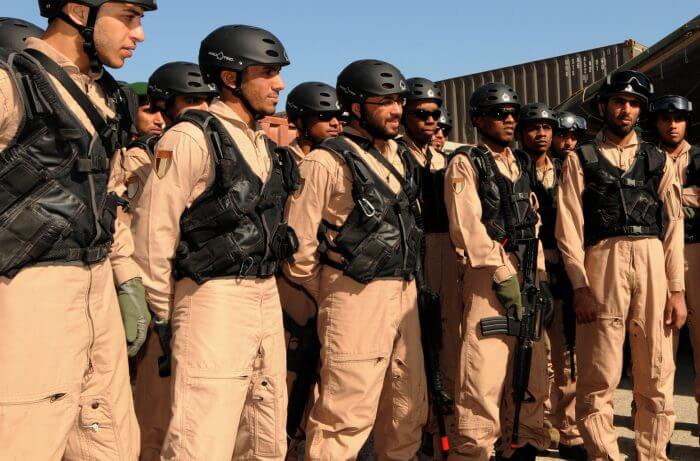
Today, the UAE Armed Forces is probably the best military in the Arab world. “Given its population of just one million citizens and a land area the size of Scotland, this is a substantial achievement,” added Dr. Yates. In an upcoming presentation at the NUS Middle East Institute, Dr. Yates will explain how the first locally-controlled military formed in 1965 grew so rapidly in size and capability to the point that by the late 1970s, the nation fielded supersonic jets, modern armored vehicles, and Exocet-equipped fast attack craft — a substantial achievement for a nation whose inhabitants lived a subsistence lifestyle with little education, health services, roads, piped water or even electricity until the early 1960s.

“I have now published two books on military history, with the chief of the UAE Navy writing the foreword for the naval book,” said Dr. Yates. “However, my major academic book is The Evolution of the UAE Armed Forces which is due out in a few months.”

While the military today is central to the nation’s development, just 60 years ago, the only security forces in the Emirates were the armed retainers of the Ruling Sheikhs and a small British-led, locally-raised Arab force, as Dr. Yates explains in his upcoming book. “Using a combination of investment in its nationals, oversight by the Rulers, engagement of expatriates and the purchase of cutting edge military hardware, the UAE Armed Forces has become the Arab region’s most capable military.”

The UAE military has some unique characteristics which make it markedly different from other militaries, notably the direct and personal involvement of the country’s leadership, a preference for the most advanced hardware, a multi-country equipment sourcing strategy, huge investment in human capital, and the engagement of expatriates to build capability through the transfer of knowledge.

Dr. Yate’s forthcoming book, The Evolution of the UAE Armed Forces, provides “unparalleled detail on the constituent forces that evolved into the UAE Armed Forces in 1976, and how the unified force has grown since then” alongside details on the politic and command structure governing the military and its enduring roles and history. The book is due out at the end of 2019.

Jade Sterling
News and Features Writer
18 August 2019

Khalifa University to Take Part in Health and Fitness Fun Week

Students staff and faculty have planned a fun and engaging series of health related activities designed to help visitors assess their overall wellbeing.

Khalifa University will be taking part in the upcoming Health and Fitness Fun Week scheduled to take place from the 19th to the 21st of February at the Abu Dhabi National Exhibition Center (ADNEC).  

Khalifa University’s booth will feature several fun games and tests designed to assess visitor’s health fitness and general wellbeing. The stations will be managed by students representing several different KU programs including Biomedical Engineering Aerospace Engineering Mechanical Engineering and Electrical Engineering as well as students from the Preparatory Program and the Med Club. Faculty and staff will be on hand to act as advisors to the students as they manage the activities.  

Activities include several non-invasive physical test including a lung capacity test a strength challenge several games to measure speed coordination and attention as well as a Body Mass Index test that does not require a person to be weighed. 

Students especially those in Biomedical Engineering will use the data collected over the three days for research purposes and as part of their future studies.