Conference to Highlight Abu Dhabi’s Role in Promoting Research in VNS Technique Used for Machine Learning Applications, Manufacturing and Logistics
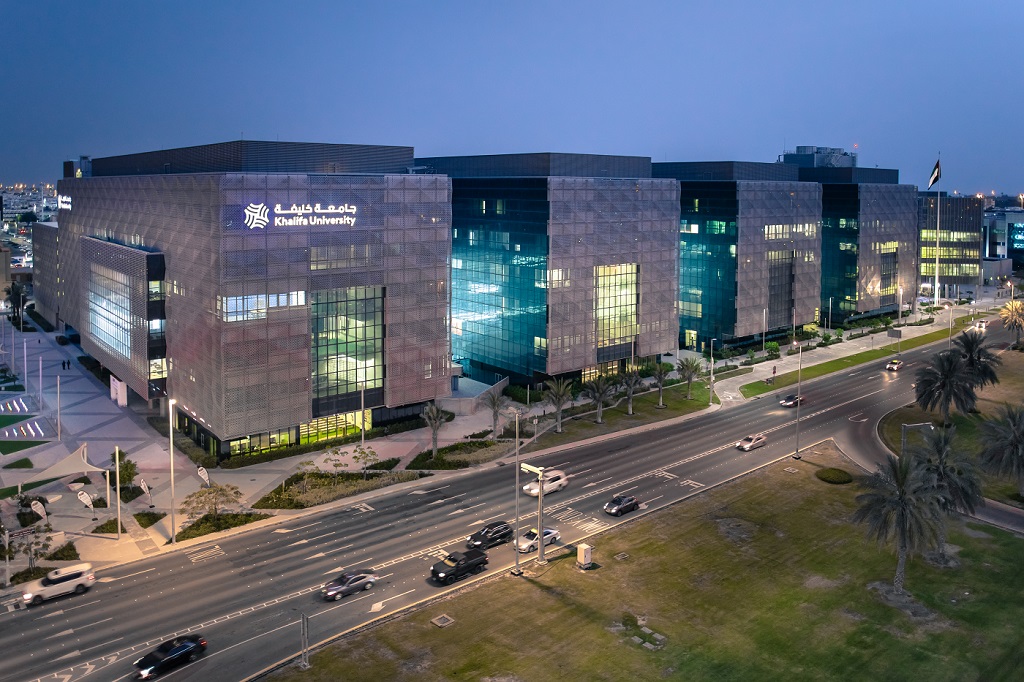
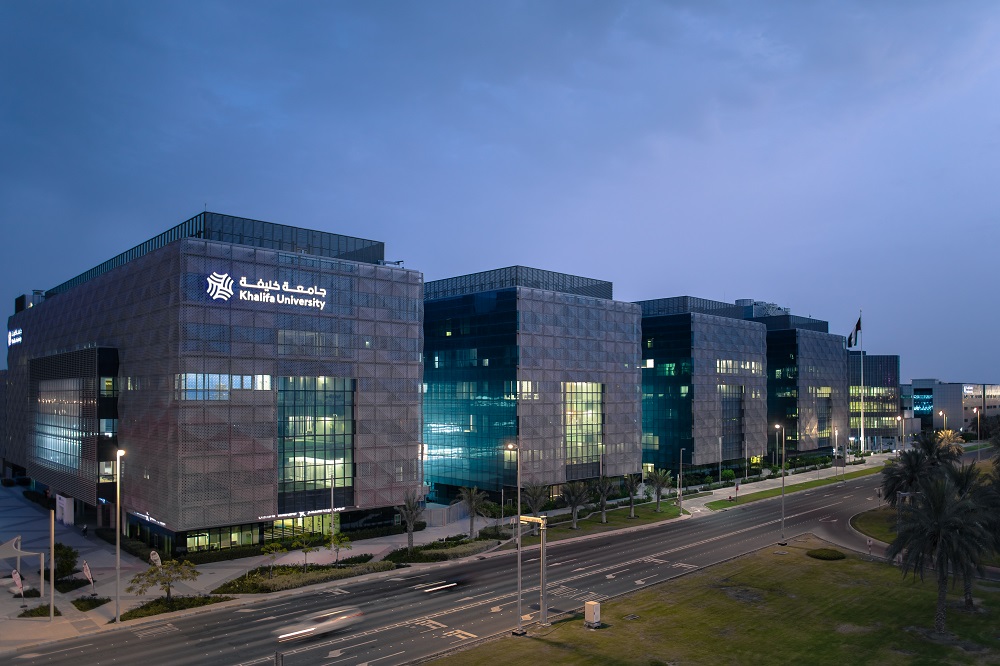
Khalifa University and the EURO Working Group on Metaheuristics (EWG EU/ME) have announced the 8th International Conference on Variable Neighborhood Search (ICVNS 2021) will be held virtually from 21-25 March 2021 in Abu Dhabi. The Abu Dhabi Culture and Tourism is a co-organizer.
The Variable Neighborhood Search (VNS) technique is widely used in many artificial intelligence (AI) and machine learning (ML) applications. The VNS algorithms can facilitate integrated manufacturing and batch-delivery scheduling, which minimizes delays. VNS can be used for better coordination within a supply chain, especially among the raw-material providers, manufacturing facilities, whole-sale distributors and customers, in order to obtain global efficiency in logistics.
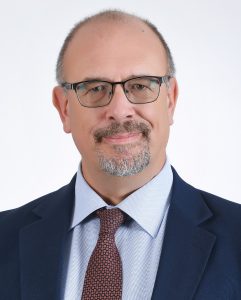
Dr. Arif Sultan Al Hammadi, Executive Vice-President, Khalifa University, is the Co-Chair of ICVNS 2021, while Dr. Pierre Hansen, HEC Montréal, Canada, will be the Honorary Chair. Dr. Nenad Mladenović, Visiting Professor, and Dr. Mohammed Omar, Department Head of Engineering Systems and Management, Khalifa University, are General co-Chairs, while Dr. Andrei Sleptchenko, Assistant Professor, Industrial and Systems Engineering, will be the Conference Chair.
A total of 27 papers will be presented at the 8th ICVNS virtual conference, providing a stimulating environment to researchers from various scientific fields to share their knowledge and expertise, and discuss ideas. A total of 14 papers will be published in a SCOPUS-listed volume. The papers from Khalifa University will be citing the works of Dr. Mladenovic, while the conference is fully dedicated to development and applications of the VNS technique proposed by him.
Dr. Panos Pardalos, Professor, Department of Industrial and Systems Engineering, University of Florida, Dr. Yury Kochetov, Professor, Laboratory Mathematical Models of Decision Making, Sobolev Institute of Mathematics, Novosibirsk, Russia, and Dr. Bassem Jarboui, Professor, Higher Colleges of Technology, Abu Dhabi, will be the plenary speakers.
The ICVNS 2021 will cover topics including ‘mixed integer programming’, ‘graphs, communication networks’, ‘clustering, data mining, location, and healthcare’, ‘Inventory, routing, supply chains’, ‘packing and covering’, ‘discovery sciences’, ‘berth allocation and quay crane scheduling’, as well as ‘public transport scheduling’. Selected papers presented at ICVNS 2021 will be published by Springer in the Lecture Notes in Computer Science (LNCS) series.
The macro-level research of Khalifa University’s Digital Supply Chain and Operations Management (DSOM) aims to provide real-world, cutting edge focus on the digital transactions, management, and optimization in multiple domains such as maritime logistics, production lines, and healthcare delivery systems. Formulated in precise mathematical definitions, VNS is also simple, clear, and universally applicable, and is known for robustness, user-friendliness, innovation, generality, interactivity and multiplicity.
Clarence Michael English Editor Specialist 21 March 2021
13 Students Participated in the Jubilee Lab to Help Shape the next 50 Years in the UAE
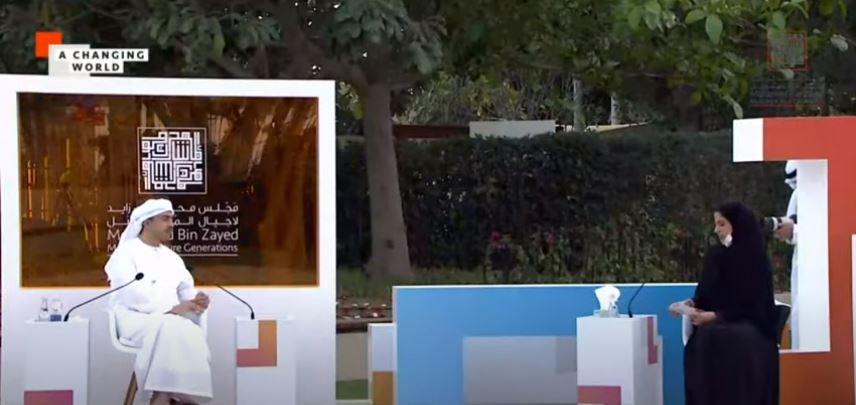
Noura Alnuaimi, MSc in Cybersecurity student and KU Student Council President, and Eman Obaid Hableel, Class of 2014 MSc in Cybersecurity graduate and Head of Youth Council at MoFAIC, had the special honor to engage directly with His Highness Sheikh Abdullah bin Zayed Al Nahyan, UAE Minister of Foreign Affairs & International Cooperation (MoFAIC), during the Mohamed Bin Zayed Majlis for Future Generations (MBZMFG) 2021 on Sunday, 14 March.
This year’s MBZMFG was held under the theme “Thriving in the Next Normal.” It brought together senior leaders and decision-makers from around the world, as well as a prominent group of experts in various fields and more than 3,000 university students from around the UAE to share and discuss ideal solutions for promoting and accelerating young people’s development in various fields in the country. The virtual event was live streamed on YouTube and can be viewed here.
Noura and Eman asked HH Sheikh Abdullah bin Zayed Al Nahyan several questions that were raised by students across the UAE that they collected during the Jubilee Lab.
Noura Alnuaimi
The Jubilee Lab was a virtual event that took place in early February. It gathered 150 Emirati university students to discuss innovative solutions to help shape the next 50 years of the UAE. Thirteen students and alumni from KU participated in the Jubilee Lab, including:
Aamer Alshehhi
Ali Alhaddad
Ayesha Alhammadi
Eman Hableel
Futoon Alshehhi
Khulood AlhosaniA
Maitha Alblooshi
Maryam Alraeese Rustam
Muath Alhashmi
Noura AlNuaimi
Azza Aljuwaied
Mohammed Alameri
Sulaiman Alaleeli
Two of the students, Mohammed Saeed Alamri, BSc in Aerospace Engineering, and Azza Abdalla Aljuwaied, BSc in Computer Engineering graduate who currently works at Microsoft, gave an interview about the findings from the Jubilee Lab on the local news program “Oloom Al Dar” on Emarat TV. The interview can be viewed here.
These students proudly represented Khalifa University and provided innovative ideas to help guide and develop the Future Plan of the UAE for the next 50 years.
Erica Solomon Senior Publication Specialist 21 March 2021
The 8th International Conference on Variable Neighborhood Search (initially called ICVNS2020) will be co-organized by the EURO Working Group on Metaheuristics (EWG EU/ME). The main goal of the 8th ICVNS conference is to provide a stimulating environment in which researchers coming from various scientific fields can share and discuss their knowledge, expertise and ideas related to the VNS Metaheuristic and its applications.
The 8th International Conference on VNS will allow specialists and practitioners on Variable Neighborhood Search to effectively screen papers and participate in lively debates.
The conference will be hosted by Khalifa University and will take place virtually, from 21-25 March 2021. More information can be found at the conference website here: http://icvns2021.info/
Khalifa University’s College of Medicine and Health Sciences has launched new initiatives aimed at bolstering the UAE’s healthcare infrastructure to advance research and train highly skilled clinicians
Khalifa University’s College of Medicine and Health Sciences (CMHS) has recently launched two initiatives designed to support the UAE’s goal of improving its healthcare research capabilities. The two initiatives together will strengthen the country’s healthcare infrastructure by providing a mechanism for conducting and collaborating on healthcare research, and for improving research skills in the country’s current and future healthcare workers.
Research and Data Intelligence Support Center
The first initiative out of Khalifa University’s CMHS is the Research and Data Intelligence Support Center (RDISC), created to ramp up the UAE’s ability to conduct pioneering research in the field of healthcare.
The new RDISC was developed in response to the UAE’s efforts to support health research, which was explained in the report “Development of a National Research Strategy for the UAE,” presented in May 2020 by Monash University Australia on behalf of the UAE Ministry of Health and Prevention.
The RDISC aims to train researchers in relevant areas of health research; to support these researchers with the methodological infrastructure required; and to provide high-end computing capabilities to prepare health data for sophisticated research.
In this way, the Center will help to close the gap in the UAE’s health sector by providing the required infrastructure and building the necessary competencies needed to leverage the vast and diverse range of health data available for research in the UAE.
The Center will also serve as the education, training and support hub for health research in the UAE, allowing its collaborators and partners to achieve health research excellence.
The RDISC will enable Khalifa University to engage in meaningful collaborative work locally, regionally and globally.
The KU Certificate in Clinical Research (KU-CCR) Training Program
The second initiative is a high-quality, comprehensive, and internationally competitive training program in clinical research designed to train medical doctors, nurses, allied health professionals and anyone interested in clinical research.
Most modern healthcare professionals are mandated to have the skills and competencies necessary to understand, interpret, discuss, and perform clinical research. However, most standard training programs do not provide these skills and competencies regularly, and the absence of these core abilities in healthcare providers has become a critical problem.
The KU Certificate in Clinical Research (KU-CCR) training program is designed specifically to develop these clinical research skills and competencies and meet the need for such training.
The KU-CCR program will specifically provide graduate medical students, also known as residents, with the building blocks needed to perform clinical research. It will do this by giving students a real-world research problem to solve. The aim is to give students the competencies to do research as lead investigators or co-lead investigators for complex projects.
In its first iteration, the program will train residents of the Abu Dhabi Health Services Company (SEHA), which will in turn allow SEHA to receive accreditation from the Accreditation Council for Graduate Medical Education. The training will elevate SEHA’s residents to an unparalleled level regionally and globally.
Through these initiatives, Khalifa University’s College of Medicine and Health Sciences is carrying forwards its founding mission to enhance the healthcare ecosystem of Abu Dhabi and the UAE, while helping the country become a global leader in health research.
Erica Solomon Publication Senior Specialist 15 March 2021
Khalifa University of Science and Technology and the IEA Greenhouse Gas R&D Program (IEAGHG) announced the 15th International Virtual Greenhouse Gas Control Technologies (GHGT-15) Conference, the biennial international gathering on greenhouse mitigation technologies, opened on 15 March.
The first-ever GHGT conference highlighted the advantages of carbon capture and storage (CCS) technologies and to discuss current status and future directions for the CCS deployment.
His Excellency Eng Awaidha Murshed Al Marar, Chairman, Abu Dhabi Department of Energy (DoE) gave the opening remarks, followed by a welcome note delivered by Dr. Arif Sultan Al Hammadi, Conference Co-Chair, and Executive Vice-President, Khalifa University of Science and Technology.
The four-day conference speakers included Kelly Thambimuthu, Chair, IEA Greenhouse Gas (IEAGHG), Bob Dudley, Chairman, Oil and Gas Climate Initiative – OGCI, Tony Espie, Chairman, CO2 Capture Project – CCP, Mechthild Wörsdörfer, Director of Sustainability, Technology & Outlooks, IEA, Bjørn Otto Sverdrup, Chairman, Executive Committee, OGCI, and Roy Vardheim, CEO (Acting), Gassnova.
A total of 355 oral presentations in 71 sessions, six panel discussions, and 254 poster presentations were presented at the GHGT-15, confirming the seven-stream technical program and keynote agendas. Khalifa University had 11 presentations accepted in oral sessions and 10 posters from faculty and students.
His Excellency, Eng. Awaidah Musrshed Al Marar, Chairman of the Abu Dhabi Department of Energy, delivered the opening keynote where he emphasized the emirate’s commitment to a responsible energy transition and the importance of Carbon Capture Utilization & Storage (known as CCUS) for the sustainability of the UAE and the country’s efforts to find balanced and inclusive solutions to the mixed challenges of energy and climate change.
His Excellency said: “We are committed to developing and implementing cleaner, sustainable energy solutions that can protect our economy, our security and our environment for decades to come. We aim to enable a responsible energy transition that is built around reliability, affordability, security and reduced environmental impact. These are fundamental pillars in our energy policy, and carbon capture and storage will be an important component of our policy moving forward to ensure security of supply in a carbon-constrained environment.
His Excellency added: “Carbon Capture Utilization & Storage is gaining global momentum as a viable, safe and commercially proven technology to help reduce greenhouse gas emissions from large-scale operations such as oil and gas and heavy industries. Abu Dhabi is capitalizing on CCUS for CO2-enhanced oil recovery and events like GHGT provide an excellent platform to explore how CCUS can help us to take advantage of our vast oil and gas resources while achieving large-scale CO2 reductions and cost efficiencies.”
Dr. Al Hammadi said: “The line-up of renowned speakers and the myriad oral and poster presentations strongly indicate the large-scale virtual participation of scientists, researchers and innovators in carbon capture technologies. We at Khalifa University are proud to bring this high-level conference to the Middle East for the first time. GHGT conference witnesses the submission of 600 papers and highlights the UAE’s active role as a key contributor to carbon mitigation and climate change measures.”
Tim Dixon, Conference Co-Chair, said: “As the premier international conference on carbon capture and storage, (CCS), staff at IEAGHG and the team at Khalifa University have worked incredibly hard to adjust the format to be able provide an engaging and successful platform for this event. This mammoth feat of bringing together and scheduling nearly 600 presentations over the four-day period, will ensure the GHGT authors maintain their platform to share and deliver their results that will provide crucial data and information to the greenhouse gas mitigation audience across the globe.”
The GHGT-15 gains significance because Abu Dhabi is already implementing some of the major CCS projects. According to a Global CCS Institute report, the next few years could feasibly see an unprecedented take-off of CCS in the Middle East, especially in the UAE and Saudi Arabia, perhaps to the point that the region could evolve to be a critical ‘global hotspot’ for CCS. The report adds that as regional interest in low-carbon hydrogen grows, with its vast underground storage potential, abundant natural gas resources and excess production capacity, the Middle East could use its developing CCS expertise and location to develop a clean hydrogen export industry.
A recent analysis by the International Energy Agency (IEA) estimates that CCS deployment will require an investment of around US$9.7 trillion in order to achieve the Paris Climate Agreement goals.
Dr. Mohammad Abu Zahra, conference Technical Co-Chair, explained that GHGT-15 will cover important topics including advances in capture technology development, CCS for industrial sources and hydrogen, and CCS technology assessment, cost and system integration. Other topics include CO2 Utilization for GHG mitigation, Demonstration projects and major national and international CCS research developments and demonstration programs, as well as Developments in other storage options for CO2.
Clarence Michael English Editor Specialist 15 March 2021
The explore-exploit dilemma exists in all areas of life. When you open a streaming service to choose a film to watch, you might start exploring different shows to find an enjoyable one to watch, or you might exploit one you’ve already seen and know you’ll enjoy again. Another example is choosing to go to a favorite restaurant over trying a new one that could be better—or worse.
One way to decide is to weigh the benefits of a known option (I know this restaurant does this dish well and I will enjoy it) against the information available for sampling something new (I have never been to this restaurant but the reviews look good). The other way to decide is much more random, say with the toss of a coin. This first example is a ‘directed exploration’ approach, while the second is a ‘random exploration’ approach.
Choosing at Random
Random exploration in human behavior has been studied in less detail than directed exploration. But in a new study conducted by Khalifa University’sDr. Samuel Feng, Assistant Professor of Mathematics, in collaboration with the Neuroscience of Reinforcement Learning and Decision Making Lab led by Dr. Robert Wilson at the University of Arizona in the United States, researchers are investigating the dynamics of random exploration in humans, and ask questions about how and why the brain makes choices seemingly randomly at times.
Their study was published recently inNature’s Scientific Reports, and has consequences in connection to reinforcement learning, a rapidly growing paradigm of machine learning and artificial intelligence.
Deciding when to explore more and when to stop and exploit what is available is a key factor in many decisions, and understanding what controls random exploration can help decision making in all aspects of life, from dinner to business. In this research, Dr. Feng and colleagues shed light on the mystery of how to design machines and algorithms that mimic human decision making for the challenging class of explore-exploit decisions.
In their words: “When choosing a class in college, should you exploit the math class you are sure to ace, or explore the photography class you know nothing about? Exploiting math may be the way to a better grade, but exploring photography—and finding that it scratches an itch you never knew you had—could be the path to a better life. As with all such ‘explore-exploit’ decisions, picking the optimal class is hard—explore too much and you’ll never finish your degree. Exploit too much, and like us, you will do math for the rest of your life.”
The explore-exploit trade-off has a rich history in computational neuroscience research. It involves choosing between a familiar option with a known reward value and an unfamiliar option with an unknown or uncertain reward value. Exploitation maximizes rewards in the near-term, while the information obtained during exploration can be used to maximize rewards in the long-term.
But exploration is labor-intensive and time-consuming. How long should we explore? When should we start exploiting? In other words, in an uncertain and changing environment, where values of all potential options are unknown or the values of these options change over time, maintaining efficient performance requires flexibly alternating between exploration and exploitation.
“From a computational perspective, the difficulty of explore-exploit decisions arises due to uncertainty about the outcome of each choice (will I like photography?) and the long time horizon over which the consequences of a choice can play out (if I like photography, should I change my major?),” the researchers question in their paper. “To make an ‘optimal decision’ that maximizes our expected future reward, we need to average overall possible futures out to some time horizon. However, this requires us to mentally simulate all possible futures and that is surely beyond what any human brain can perform.”
Modeling Decision Making
Dr. Feng and the research team used mathematical models to break down the problem: “Mathematical modeling of these decisions provides quantitative assessment of underlying behavioral mechanisms. Inspired by research in machine learning, recent findings in psychology suggest that humans use two strategies to make explore-exploit decisions: an explicit bias for information (‘directed exploration’) and the randomization of choice (‘random exploration’). Despite differences in implementation, both strategies are driven by the same goal: increasing reward in the long run.”
They developed a model of explore-exploit behavior to investigate how random exploration could be controlled, assuming that the decision between exploitation and exploration is accomplished by accumulating evidence over time. In this context, behavioral variability when making choices can be controlled by three different parameters. Current experimental data, however, cannot distinguish which of these parameters is behind the selected choice. Instead, they show that these explore-exploit decisions are likely driven by a ‘signal-to-noise’ mechanism within the brain.
“In directed exploration, a decision is made by comparing the expected values of exploring and exploiting,” explained Dr. Feng. “These expected values combine the predicted short-term payoff from picking an option once, the ‘expected reward,’ with an estimate of the long-term value of the information obtained from choosing that option, the ‘information bonus,’ also known as the future expected value. The information bonus increases the value of exploratory options such that a directed explorer will find exploration more appealing. In contrast, in random exploration, the tendency to exploit the option with the highest short-term expected reward is countered by ‘noise’ in the decision process. This noise introduces random variability to the decision, which leads to exploration by chance.”
Getting through the Noise
Noise is inevitable in human decision making because humans are unreliable decision makers, strongly influenced by irrelevant factors such as their current mood, hunger, and even the weather. Some decisions are noise-free as they follow strict rules that limit subjective judgement. Other decisions are ‘a matter of judgement.’
A key feature of both types of exploration is that they appear to be subject to cognitive control: when it is more valuable to explore, people exhibit more information seeking (directed) and more variability in their behavior (random). Exactly how the brain achieves this control of directed and random exploration is unknown, and the signal-to-noise mechanism suggested by this study sheds some light on how the brain processes these types of decisions.
“When it is valuable to explore, the representation of reward cues—or at least, the extent to which these cues are incorporated into the decision—is reduced, leading to more random exploration overall,” explained Dr. Feng.
These findings are useful for programming machines that mimic human decision making.
“In reinforcement learning, an agent tries to maximize their reward by choosing beneficial actions within some environment. It is a growing paradigm driving many AI applications including gaming (computers playing chess/go), robotics, advertising, and computational chemistry,” explained Dr. Feng. “In such applications, our goal is not only to maximize numeric performance but also to design machines and algorithms that learn and decide like humans.”
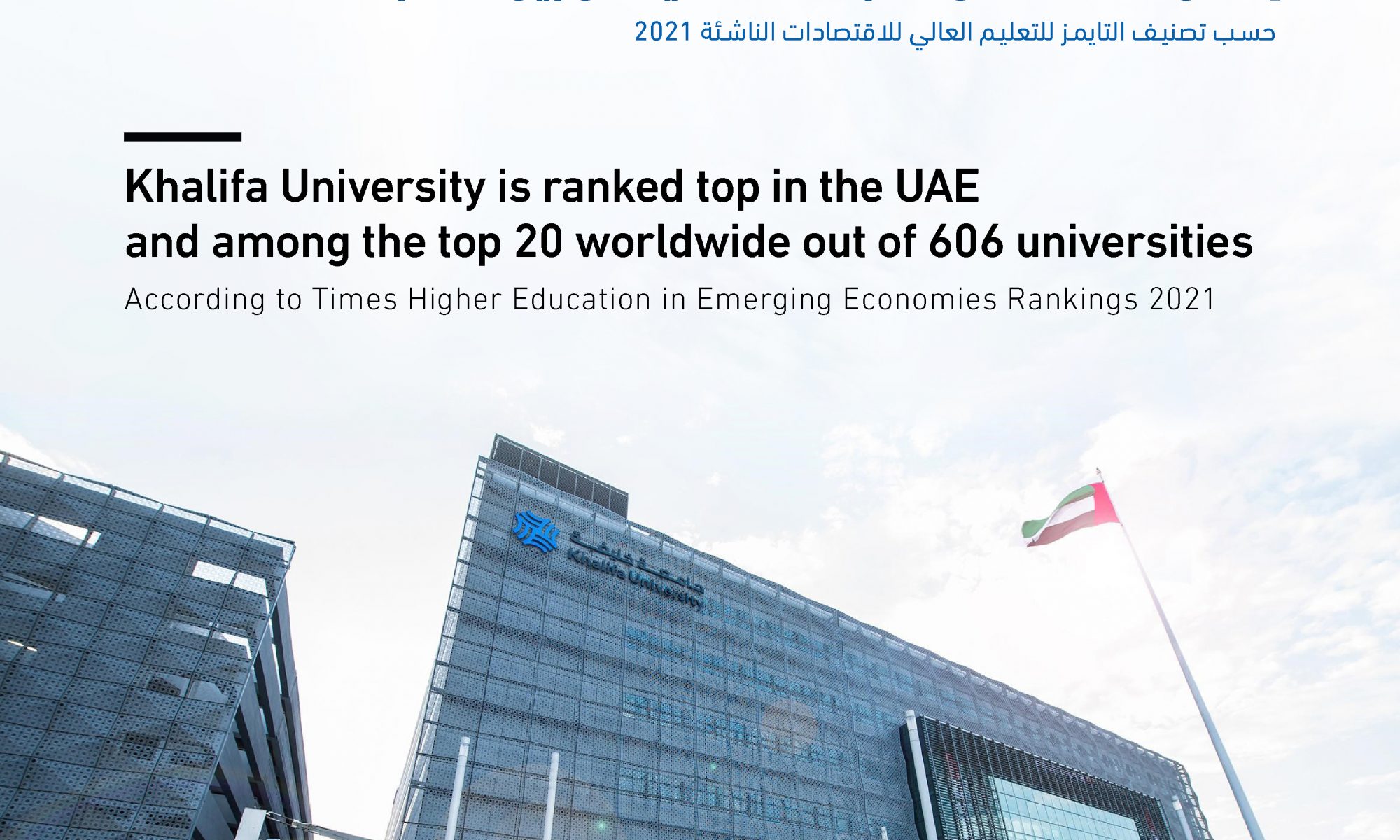
Khalifa University of Science and Technology has announced it has been ranked among the Top 20 globally and top in the UAE in the Times Higher Education (THE) Emerging Economies Rankings 2021.
Khalifa University is ranked 20th among 606 emerging economies universities from 48 countries and regions in the most recent THE rankings, the only global performance tables that judge research-intensive universities across all their core missions – teaching, research, knowledge transfer and international outlook. Though the rankings use the same 13 carefully calibrated performance indicators to provide the most comprehensive and balanced comparisons, trusted by students, academics, university leaders, industry and governments, the weightings are specially recalibrated to reflect the characteristics of the emerging economy universities.
Clarence Michael English Editor Specialist 14 March 2021
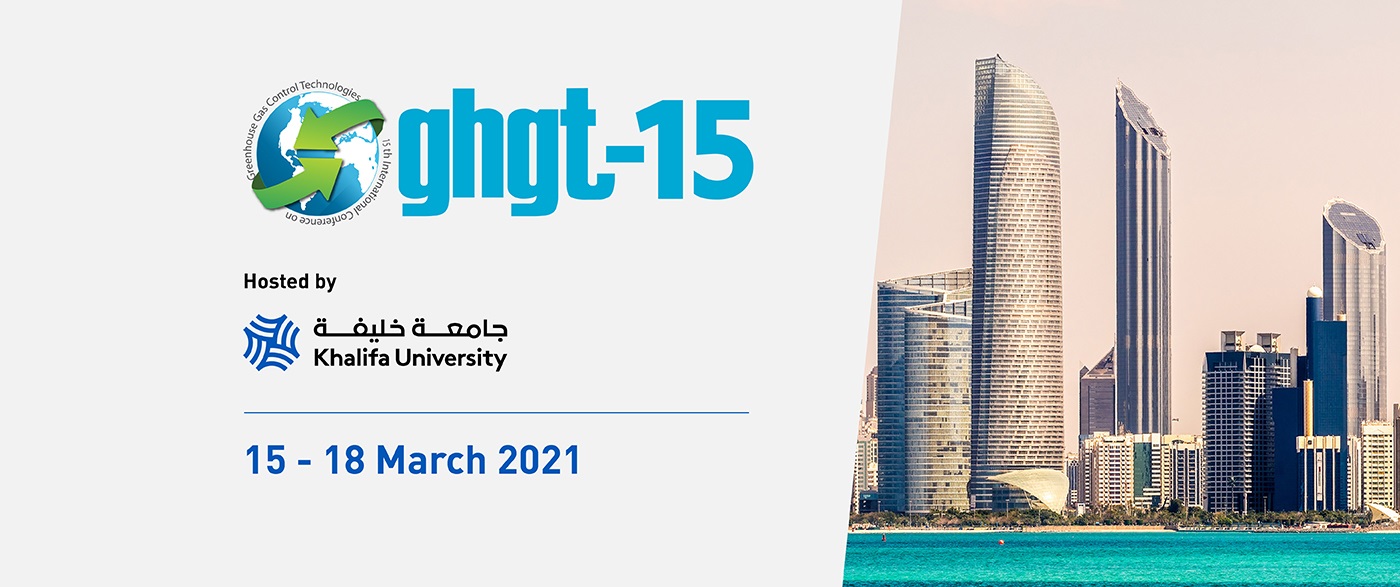
Khalifa University of Science and Technology and the IEA Greenhouse Gas R&D Program (IEAGHG) have announced that the 15th International Virtual Greenhouse Gas Control Technologies (GHGT-15) Conference, the principal international gathering on greenhouse mitigation technologies organized once every two years, will be held virtually from 15-18 March 2021 in Abu Dhabi.
This is the first time a GHGT conference has come to the Middle East region to highlight the advantages of carbon capture and storage (CCS) technologies and to discuss current status and future directions for the CCS deployment.
Dr. Arif Sultan Al Hammadi, GHGT-15 Co-Chair and Executive Vice-President, Khalifa University, said: “Khalifa University is delighted to support multilateral institutions such as the IEAGHG and bring the GHGT-15 conference to Abu Dhabi and the UAE. Abu Dhabi has already adopted advanced carbon mitigation technologies, implementing CCS projects that benefit diverse stakeholders. We believe the conference will adequately highlight newly emerging technologies, while demonstrating the proactive role the UAE continues to play in the sustainable energy area. Our support to this conference stems from Khalifa University’s emphasis on research and its efforts in providing a strong learning ground for tomorrow’s professionals in alternative energy and sustainability through academic and outreach programs.”
Tim Dixon, IEAGHG General Manager, said: “As the premier international conference on carbon capture and storage, (CCS), staff at IEAGHG and the team at Khalifa University have worked incredibly hard to adjust the format to be able provide an engaging and successful platform for this event. This mammoth feat of bringing together and scheduling nearly 600 presentations over the four-day period, will ensure the GHGT authors maintain their platform to share and deliver their results that will provide crucial data and information to the greenhouse gas mitigation audience across the globe.”
The virtual GHGT-15 gains significance following some of Abu Dhabi’s major CCS projects including around 0.8 Mtpa of CO2 that is captured from the Emirates Steel plant as Phase I of the Abu Dhabi National Oil Company (ADNOC) Al Reyadah project.
A recent analysis by the International Energy Agency (IEA) estimates that CCS deployment to achieve the Paris Climate Agreement goals will require investment of around US$9.7 trillion. According to the Global CCS Institute’s report, the next few years could feasibly see an unprecedented take-off of CCS in the Middle East, especially in the UAE and Saudi Arabia, perhaps to the point that the region could evolve to be a critical ‘global hotspot’ for CCS.
Clarence Michael English Editor Specialist 10 March 2021
Today more than half of the world’s population lives in cities, and by 2050 this percentage is expected to rise to nearly 70 percent. In parallel to rapid growth in urbanization, technological progress has led to the mass proliferation of digital information about people, places, and things that can be rapidly transmitted and analyzed with increasingly powerful networking technologies and analytical tools. This digital proliferation is synonymous with the internet-of-things, or IoT, and has converged with urbanization to create the paradigm of “smart” cities.
A smart city is not just technologically advanced; it is a platform for the sustainable and inclusive enhancement of nearly all aspects of society. However, achieving such positive outcomes as smart cities evolve is not a simple task.
The Evolution of Smart Cities
While urbanization and technology have laid the foundation for smart cities, the COVID-19 pandemic that emerged in 2020 may ultimately shape long-term implementations.
Dr. Steve Griffiths
As a result of social distancing mandates implemented to mitigate disease spread, smart city technologies and services for healthcare, work, education, retail, finance, security, entertainment, food services, mobility, and essentially any other activity requiring human interaction have undergone both acceleration and transformation.
Although the fundamental architecture of smart cities remains centered around an IoT foundation upon which applications are built for defined use cases, the use cases themselves have both evolved and accelerated in their implementation.
In healthcare alone, activities such as telemedicine, contact tracing, public health messaging, mobility pattern analysis, and robotic patient care have emerged and begun to transform the notion of healthcare delivery from one of in-person interaction to one of digital engagement.
Likewise, urban transportation is seeing significant changes due to changing social practices resulting from the pandemic and government policies being implemented for pandemic recovery. Digital technologies will play a key role in these changes as efforts to reestablish demand for public transportation increasingly focus on flexible transit scheduling and planning and the development of multimodal digital platforms that integrate public transportation with bikes, scooters, ride-hailing, and other mobility modes.
In short, even the most established smart cities face the innovation challenge of re-imagining city operations for a new era of heightened concerns for health and resiliency, the latter of which additionally factors into climate change considerations. Similar to the COVID-19 pandemic, climate change is now generally recognized as a globally disruptive and destructive issue that must be mitigated through increased government efforts that include the design, implementation, and operation of smart cities.
While the noted trend towards increased city intelligence through digitalization affords many opportunities for improving the lives of citizens, it also creates a number of security concerns.
The rapid growth in digital information collection, storage, and use has opened up multiple new attack surfaces for cyber-terrorism, cyber-warfare, and cyber-crime. While cyber-terrorism and cyber-warfare often have social and political motivations, cyber-crime is tied largely to commercial and economic interests and can impart significant financial costs on victims. Indeed, the financial impact of cyber-crimes is expected to amount to as much as US$6 trillion in 2021 considering damage and destruction of data, stolen money, lost productivity, theft of intellectual property, theft of personal and financial data, embezzlement, fraud, post-attack disruption to business operations, forensic investigation, restoration and deletion of hacked data and systems and/or reputational harm.
This considerable cost is expected to rise to as much as US$10.5 trillion by 2025 as the storage of digital data rises in the coming years. The accumulation of digital data has only hastened as a result of the COVID-19 pandemic as the extent of consumer online interactions has been accelerated by three to four years and the extent of business product and service digitalization has been accelerated by six to ten years.
The rapid, and now accelerated, pace of digital activity places a great burden on smart city infrastructure as operational technologies (OT) and information technologies (IT) converge to offer new services and capabilities. Legacy OT systems that are not secure combined with the proliferation of novel, but insecure, digital devices combine to make cybersecurity and cyber resilience urgent for smart cities. Preservation of the confidentiality, integrity, and availability of information in cyberspace coupled with the capacity for rapid recovery from cyber incidents must sit at the top of cyber secure and cyber resilient smart city agendas.
A Forward-Looking Agenda for Smart Cities
The sharing of international expertise, technologies, and best practices can play an important role in achieving cyber secure and cyber resilient smart cities. The United Arab Emirates, Singapore, and Israel are three highly urbanized countries that are aligned in their ambitions for innovation and security in the urban context. While each country scores highly in international innovation rankings, Singapore is particularly advanced in smart city technology innovation while Israel is a global leader in cyber security innovation.
The UAE has rapidly built smart city visibility, particularly related to developments in the emirates of Abu Dhabi and Dubai, and has visible initiatives to ensure that these cities are cyber secure and resilient, including the 2020 formation of a Cybersecurity Council headed by a recently appointed government Head of Cyber Security.
Among emirate level initiatives, Dubai has established a Cyber Security Strategy and in Abu Dhabi, the Advanced Technology Research Council (ATRC) was formed in 2020 and has set forth a research and development strategy that clearly puts cybersecurity at the forefront by including cryptography, digital security, and secure systems as three of seven top priority research areas for the emirate.
An agenda for smart city collaboration among the UAE, Singapore and Israel would certainly involve the exchange of best practices regarding legal and regulatory frameworks as well as engagement in technology investment and trade.
However, ecosystem development is what underpins long-term sustainability and hence international collaboration should further entail targeted initiatives addressing human capital, R&D, and innovation. Human capital development is very important given the growing shortage of skilled cyber security manpower. R&D supports the development of human capital and further brings value to the development of cutting-edge approaches to smart city services, security, and resiliency.
R&D topics of particular merit within the cyber security context include the protection of edge devices, application of artificial intelligence techniques, application of blockchain, and in the coming years, the implementation of quantum technologies. Innovation further builds on human capital and R&D advances to establish commercially viable new technologies tailored to applications.
On this latter point, R&D and innovation collaboration may focus on specific smart city sectors of common interest and growing importance. Given that both healthcare and transportation are being re-imagined as a result of COVID-19, focused initial collaboration efforts in these domains, for instance, could lead to large rewards for all involved.
Urbanization and technological trends make the rise of smart cities inevitable. As discussed in this paper, however, smart cities will inherently face threats and challenges. Collaboration among countries that have common interests in securing a successful future for their smart cities can help mitigate these threats. The UAE, Singapore, and Israel are three such countries that can reap the benefits of collaboration through a holistic partnership that addresses human capital, R&D, and innovation while taking into consideration applications with both near and long-term importance.
The full conference session to which the story relates is available online, here:
Dr. Steve Griffiths is the Senior Vice President of Research and Development and Professor of Practice at Khalifa University.
Technology Innovation Institute (TII), the applied research pillar of Abu Dhabi’s Advanced Technology Research Council (ATRC), announced the appointment of international experts in the field of systems security to the Board of Advisors of its Secure Systems Research Centre (SSRC).
Secure Systems Research Centre is one of the initial seven dedicated centers at TII and is among the few global centers of its kind to bring together experts to conduct groundbreaking research in the field of secure systems. The distinguished new Board has combined expertise in security and resilience relating to autonomous computing and will guide the efforts of the Centre’s research team in developing end-to-end solutions to protect cyber-physical and autonomous systems.
Prof. Ernesto Damiani
The Board of Advisors is comprised of:
Prof. Ernesto Damiani,Professor, Department of Electrical Engineering and Computer Science, Senior Director, Artificial Intelligence & Intelligent Systems Institute, Director of the Center for Cyber Physical Systems (C2PS), Khalifa University in the UAE, whose research interests include secure service-oriented architectures, privacy-preserving big data analytics and cyber-physical systems security.
Female scientist’s platform SPL.Co automates software migration to the cloud through AI
Emirati scientist Salwa Alzahmi founded tech start-up SPL Co. in 2019 after observing the challenges companies faced when migrating their data into cloud-native architecture.
With coronavirus accelerating digital transformation and reliance on tech, SPL. Co was globally recognized at the Global Telecom Award GTB and the IET Achievement Awards for engineering and technology.
Salwa Alzahmi founded tech start-up SPL Co.
SPL. Co is a provider of software transformation for current IT systems through an Artificial Intelligence (AI) model which automatically identifies and composes the part of the system code that should be lifted to the cloud.
In an exclusive interview with Arabian Business, Alzahmi spoke of her experience with the Ibtikari program, an intensive five-month incubator run by startAD in partnership with Khalifa Fund, advancing technology startups founded by UAE Nationals.
Khalifa University Ranks 214th Internationally in ‘Engineering and Technology’ in 2021 QS World University Rankings by Subject Leaping 67 Notches
Khalifa University has leapt 67 notches to be ranked 214th globally in the ‘Engineering and Technology’ category, top in the UAE and in six subjects in the most recent 2021 QS (Quacquarelli Symonds) World University Rankings by Subject.
The milestone achievement comes as Khalifa University has been ranked 21st in Petroleum Engineering internationally, a jump of seven notches, in the QS World University Rankings by Subject.
Dr. Arif Sultan Al Hammadi, Executive Vice-President, Khalifa University, said: “The international acknowledgement of Khalifa University’s academic status through the 2021 QS World University Rankings by Subject further consolidates our status as a top-ranked institution renowned for world-class quality education. In a year beset with a global pandemic that brought major challenges to academic institutions, Khalifa University has again vindicated its primary status globally, regionally and in the UAE, because of our expert and dedicated faculty members and the level of research produced at the University. We believe this milestone recognition will motivate us even further to reach bigger heights in the coming years.”
Khalifa University has also performed better in other subjects with Civil and Structural Engineering ranked within the top-200 band globally, while Chemical Engineering, Electrical and Electronic Engineering, and Mechanical Engineering coming among the ‘top-250 band’ in the 2021 QS World University Rankings by Subject.
The QS World University Rankings by Subject is an extensive independent comparative analysis on the performance of 13,883 individual university programs, taken by students at 1,440 universities in 85 locations across the world, across 51 academic disciplines.
Four components – academic reputation, employer reputation, research citations per paper, and the H-index – are used to rank universities in the QS World University Rankings by Subject 2021. Apart from academic and employer reputation, the QS World University Rankings by Subject measures ‘citations per paper’ rather than ‘citations per faculty member’ for more reliability in statistics. The H-index is a way of measuring both the productivity and impact of the published work of a scientist or scholar. It is based on the set of the academic’s most cited papers and the number of citations that they have received in other publications.
Khalifa University already ranks at #211 in the QS World University Rankings 2021, which features 1,029 of the most prestigious universities in the world.
Clarence Michael English Editor Specialist 7 March 2021