

EBTIC Wins Two Awards at Computing AI & ML Machine Learning Awards 2019 for Intuitu Project

Khalifa University’s Emirates ICT Innovation Center (EBTC) Develops Intuitu, an Advanced AI Tool to Drive Optimized Warehouse Deployment

The warehouses that pick, pack and dispatch our products and packages are getting smarter, more efficient, smaller, and even portable, thanks to recent advancements in digitalization, big data, and artificial intelligence (AI). As these ‘warehouses of the future’ shift from massive brick-and-mortar buildings to mobile containers closer to the customer, they present unique optimization challenges for the companies that use them.

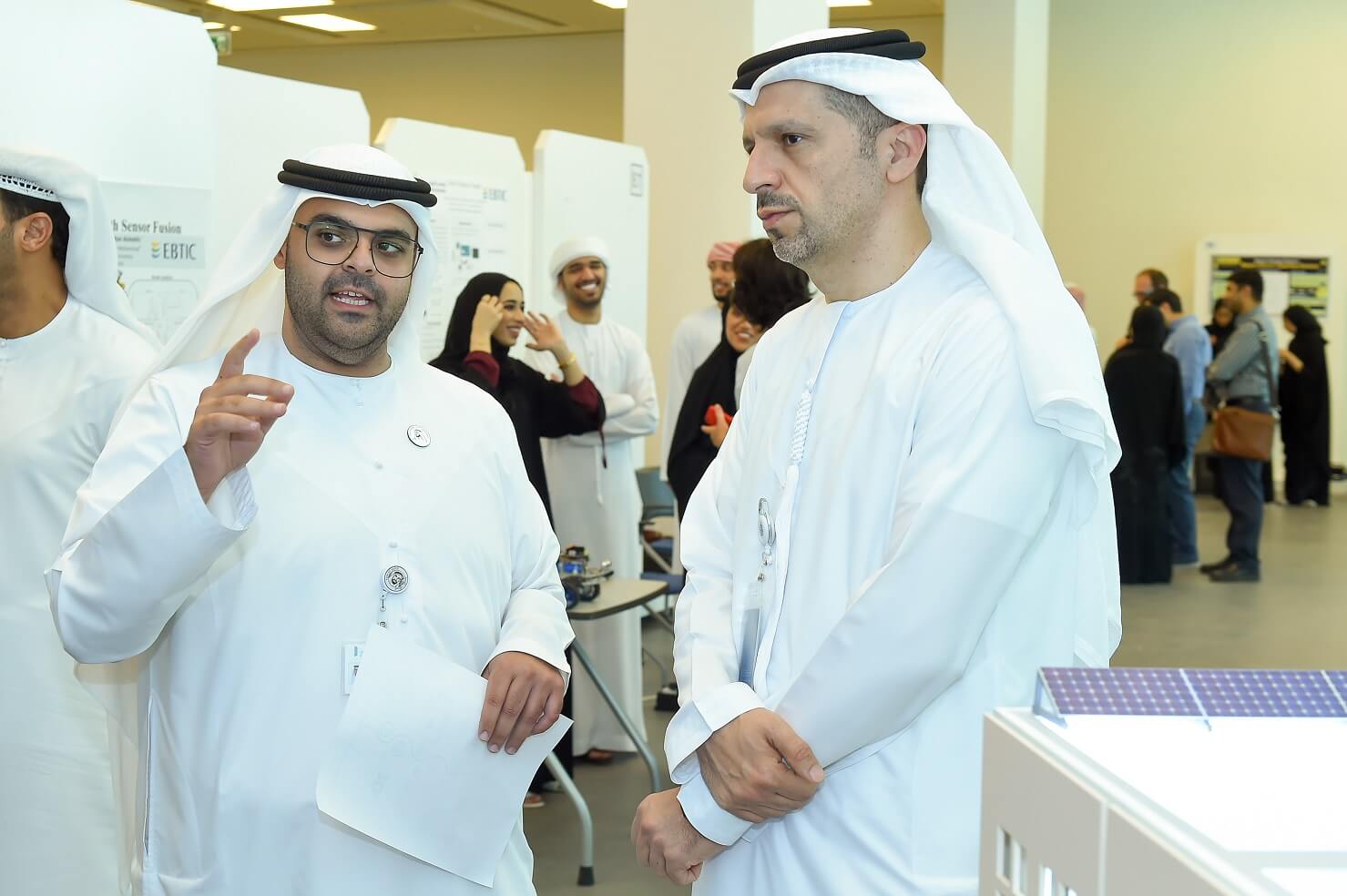
This month, at the AI and Machine Learning Awards 2019 in London – a new line up of awards launched this year by Computing, UK’s leading business technology information resource – researchers from Khalifa University’s Emirates ICT Innovation Center (EBTIC) won two awards, including ‘Outstanding AI/Machine Learning Project’ and ‘Most Innovative use of AI/Machine Learning’ for their new cutting-edge tool for solving optimization problems related to warehouse deployment, called Intuitu.

Developed by researchers at EBTIC – an ICT research and innovation center founded by Khalifa University, Etisalat and BT, and supported by ICT Fund – and led by Dr. Sid Shakya and Dr. Rom Lee, together with BT, UK, Intuitu is an AI-based tool that optimizes the deployment of warehouses for large service organizations such as telecommunications companies. EBTIC is also working closely with its local partner Etisalat, one of the world’s leading telecom groups, to deploy the Intuitu tool to improve operational efficiency and faster service delivery of Etisalat’s mobile warehouses. They are also collaborating to leverage Intuitu’s advanced AI logic to manage Etisalat’s inventories and warehouses more efficiently.

“Recent advancements in internet-of-things (IoT) and connected technologies have greatly impacted warehouse design. They are getting smaller and mobile in their nature, shifting from fixed structures to mobile containers or lockers. It is a relatively new concept and poses challenges as redeployment has to happen frequently and optimally. Placing warehouses at the right place and at the right time can reduce travel and maximize productivity for field engineers,” said Dr. Sid Shakya, a Chief Researcher at EBTIC.

IoT enabled warehouses can be monitored and operated remotely. A fixed number of engineers and technicians are assigned to the warehouses based on their home location and working location. Ideally, the distance the workers have to travel to get to the warehouse and then to the client should be minimized. These mobile storages can be quickly deployed to different locations in a very short time. More importantly, they can be moved from one location to another and can be redeployed and reused, contributing to a more sustainable and eco-friendly model of warehousing.

One of the main goals of Intuitu is to determine the most ideal configuration of portable warehouses so that they are closer to consumers for faster delivery, while remaining close to technicians for optimal productivity. The tool drastically reduces the amount of time it would take for a technician to be deployed to provide a customer a requested service, which in turn will lead to significant efficiency gains.

Intuitu models the warehouse deployment problem as a combinatorial optimization problem – when mathematical techniques are applied to find optimal solutions within a finite set of possible solutions – and uses a sophisticated type of evolutionary algorithm known as genetic algorithm (GA) to find the optimal deployment design.

In this model, five key objectives were optimized: Minimizing the cumulative travel time for technicians to get spare parts; minimizing the distance from a warehouse to the served exchange sites; minimizing the distance from a warehouse to the home locations of the assigned technicians; minimizing the number of technicians that a warehouse serves; and lastly, minimizing the number of tasks that a warehouse is expected to serve per day.

Dr. Rom from the Inutitu team elaborated on how the tool works, “The genetic algorithm starts with a population of random solutions, which in this case, are a set of random warehouse locations, and performs a distance based clustering algorithm to find the sites that will be served by each location. It then calculates all five objectives and combines them together to evaluate the effectiveness of each solution. It then iteratively ‘evolves’ the population by applying genetic operators known as selection, crossover and mutation over a fixed number of allowed iterations, also known as generations, and consequently presents the best solution in the final population as the output.”

“Evolutionary algorithms and genetic algorithms are active areas of research in the AI community and EBTIC is at forefront of this research field,” Dr. Rom added.

“To make AI models operational, you must bring together a number of components including data, problem modelling, and identification of the right AI techniques. EBTIC approached this task in an agile fashion working closely with BT’s Applied Research team, and identified the right AI techniques to model the problem,” said Dr. Sid

Dr. Nawaf Al Moosa, Director of EBTIC, said: “EBTIC has a history of innovating practical AI solutions and have been leading in intellectual property generation in UAE for the past 10 years. These awards are a further testament to EBTIC’s successful history of applying AI techniques to the operations of its partner organizations, and to their effort to promote AI research in the UAE and the region.”

EBTIC is a foundational partner of Khalifa University’s new AI and Intelligent Systems Institute (AI Institute), a multidisciplinary research unit focused primarily on robotics, artificial intelligence, data science, next-gen networks, semiconductor technologies and cybersecurity. EBTIC and the AI Institute are committed to developing the key technologies required to bring the UAE significantly closer to reaching its goal of becoming a global hub for Artificial Intelligence innovation.

Erica Solomon
Senior Editor
5 August 2019
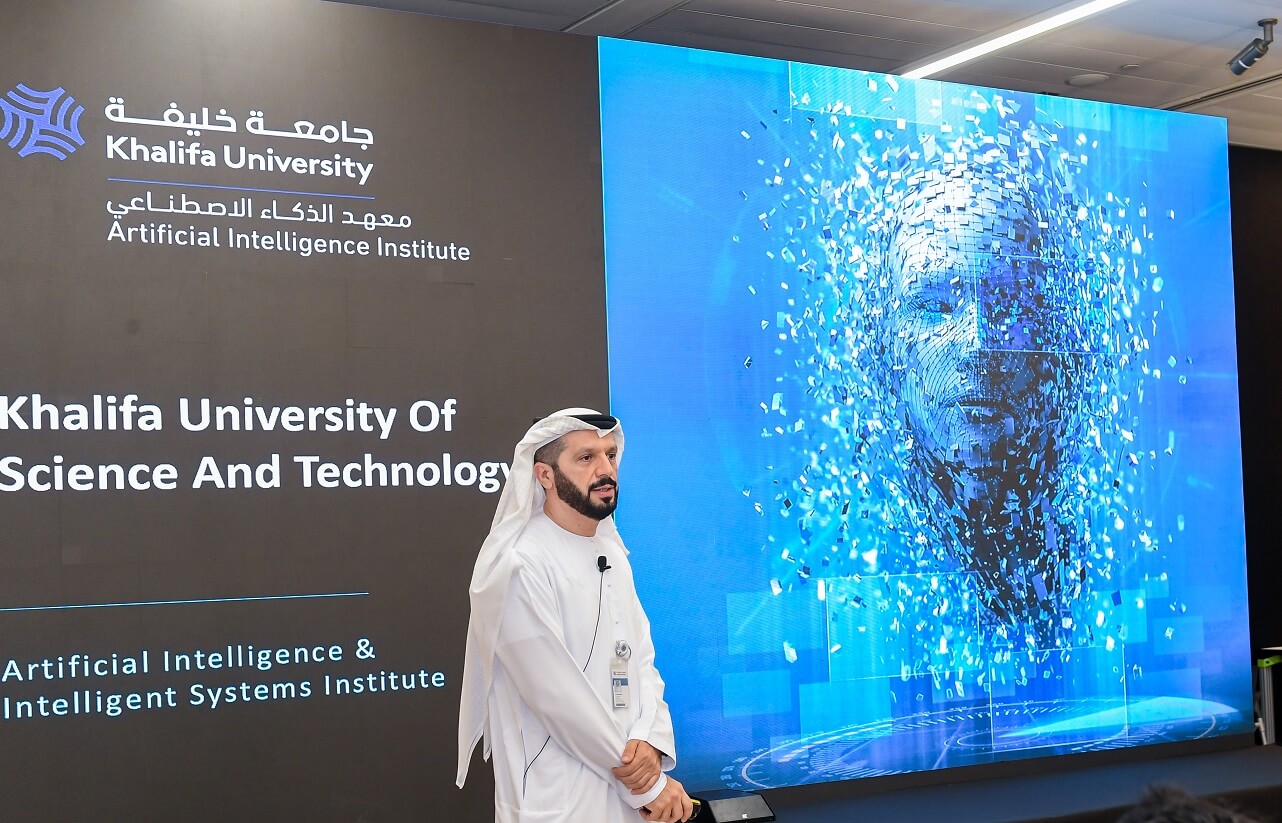
 

Khalifa University to Drive AI Innovation in the UAE

KU’s New Artificial Intelligence and Intelligent Systems Institute makes AI a Central Focus of its Academic and Research Activities

Self-driving cars, cancer diagnosis systems and workflow optimizations: the uses of artificial intelligence technology are exhaustive, ranging from the artistic to the mundane, from life-saving to recreational.

AI is by no means new; as early as 1950, Alan Turing published a paper titled Computer Machinery and Intelligence exploring the concept of AI and igniting the collective imagination. It’s only now that computers have advanced their technical capabilities to the point where they can handle the complexity of the machine learning algorithms that utilize massive amounts of available data to produce useful insights. A computer’s processing power is now over one trillion times more powerful than in Turing’s day, and they are increasingly being designed specifically for AI applications and therefore accelerating the pace of AI development.

Khalifa University’s Artificial Intelligence and Intelligent Systems Institute (AI Institute) is a multidisciplinary research unit focused primarily on robotics, artificial intelligence, data science, next-generation networks, semiconductor technologies, and cybersecurity. Its mission is to conduct applied and fundamental R&D of the key technologies required to bring the UAE significantly closer to reaching its goal of becoming a global hub for AI innovation.

KU now has three flagship research institutes that serve as interdisciplinary research units focused on long-term strategic priorities. The AI Institute joins the Masdar Institute, focusing on sustainable energy, water and the environment, and the Petroleum Institute, focusing primarily on upstream and downstream hydrocarbon exploration and production.

Through the AI Institute, Khalifa University is positioning artificial intelligence as a central focus of its integrated academic and research activities—with good reason.

According to PwC, AI could contribute as much as USD 96 billion to the UAE’s Gross Domestic Product (GDP) by 2030 and Accenture has stated that AI could add as much as USD 182 billion to the UAE’s Gross Value Add (GVA) by 2035. A report titled “Artificial Intelligence in the Middle East and Africa: United Arab Emirates – Outlook for 2019 and Beyond,” commissioned by Microsoft and conducted by EY, says the UAE has already seen the second highest regional investment in AI over the past decade: more than US$2.15 billion.

Research projects already undertaken by the research centers now housed under the AI Institute include sentiment analysis across social media, diagnosing cardiovascular disease, and surveillance by collaborating unmanned vehicles, just to name a few. Future projects will build on the institute’s capabilities in robotics, machine learning, natural language processing and computer vision to the fields of energy, water, health, aerospace, supply chains and logistics. The recently launched KU-Korean Advanced Institute of Science and Technology (KAIST) Joint Research Center focuses, for instance, focuses on AI and intelligent systems for smart transportation and smart healthcare. The smart healthcare projects in this center compliment those being conducted by KU’s Healthcare Engineering Innovation Center (HEIC), which is also part of the new institute, and works on topics like minimally invasive biorobotics.

Most importantly, much of the research will cover operational AI, which is the application of AI for real-world applications, particularly at prototype and demonstration scale. This is rather different from fundamental AI, which is focused much more on advancing AI algorithms and platforms. The research projects carried out under the AI Institute are use-inspired, meaning that solutions are sought to identified practical challenges. The results of these projects will not only be ground-breaking, innovative and exciting to the field at large, but also practical and applicable to the population of the UAE and the world.

Artificial intelligence is already tasked with decision-making across many critical infrastructures, with more to come. From energy grids to hospitals to financial services, AI is being applied with the goal of advancing major efficiencies and process improvements. However, integrating new technologies into existing complex systems is a delicate and difficult task and problems with data-inputs, inaccuracies, and faulty results can ultimately lead to poor outcomes and disappointment.

The establishment of the AI Institute comes at a pivotal time for the United Arab Emirates. One in five companies operating in the country consider AI their top digital priority, and 94 percent of companies have AI strategy at the heart of their senior management focus.

Since 2010, the UAE leadership has been launching national strategies and targets to guide the country’s development into a sustainable and competitive knowledge-based economy. Sophisticated strategies, like Abu Dhabi Vision 2030, UAE Vision 2021, and the National Innovation Strategy, are guiding the country in focusing on specific sectors and outcomes that will position the UAE as a knowledge and innovation leader.

The UAE Artificial Intelligence Strategy and the Fourth Industrial Revolution Strategy position the UAE to become a global leader in these emerging technology domains. By leveraging its robust expertise in ICT, data analytics and robotics research, and partnering with the region’s leading industry experts in the field, KU’s AI Institute is set to develop the innovative technologies needed to achieve the UAE’s AI transformation goals.

Jade Sterling
News and Features Writer
29 July 2019

Artificial Intelligence for Cyber Crisis Management Expertise Shared

Khalifa University’s Dr. Ernesto Damiani Discusses the Need to Leverage AI and Big Data Analytics to Prevent Cyberattacks

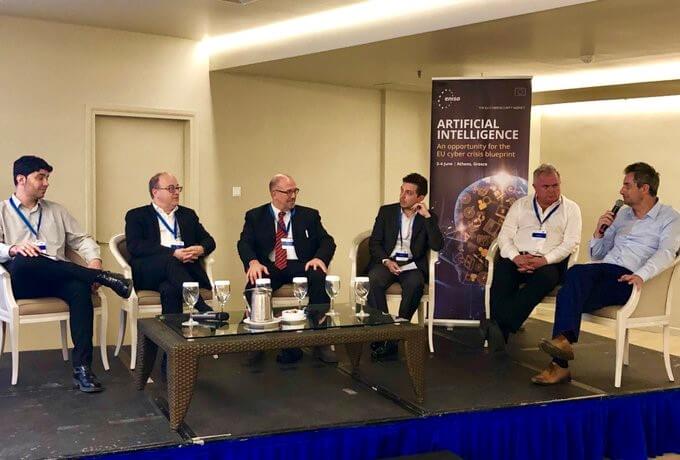
As a regional expert in the field of artificial intelligence (AI), Khalifa University’s Dr. Ernesto Damiani, Professor of Electrical and Computer Engineering and Director of KU’s Center on Cyber Physical Systems (C2PS) and Senior Director of KU’s recently launched Artificial Intelligence and Intelligent Systems Institute, was invited to the European Agency for Network and Information Security’s (ENISA) high-level meeting in Athens in June to discuss the pressing issue of cyber crisis management.

ENISA is the EU agency tasked with establishing a high level of network and information security within the European Union. The meeting in Athens convened AI experts from around the globe to share and debate the best practices for preventing and managing cyber-attacks.

“When a security crisis takes place in the physical world some things are certain, like who is threatening you, how and (most of the time) why. This is not the case for cyber-crises, as the hand pointing the gun at you is hidden in the Dark Net and the gun itself may have been planted in your network years before. AI has become crucial for cyber-security,” explained Dr. Damiani.

A good example of a hidden cyber-gun is EternalRocks, a computer worm that infects Microsoft Windows machines, which was originally developed by the United States’ National Security Agency (NSA). Once installed on the victim’s machine through a phishing email, EternalRocks’ small infecting module (or carrier) installs Tor, the notorious private network that conceals Internet traffic, to access its hidden servers. The carrier uses Tor to connect to a remote server and downloads an entire Trojan horse that allows the remote attacker to control the victim’s machine and the networks it is connected to.

Unlike ransomware such as WannaCry, which infected 230,000 computers in May 2017, EternalRocks does no immediate harm to its hosts.

“It just hides on a disk, renaming itself to escape detection, and then stays dormant for months, even for years, until the time comes for a “soft” attack aimed at collecting and stealing information or for a generalized attack to clog the victim’s network,” said Dr. Damiani.

“Soft” attacks are especially dangerous because they can subtly impair a country’s key industries and markets, steal relevant information and weaken defenses, while going completely unnoticed.

Traditional security measures, like cyber-walls, are useless once EternalRocks “sleepers” are installed inside a system’s defense perimeter. Sleeper modules generate traffic at random intervals, waiting for network activity bursts to hide their footprints. This makes traditional attacks identification techniques based on fixed traffic patterns almost useless against sleepers.

However, some AI models, like Recursive Neural Networks (RNNs), can be equipped with long-term memory to find, remember and link to each other statistically rare events taking place on smartphones, computers and other devices, as well as on the network connecting them. RNNs are trained to match these sequences to “attack graphs”, i.e. event connections that correspond to an attack.

Dr. Damiani and a team of KU researchers from the Center on Cyber-Physical Systems, the Emirates ICT Innovation Center (EBTIC), in collaboration with other UAE-based stakeholders in the telecommunication domain, are developing an AI model that will be able to identify suspicious activities trying to escape detection. The team is automating the set-up and deployment of Big Data pipelines that ingest streams of events (like smart phones’ data connections start and end, use of apps, hand-overs from one cell to the other) coming from large-scale mobile network environments comprising millions of smartphones and other devices. These streams are collected using a technique based on a multiple-SIM probe developed by C2PS in collaboration with Purdue University’s CERIAS center, and then fed into the AI models that identifies suspicious activities.

Cyberattacks are the fastest growing crime in the US, according to a report released last year by Cybersecurity Ventures, and they are increasing in size, sophistication and cost. Cybersecurity Ventures predicts that cybercrime will cost the world US$6 trillion annually by 2021.

Using data analytics and AI to prevent cyber threats is critical for achieving information security and better cyber resilience. This capability is critical as we shift from merely reacting to incidents to predicting, understanding and responding to complex events.

Erica Solomon
Senior Editor
18 July 2019

Khalifa University Students Develop Systems to Facilitate Process Improvements at Two Organizations in Abu Dhabi

Research Projects Part of Initiatives by the Center for Digital Supply Chain and Operations Management

Two undergraduate student teams from the Industrial Systems Engineering (ISYE) department at Khalifa University have successfully completed process improvement projects at two organizations in Abu Dhabi.

The Khalifa University students undertook these initiatives at Cleveland Clinic Abu Dhabi (CCAD) and Capital Health Screening Center (CHSC) as part of their senior design projects (SDP). Students Mariam AlShamsi, Ameera Ali Bawazir (MATH), Mohammad Ballaith, and Mohammad Alalami worked at CHSC, while Alanod Alajami, Fatima Alseiari, Khadija Jumaa, and Mariam Al Abboodi worked at the CCAD warehouse. The two organizations welcomed the students and offered them an opportunity to understand their extensive operations.

Undergraduate students Mariam AlShamsi, Ameera Ali Bawazir, Mohammad Ballaith, and Mohammad Alalami completed a process improvement project at Capital Health Screening Center.

Undergraduate students Alanod Alajami, Fatima Alseiari, Khadija Jumaa, and Mariam Al Abboodi completed a process improvement project at the CCAD warehouse.

The projects were part of the initiatives by the Center for Digital Supply Chain and Operations Management (DSOM) affiliated faculty, focusing on high-quality, impactful research and education in digital supply chain and efficient engineering operations.

Dr Arif Sultan Al Hammadi, Executive Vice-President, Khalifa University of Science and Technology, said: “Khalifa University’s contribution to facilitating process improvements at two organizations in Abu Dhabi strongly reflects not only the faculty expertise at the university but also our students’ commitment to apply the knowledge acquired in real-world circumstances. Digital supply chain remains a key component of Industry 4.0, and only a smart, better-connected, and highly efficient supply chain ecosystem will drive future economic growth. We believe the DSO’s process improvement projects by our students signify the right initiative in further expanding digitization across all areas, benefitting business operations locally and regionally.”

Following the students’ project, the CHSC was able to reduce (reduced) the average waiting times from 13.9 minutes to just 4.7 minutes during the hours of 7am to 9am. From 9am until 12 noon, the waiting time was reduced 12 minutes from the previous 26.7 minutes. Similarly, the CCAD has agreed to incorporate measures that will help the warehouse run smoother, following the students’ project.

Process improvement is vital for industrial engineers, and students are asked to take a systems approach for the SDP project. The students use optimization and simulation tools based on the data they collect before proposing suitable solutions to the challenge.

The Acting CEO of CHSC, Haitham Al Subaihi, awarded certificates to the ISYE SDP team while Abdalla Al Mulla, representing the process improvement office of CCAD acknowledged the ISYE SDP team.

The DSO is aligned with UAE’s Vision 2021 National Priorities and Agenda, which call for transforming the UAE’s oil-based economy into a knowledge-based economy. The DSO’s focus areas will include digital supply chain’s associated analytics and knowledge generation and management, in addition to creating a new stream of research in the field of robust, digital operations management.

Clarence Michael
News Writer
28 July 2019