Spotlight on Masdar Institute’s Sustainability Research at Think Science Fair 2016

Youth and visitors were treated to Masdar Institute of Science and Technology’s innovation highlights and an exciting quiz competition during its participation at Think Science 2016.  

Organized under the patronage of His Highness Sheikh Abdullah bin Zayed Al Nahyan, UAE Minister of Foreign Affairs and International Cooperation and Chairman of the Emirates Foundation, Think Science 2016 is a three-day event held from 17-20 April at the Dubai World Trade Center. Combining science and fun, it encourages cooperation and interaction between young scientists and the science and technology business sector. The event has gathered more than 550 UAE youth to showcase their inventions for the national science fair and event.

Dr. Lamya N. Fawwaz, Vice President for Institutional Advancement and Public Affairs, Masdar Institute, said, “Our involvement with the Think Science 2016 is motivated by the importance the UAE places on capacity building and education, especially in science and technology. By interacting with young students at such events, we aim to fuel their interest in innovative science and technology. We believe research-based institutions such as Masdar Institute can play a more effective role in stimulating the young minds and guiding them towards disciplines that are not only intellectually stimulating and professionally rewarding, but also important for the country’s knowledge-economy transformation.”  

At Masdar Institute’s stand, representatives drew attention to the potential impact that youth can have though a pursuit of graduate-level research into sustainability technologies. The Institute, which has already produced several sustainability innovations at its campus in Abu Dhabi, welcomed the enthusiasm shown by visitors to the stand. Dr. Ken Volk, Outreach Manager, Masdar Institute, led the Masdar Institute ‘Go Green’ quiz competition, which witnessed enthusiastic participation by students of all ages.  

Dr. Volk said: “The competition was an exciting opportunity for young students at the Think Science Connect event to think green, and to see the value of adopting sustainable lifestyles. We hope the impact the competition made on the youth will remain with them and guide their future.”

Clarence Michaels
News Writer
18 April 2016

Masdar Institute Strengthening the UAE’s Solar Power Capabilities Through its Innovative Solar Platform

Advancement of solar power technologies in support of the UAE’s renewable energy goals has been getting a critical boost thanks to the Masdar Institute Solar Platform (MISP).

“The MISP provides the opportunity for concentrating solar power (CSP) technologies to develop on a significant scale by providing the region with access to a high-performance CSP research and demonstration infrastructure. The importance of this research is underscored by the Dubai Electricity and Water Authority’s (DEWA) recent announcement that they will launch CSP projects in Dubai that by 2030 will generate 1,000MW of solar power,” said Masdar Institute’s Dr. Steve Griffiths, Vice President for Research and Interim Associate Provost.

Earlier this month DEWA announced the plans for the CSP facility at the Mohammed bin Rashid Al Maktoum Solar Park, which is to be the largest CSP project in the world. A group led by Abu Dhabi’s renewable energy company Masdar recently  won the bid to build the third phase of the park, which includes 800 megawatt solar power plant.

CSP systems are considered a promising solar power technology for large-scale power generation. When CSP is coupled with thermal energy storage (TES), it is capable of producing constant power (baseload) for up to 24 hours a day , making it well suited for integration to the electric grid.

The MISP was launched last year in recognition of the increasingly important role CSP will play in achieving the UAE’s renewable energy target of making 24% of its energy mix come from renewable sources by 2021.

Using Masdar Institute’s one-of-a-kind 100 kW beam-down solar concentrator facility, the aim of the MISP is to provide local and international research institutes and solar companies the opportunity to research, test and validate new CSP components and TES systems capable of withstanding the UAE’s harsh desert climate in order to increase the implementation and utilization of CSP in the UAE and wider world.

A stream of innovative CSP-related collaborative research projects and pilots with the MISP’s international partners – which include EnergyNest AS, Heidelberg Cement, Siemens AG, Dow Chemical, SQM, National Instruments, Shams Power, Parker, Ibiden Co. Ltd., the Massachusetts Institute of Technology and Dongfang Electric Corporation – are already underway.

TESTING AT MISP

The MISP’s unique configuration, which is purposely adapted to make research – especially thermal storage-related research – easy, makes it especially valuable as a research facility.

The 20-meter high tower is surrounded by a solar field of 33 heliostat mirrors in three concentric rings, which adjust their angle to track the sun as it moves across the sky, and direct the reflected light to the top of the tower. Lining the top of the tower is a 45-mirror array which redirects the light from the heliostats toward a receiver at the tower’s base.

In conventional CSP tower systems, the light is concentrated on a receiver at the top of the tower. However, the MISP’s beam-down tower concentrates the light on a ground receiver, which is perfectly configured and convenient for research purposes.

The facility is also being used to test reflector technologies, absorber tubes, heat transfer fluids, mirrors and a variety of components used in the CSP industry.

VALIDATING NEW SYSTEMS

In order to bring novel CSP technologies to the market, the technologies must first be validated in the field. This pre-commercial testing phase is pivotal to the technology’s transformation into a market-ready product. Currently, two unique TES systems are being validated for their market readiness at the MISP, while one has already completed its validation.

The first one, which was developed by EnergyNest, a Norwegian thermal storage technology developer, uses a special blend of concrete as the medium for storing energy in a smart modular configuration. The system allows for storage of thermal energy up to 400°C, making it the first high-temperature thermal energy storage demonstration system in the Middle East. This innovative new technology has the potential to drop the costs of TES systems in CSP facilities significantly.

Dr. Nicolas Calvet, Chair of the MISP and Assistant Professor of Mechanical and Materials Engineering at Masdar Institute said: “According to our industrial partner EnergyNest, this system could be 30% to 70% cheaper than the conventional two-tank molten salt technology depending on the size of the storage. The pilot results are better than expected and now we need to confirm the results on a longer-term basis.”

In May 2015, Masdar Institute and EnergyNest successfully completed a comprehensive 2 x 500kWh proof-of-concept for the EnergyNest TES technology. Since then, EnergyNest has increased its technical support to demonstrate its TES pilot project’s performance over many charge/discharge cycles, as there is no industrial benchmark for solid-state thermal energy storage systems to use as reference. Therefore, to develop a commercial TES with an expected lifetime of 30-plus years, it has become critically important for researchers to obtain as many charge/discharge cycles as possible within the shortest timeframe to demonstrate the technology’s stability and performance over time.

Thus, by contributing to the development of industrial benchmarks to ensure novel TES systems are technologically feasible on a long-term basis, MISP is contributing important benchmarking data for the CSP industry.

The second TES prototype system currently being validated at the MISP was developed through a collaborative Masdar Institute-Massachusetts Institute of Technology (MIT) research project. The system, called Concentrated Solar Power On Demand Demonstration (CSPonD Demo) came online in October 2015.

The innovative prototype directly absorbs and stores thermal energy in the form of molten salts in a single-tank system, which is considerably more efficient than the conventional two-tank system commonly used today.

“The CSPonD Demo prototype is expected to directly absorb and store 600 KWh of thermal energy in a one-tank system on the ground, thus avoiding the need to pump molten salt to the top of the solar power tower, which is the method employed by traditional two-tank TES systems. It will produce constant power of 25 kW at all times of the day and night,” explained Dr. Calvet, who is leading the project.

A traditional two-tank molten salt TES uses mirrors to concentrate sunlight onto a solar receiver located at the top of a high tower. The CSPonD Demo system avoids the use of pipes, pumps, and double tanks by bringing the sunlight down directly to a receiver on the ground, which it does through secondary mirrors at the top of the tower or hill side heliostat field. It also avoids costly high-temperature receiver tubes that undergo thermal fatigue and can bring the entire system down with the smallest of leaks.

Another collaborator that leveraged MISP’s CSP testing capabilities is Ibiden Co. Ltd., a Japanese electronics and ceramics company. Ibiden used MISP to test the ability of its new silicon-carbide heliostat mirrors to withstand extreme desert conditions. The goal is to use as little water as possible to clean the light-weight mirrors, which accumulates sand and dust overtime, thus avoiding the over-use of scarce freshwater resources.

Ibiden completed its testing in September of 2015, demonstrating the success of MISP in validating a key CSP technology and helping to position it as a market-ready product.

ADVANCING MI RESEARCH

MISP enhances the research activities of Masdar Institute faculty and students by providing them with a unique research facility where they can test the performance of their innovative sustainability-related technologies.

Masdar Institute Assistant Professor of Mechanical and Materials Engineering Dr. Khalid Askar is using the MISP to test the specialized coatings his research group is developing for durability and weather resistance. His team is also examining the abrasion resistance as well as the dust- and sand-repelling properties of the coating, which he aims to apply to solar photovoltaic (PV) panels.

Other research projects capitalize on facility to monitor circumsolar radiation and aerosol levels, which are important weather factors that affect CSP performance.

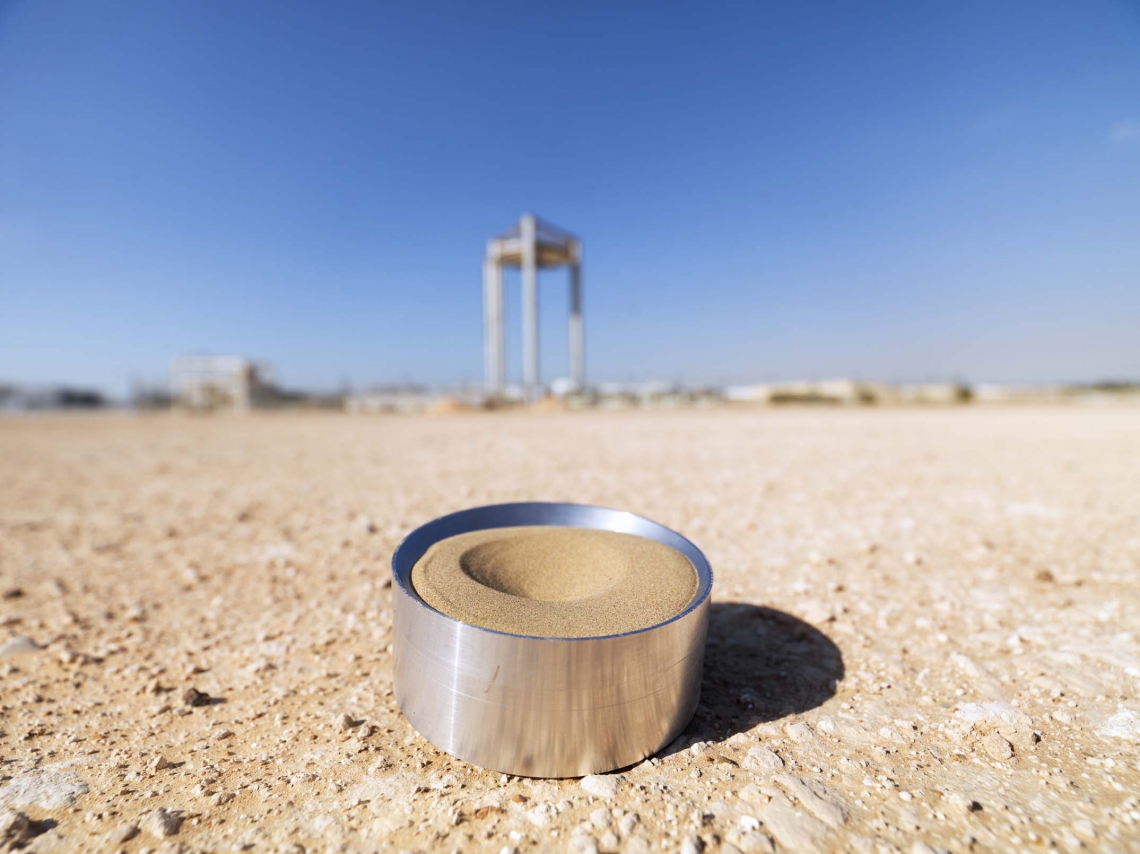
A third research project led by Dr. Calvet plans to leverage MISP to test a novel sand-based TES system, which is currently at lab-scale but has the potential to store thermal energy at higher temperatures, up to 1000°C. Being able to reach extremely high temperatures means hotter steam for the turbine – and more efficient electricity production. Utilization of waste with similar properties from the local steel and aluminum industries is also being evaluated as potential TES media.

A TES system based on such a local and natural material like sand or utilization of industrial waste also represents a new sustainable energy approach that is relevant for the economic development of Abu Dhabi’s future energy systems.

CONCLUSION

The innovative research and development outcomes produced by the MISP intend to lead to the creation of next-generation CSP and TES technologies that are more affordable and efficient, making thermal solar energy an increasingly viable option for solar power generation in the UAE and around the world, helping the UAE reach its innovative renewable energy ambitions.

MISP joins the Masdar PV testing facility as part of the Masdar Solar Hub – the first independent solar testing and R&D facility in the UAE established through a collaboration between Masdar and Masdar Institute – in bringing game-changing solar technologies to commercial maturity.

Erica Solomon
News and Features Writer
20 July 2016

Siemens Underscores Importance of Supporting UAE’s Entire Human Capital Pipeline

By Dietmar Siersdorfer

Technological innovations are not developed in a vacuum. They are the result of an innovation ecosystem that begins with primary schools that teach children a love of science and mathematics, and to high schools that provide academic rigor. It continues through to the higher-secondary level where colleges and universities provide the advanced training and opportunities for aspiring innovators to reach their dreams.

As an international brand focusing on innovation in electrification, automation and digitalization, Siemens understands the importance of these critical components of the innovation ecosystem. Without a vibrant and relevant educational system to inspire, train and guide young people into STEM fields, there would be no technicians, engineers, researchers and analysts to join our teams and develop our products. Education and training also play a key role in nurturing the understanding and value of innovation, which is key to building the market for innovative products.

That is why Siemens supports the development of youth in the UAE and around the world.  We believe a company that does not add value to society has no right to exist. With this in mind, we pride ourselves on ingenuity and on looking beyond mere profit-making to positively contribute to society through the transfer of knowledge via educational and training initiatives.

Here in the UAE, one of our most important markets, we pay particular attention to the entire human capital pipeline – from students, to university researchers, to hiring new local graduates. We are active participants in the UAE Youth Ambassadors Program, which was launched by His Highness Sheikh Mohammed bin Zayed Al Nahyan, Crown Prince of Abu Dhabi and Deputy Supreme Commander of the Armed Forces, to develop and prepare Emirati youth to lead partnerships with countries of strategic importance to the UAE and assume prominent positions in the country’s key sectors. Through this program we facilitate UAE National students on learning trips to Germany, where they visit Siemens facilities in Berlin and Munich.

Another part of the human capital development pipeline is the expansion of relevant and industry-appropriate undergraduate programs, to ensure graduates are able to find gainful employment. In this regard, Siemens is collaborating with Abu Dhabi Polytechnic for the implementation of its Mechatronic Systems Certification Program, which was recently awarded the first AHK Education Award from the German-Emirati Joint Council for Industry and Commerce (AHK). The Siemens Mechatronic Systems Certification Program is an international, industry standard comprehensive skills certification in mechatronic systems offered together with partner schools worldwide.

Of course, it is of vital importance that the education students receive be of relevance to their country and the wider world. To ensure that the specialized technical skills the UAE’s graduate students receive are directly relevant to local industry, we also engage in collaborative university research. Siemens has collaborated with Abu Dhabi’s leading research university focused on advanced technologies and clean energy, the Masdar Institute of Science and Technology, on a number of projects that are directly relevant to the country’s strategic goals. One of our earlier projects with the Institute investigated the use of renewable technology through testing and research to identify its applications in the Middle East region. The collaboration aimed to support the UAE’s goal of increasing the percentage of renewable energy in its energy mix to 24% by 2030.

We have also completed several research projects with Masdar Institute focusing on carbon capture, utilization and storage (CCUS), involving CO2 capture at gas-fired power stations with focus on equipment designs, waste handling and CO2 purification requirements for underground storage or enhanced oil recovery. This is an area of research that has multiple benefits, potentially helping mitigate climate change, reduce the UAE’s carbon footprint and contribute to the UAE’s goal of 70% enhanced oil recovery.

And at the end of the pipeline, when STEM-loving young graduates enter the workforce, Siemens is proud to hire them as the newest members of our own innovation community. Today, we employ some of the UAE’s latest engineering graduates. We currently have one Masdar Institute alumni at the Siemens head office, and another graduate who participated in a semester of study at Masdar Institute at our Denmark offices. This gives the UAE’s future innovators the opportunity to take what they’ve learned through their studies and student research, and apply it to advancing industry and having a real-world impact. We are proud to be part of the UAE’s human capital development and look forward to seeing our contributions to the education of the country’s young people bear fruit.

Dietmar Siersdorfer is CEO of Siemens Middle East and UAE

Printed in The Gulf Today on 4 June 2016

Energy-Efficiency for a “Smart” Mosque

As tens of thousands of worshipers pour into the UAE’s mosques each day, mosques witness significant increases in energy consumption, prompting researchers from the Masdar Institute to develop advanced sensor technologies that will make mosques “smart” and significantly more energy-efficient.

Mosques have long been an important part of the fabric of the UAE and could soon become an important contributor to the country’s sustainability efforts. Through advanced building automation technologies, “smart” mosques could help reduce the UAE’s energy and carbon footprint by reducing mosques’ overall energy consumption in a relatively simple and affordable way.

In the UAE, air-conditioning accounts for 60% of annual and 75% of peak-day electricity consumption. Thus any effort to reduce the country’s energy consumption, particularly air-conditioning consumption, will reduce not only the energy footprint but also the harmful carbon emissions emitted by the electrical power stations that power air-conditioners.

RATIONALE

An obvious solution to the country’s high energy demand  is to make sure that air-conditioners are used properly and optimally. Poorly maintained and improperly controlled air-conditioning equipment can lead to high levels of energy wastage – as high as 30% – in commercial buildings, which is why Masdar Institute has done prior work on air conditioning designs and standards that are most suited to the UAE. This work, done in collaboration with the Abu Dhabi Executive Affairs Authority, is now being further developed and piloted to achieve optimal air conditioning systems for the UAE. In conjunction with air conditioning system design, the overall control of cooling demand in buildings via sensors is also important and highly relevant to the country’s Mosques.

To address overall energy demand, the researchers must address the biggest challenge to managing mosque energy consumption, which is directly related to their unique usage patterns. Mosques experience sudden influxes of users at five specified times throughout the day, corresponding with the five daily Islamic prayers. Each of these occupancy times average less than an hour, with maximum occupancy occurring during the actual performance of each prayer, which lasts about 15 to 20 minutes.

A few exceptions to the typical daily mosque usage patterns include Friday prayer – the congregational prayer held every Friday – and Taraweeh prayer – the prayers held each night during the month of Ramadan – as well as other special occasions, such as lectures and seminar activities.

On most days though, mosques sit idle for a significant portion of the day, during which time they are either empty or nearly empty. Setting the air-conditioner controls to cool for the full occupancy requirements, or to be suitable for the low occupancy levels, may not only greatly impact the spiritual experience and physical comfort of mosque users, but also lead to high levels of energy wastage.

 For example, two of the appointed prayer times coincide with peak electricity usage in the middle of the day, when air-conditioning consumes up to 75% of the UAE’s electricity during the summer months. As the thousands of mosques spread across the UAE fill up with worshippers who require high levels of air-conditioning, demand for electricity is increased, which is why developing optimal energy management approaches to deal with cooling are essential to the UAE’s energy security.

“Often mosques choose one of two options to deal with air-conditioning,” explains Masdar Institute’s Assistant Professor of Computing and Information Sciences Dr. Talal Rahwan. “Either a mosque will leave the air-conditioner on all day, even when the mosque is empty. Or, the mosque will lower the air-conditioning when no one is present, and increase it again to a very high level once the mosque becomes full, which leaves the inhabitants hot and uncomfortable while they wait for the entire building to cool. Furthermore, turning the air-conditioning to a very high level to quickly cool the users is very inefficient and wasteful. Worse still, by the time the building becomes cool enough for comfort, the worshipers have left the mosque altogether.”

Dr. Rahwan and Dr. Sid Chi-Kin Chau, Assistant Professor of Computing and Information Sciences, are leading Masdar Institute’s “Smart Mosques” project. Their mosque-tailored sensors will help ensure mosques’ air-conditioning systems are consistently utilized in a more optimal way, so as to achieve thermal comfort with minimum energy requirements.

 PROJECT BRIEF

Many off-the-shelf sensors are being used to improve commercial buildings’ energy-efficiency in the UAE and around the world. However, the nature of mosques’ daily use benefits from sensors optimized for the unique mosque usage patterns and building parameters. The multiple peak times of sudden crowding followed by hours of dormancy, coupled with mosques’ open design, differentiate mosques from other buildings.

The customized sensor system developed by Dr. Rahwan and Dr. Chau is optimized specifically for mosques. By using sensor technologies equipped with processing capabilities on-site, the deployed systems  quickly learn the movements of the mosque’s occupants and the overall usage of a particular mosque. The fast and reliable processing power of the on-site computing enables the data to be processed in the mosque itself, avoiding the need of a large bandwidth connection to transfer all this data back to a remote server, a feature that makes the system easy and relatively cheap to install.

By using intelligent algorithms to analyze a video feed of the mosque, each smart sensor learns the times of the day when the mosque becomes full. It then automatically begins cooling the mosque slowly and efficiently prior to those times, so that once full, the mosque will be cool, allowing worshippers to pray comfortably, without requiring high-energy rapid cooling. Then, before the worshipers even start leaving the building, the system will switch off the air-conditioner in anticipation of their departure, resulting in lower energy consumption. This ability to forecast the future occupancy is what makes the mosques smart.

The team’s novel smart sensors are self-contained, affordable and adaptive, and have caught the attention of the UAE’s General Authority of Islamic Affairs and Endowments.

Masdar Institute has been working with the authority to get the smart sensor system installed and tested at a number of local mosques. Currently, the smart mosque sensor system is fully installed and being tested at two Abu Dhabi mosques – Masjid Fatah and Masjid Al Haq.

Fatiha AlBarqi, Head of Mosques Service Division, General Authority of Islamic Affairs and Endowments, said: “We expect that Masdar Institute’s smart mosque technology will minimize the power consumption of mosques while also helping with the overall management of the mosques.” 

The assistant professors are also supported by UAE National MSc student in Computing and Information Sciences Sarah Bamatraf. She developed a 3-dimensional simulation of the mosques, which is being used to test and fine-tune the sensor system under different weather conditions and occupancy patterns.

APPLICATIONS/IMPACT

Efforts to develop sustainable mosques are on the rise, as evidenced by the recent construction of Dubai’s AED 20 million Khalifa Al Tajer Mosque, dubbed the Islamic world’s first “eco-friendly mosque.” The LEED-certified mosque is equipped with energy-saving LED lights, water flow sensors and a climate control system to regulate air-conditioning.

While constructing eco-friendly mosques should be encouraged, what of the thousands of previously constructed UAE mosques? The Masdar Institute research team believes their sensors can be easily installed on these existing mosques at a relatively low-cost.

Additionally, the technology has a scope for further application. While the smart sensors currently focus on energy demand, they can be used to enable the system to detect malfunctioning air-conditioners and may eventually monitor water consumption and detect leaky water pipes.

“We are certain that the smart mosque technology can be expanded upon and modified further to include a range of sensing activities that will further help to create a truly sustainable, energy-efficient mosque,” said Dr. Chau.

The data generated by the sensor system has a diverse range of applications beyond reducing carbon emissions. For example, Bamatraf will be leveraging the data collected by the mosques’ sensors to develop a mobile application that will reveal occupancy rates in each mosque, which will help worshipers make informed decisions when selecting the mosque at which to pray. This app will help users avoid the uncomfortable experience of praying in an over-crowded mosque, especially during Friday prayers.

CONCLUSION

Turning the thousands of mosques in the UAE into “smart” mosques with optimized energy systems would not only give a critical boost to the country’s efforts to achieve higher levels of sustainability and lower levels of cooling demand, but also drive future growth in the country’s emerging technology sector.

Erica Solomon
News and Features Writer
15 June 2016

Alumni Spotlight: Building Software to Make Laboratories “Smart” and Sustainable

Dr. Hamzah AlZubi, a Class of 2011 MSc in Computing and Information Science (CIS) alumnus, has continued to build upon the expertise and insights he gained during his master’s studies to become an expert in the development of advanced artificial intelligence (AI) algorithms, which he now uses in his professional work in the UK to make laboratory automation systems faster, more powerful and smarter.

AlZubi, who was among Masdar Institute’s first class of graduates, believes that smart machines have a critical role to play in making people’s lives easier and more sustainable. That is why he studied machine learning and optimization techniques – two key computing technologies that make machines “smart” – during his graduate studies at Masdar Institute.  Dr. AlZubi continues to explore these AI systems in his current job at CSols Ltd., where he works to make “labs of the future” smarter.

“One of the grand challenges of engineering is being able to understand the human brain and design intelligent machines that replicate human intelligence,” explained Dr. Alzubi. “AI algorithms play a major role in our daily lives, from social media, online shopping, science, etc. With the rapid growth of data, big data algorithms are also required to analyze complicated data sets. The merging of these techniques – AI and big data – is vital to cope with a high data volume in a smart approach,” he added.

Before taking on his current position, Dr. AlZubi leveraged his advanced CIS degree from Masdar Institute to pursue a PhD in Electrical Engineering and Electronics from the University of Liverpool in the UK. While there, he developed a dynamic network of connected sensors, also known as “Internet of Things” (IoT) devices, for the aquaculture industry.

“We deployed smart sensors to collect information on the surrounding environment in an aquaculture system and fed the sensors with interactive AI algorithms, which were based on the cloud. The AI algorithms we developed interacted with the environment through an online learning platform, without having had any previous knowledge of it,” Dr. AlZubi explained.

The advanced, machine learning-based smart sensors Dr. AlZubi and his colleagues developed have been implemented by several groups in the University of Liverpool, Salford University, and some local companies as well, including in the NHS Alder Hey Children’s Hospital in Liverpool-UK.

The young Jordanian credits his experience at Masdar Institute for the complex problem-solving skills, analytical thinking abilities, awareness of sustainability, and technical computing skills – particularly in the areas of machine learning and data analytics – that contributed to his doctoral degree achievement.

Dr. AlZubi’s challenging master’s thesis pushed him deeper into the computing field. His thesis work focused on the development of a novel brain computer interface (BCI). This system allows direct communication between the brain and a computer through the development of appropriate machine learning and signal processing tools. He also contributed to a Masdar Institute project to optimize the design of a hybrid solar-wind energy plant.

After receiving his PhD in 2015, Dr. AlZubi stayed at the University of Liverpool as a postdoctoral researcher for a year and a half. During that time he helped develop real-time, multi-object 3-dimensional tracking algorithms and automatic biometric systems, which are technological systems that use information about a being to identify that individual. He also spent time on another project during his postdoc posting, developing optical techniques to detect the degeneration of algorithms used to monitor transformer oil (the mineral oil used in power transformers), which plays an important role in fault diagnosis of electrical power transformers.

Now, AlZubi is employed as a product developer for the UK-based CSols Ltd., a laboratory informatics company that develops laboratory software solutions to optimize laboratory run costs and turnaround times, and enhance laboratory quality control.

For the last three months, Dr. AlZubi has been developing AI agents and big data applications for automated labs. He also works with a team of researchers developing solutions to manage and reduce a laboratory’s carbon footprint. He is currently co-supervising two PhD students from the University of Liverpool as part of a collaborative research project between the University and CSols Ltd.

“I believe today’s laboratory operations can be optimized and managed using both AI and big data techniques. Also, several relationships and dependencies can be revealed within the massive volume of laboratories’ data around the globe. So, we currently develop big data techniques to estimate and optimize laboratory carbon footprint and manage laboratory operations,” explained Dr. AlZubi.

Dr. AlZubi, now leveraging his advanced research capabilities to support the high-tech industrial sector, exemplifies Masdar Institute’s vision of developing high-caliber human capital for the development of smarter, more sustainable, technologies.

The computing specialist plans to continue developing innovative solutions to help make industrial laboratories smarter and more sustainable, and hopes to be able to deploy these solutions to laboratories around the globe soon.

Erica Solomon
News and Features Writer
24 July 2016

Clean Energy on the Region’s Agenda

By Dr. Steve Griffiths 

Although the energy sector has historically been slow to evolve and is generally lacking in innovation, this is quickly changing.

Today we are seeing significant energy sector innovation, stimulated by key trends that include diversification of energy resources, increasing amounts of clean energy deployment, distribution of energy production to include simultaneous producers and consumers of energy, and a strong global commitment to climate change and sustainability as demonstrated by the outcomes of the recent Paris climate conference (COP21).

These driving forces for energy system innovation have been paralleled by advances in the information, biological and material sciences, which are redefining how energy systems can and will function in the future.

The urgency for clean energy innovation at the national and regional levels is evident from the 2015 launch of Mission Innovation, an initiative in which 20 countries and the EU have committed to doubling their government-led clean energy research and development investments over a five-year period. The specific focus of this effort is to achieve transformational clean energy technology innovations that are scalable in a variety of economic and energy market conditions.

The way in which Mission Innovation countries and others address clean energy innovation depends on the relative prioritization given to factors such as economic growth, energy access and security, and climate change.

DEMAND GROWTH

If we consider the GCC countries, several factors are supportive of clean energy innovation, but perhaps the most relevant is the need to meet the rapid growth in power demand.

GCC electricity consumption grew at an average rate of more than 6% a year in the decade between 2003 and 2013, as a result of population growth and urbanization, rising income levels, industrialization and low electricity prices.

This sharp rise in power consumption has resulted in substantial demand for new production capacity. At present, fossil fuels are the only natural resource used to fuel power generation capacity; about 60% of the region’s installed capacity is based on natural gas-fired power generation and the remaining 40% on the burning of liquid fuels such as crude oil, diesel and heavy fuel oil.

The opportunity cost of burning oil products for power generation rather than being exported or used in higher-value products is clear. The rising marginal cost of natural gas extraction in the region has made gas-fired power generation increasingly costly and unsustainable. So transitions toward clean energy are needed.

As an indication of the urgency of the situation, both the UAE and Saudi Arabia have joined Mission Innovation and have made commitments to hike up spending on clean energy innovation and thus raise the levels of clean energy within their national energy systems.

LOCAL SOLUTIONS

In order to realize a national energy system transition, the import of commercially available technologies alone is not sufficient. Research and development is essential for bringing technological solutions into a local context and stimulating the formation of a trained local workforce capable of deploying these technologies.

This is accomplished by the establishment of a clean energy innovation system that spans from fundamental research to market-driven technology deployment. Of particular importance to such a system is collaborative, “use-inspired” fundamental research that builds on advancements in fundamental science to achieve innovation in targeted application areas.

Collaborative, use-inspired research has been a hallmark of Abu Dhabi-based Masdar Institute of Science and Technology’s (Masdar Institute’s) research strategy and has allowed us to have an impact across the energy spectrum.

A clear example within the GCC context is the work that has been done on advanced cooling technologies. Air-conditioning (AC) accounts for as much as 60% of annual and 75% of peak-day electricity demand in GCC countries. Hence it is essential for regional AC systems to meet minimum energy performance standards (MEPS) that are tailored to regional climate conditions.

However, this has historically not been the case, contributing to the unsustainable electricity supply and demand situation. In response, the Masdar Institute and Abu Dhabi’s Executive Affairs Authority (EAA) initiated in 2012 a collaborative research program to identify new standards and designs for regional AC systems.

Through this collaborative, use-inspired research program, a new design has been identified that can potentially save more than 10% of UAE domestic energy consumption with accompanying financial savings. The design is now being further demonstrated in Masdar City with the intent of commercialization with an industrial partner. With clean energy innovation now an international priority, collaborative, use-inspired research will be an increasingly visible global trend. 

Dr. Steve Griffiths is Vice President for Research at the Masdar Institute of Science and Technology

18 July 2016

This op-ed was first published in MEED Business Intelligence on 22 June 2016

Research Leverages Graphene’s Strengths to Advance Key UAE Sectors

The unique and valuable properties of graphene – a wonder material noted for its strength and electrical conductivity – are being leveraged by Masdar Institute researchers to help advance technologies of relevance to strategic local industries like oil and gas and desalination.

“The graphene market is still relatively new and in the early stages of development with only a few products being commercialized to date. However, strong growth of graphene and other related 2-dimensional materials is expected due to superior strength, weight, conductivity, and transparency properties. That is why Masdar Institute is working to utilize graphene to develop new membranes, sensors and composites,” said Dr. Steve Griffiths, Vice President for Research and Interim Associate Provost at Masdar Institute.

One such project is co-led by Dr. Irfan Saadat, Professor of Electrical Engineering, and Dr. Amal Al Ghaferi, Assistant Professor of Materials Science and Engineering. They are using graphene and carbon nanotubes to develop smart sensors for deployment in oil and gas pipelines. The research is part of a collaboration with ADNOC and the Petroleum Institute and aims to detect and monitor the build-up of scaling or impurities inside gas and oil pipelines.

Graphene and carbon nanotubes were used to make the scale sensors using two different synthesis methods. These sensors will help oil and gas plants operate at optimized levels and thus recover more oil from their pipelines. This will improve the operational efficiency of the UAE’s oil and gas industry, which is a vital pillar of the economy.

“Given that graphene is a 2D material, it has very unique properties that are not available in typical bulk-3D materials. These include the fact that it is highly conductive, very strong, thermally conductive and transparent. They also are inert and chemically and thermally stable, which opens a wider window for hostile environment applications,” Dr. Saadat explained.

Graphene is made of a single layer of carbon atoms. Its unique structure – a repeating pattern of hexagons – lends it some very unique physical and electromechanical characteristics. It is said to be the strongest material in the world and electrons move through graphene so quickly they appear to be massless. These characteristics result in a material that has the power to transform electronics, computing and many other technologies.

Dr. Saadat and Dr. Al Ghaferi are also contributing to a collaborative graphene research project with the University of Manchester that is being led by Dr. Ibraheem Almansouri, Assistant Professor of Microsystems Engineering at Masdar Institute. The project is exploring the use of inkjet-printed graphene micro-sensors that can be used in the energy applications targeting oil and gas sector. By leveraging inkjet printing, which is a low-cost and mass scalable material production method, this project aims to make the fabrication of graphene sensors easy, affordable, portable, and flexible. Dr. Almansouri said: “The success of fabricating these inexpensive and flexible sensors relying on the favorable properties of graphene will expand the application domain upon the completion of this project.” The project is part of a collaborative partnership the University of Manchester, which is the institute credited with discovering graphene. The joint research program focuses on “pre-competitive” research in graphene and related 2D materials for sensors, membranes and composites for the aerospace, defense and energy markets.

Graphene also has the potential to improve the way the UAE produces freshwater from seawater.  French environmental resource company Veolia has sponsored a project led by Dr. Linda Zou, Professor of Chemical and Environmental Engineering, to leverage graphene’s excellent electrical properties to improve the effectiveness of capacitive deionization (CDI). CDI is a desalination technology that uses an electric charge to remove salt from water, which is potentially a less energy intensive desalination process than those that rely on heat, chemicals or high-pressure membrane systems.

Masdar Institute students are also helping to advance the applications of graphene to strategic UAE sectors and real-world challenges.

MSc graduate and current PhD student Chia-Yun Lai’s Master’s thesis research characterizing the surface wettability of graphene and fish scales garnered significant attention from the scientific community.

Surface wettability is the ability of a liquid to maintain contact with a solid surface. It is important in a number of applications of relevance to the industries targeted in the UAE, including development of semiconductor wafers, electronics, plastics, etc.

As part of her research, conducted under the guidance of her faculty advisor Dr. Matteo Chiesa, Lai developed a new wettability investigation technique and tested its ability to study wettability of graphene and fish scales at the nano level. Through her research Lai joined the first investigators around the world to establish the relationship between different length-scale wettability measurements for improved spatial resolution. Her work resulted in five papers published, including four peer-reviewed journal papers, and one conference paper.

Beyond sensors and composites, graphene is expected to be integral to the next innovations in wearable electronic devices, aviation components, broadband photodetectors, radiation-resistant coatings, and energy storage. According to research in ‘Graphene Markets, Technologies and Opportunities 2014-2024,’, the markets for graphene will grow from around US$20 million in 2014 to more than US$390 million in 2024.


Zarina Khan
Senior Editor
23 June 2016


Space-Related Research Earns NASA’s Praise

NASA Administrator Charles Bolden believes that Masdar Institute’s Master’s concentration in Space Systems and Technology is a comprehensive program with a vision to supply the UAE with the human capital needed to position the country as a regional leader and a global player in the space sector, which he expressed during his visit to the Institute earlier this month.

Bolden lead a NASA delegation to Masdar Institute the day after he signed a momentous space and aeronautics cooperative agreement with the UAE Space Agency. The purpose of Bolden’s visit was to get a closer look at some of the cutting-edge research activities at the Institute aimed at contributing to the UAE space sector and aligned with the space technologies and systems that the joint UAE-US agreement seeks to advance.

The delegation included Albert Condes, Associate Administrator for International and Interagency Relations at NASA; La’Shanda Holmes, White House Fellow at NASA; Dr. Matthew Koeppe, International Program Specialist in NASA’s Office of International and Interagency Relations; Stephanie L. Schierholz, Press Secretary for NASA; and Michelle Su, Economic Assistant at the U.S. Embassy Abu Dhabi. As part of their visit they toured the Institute’s cutting-edge undercroft laboratories, including the micro and nano fabrication facility, the microscopy lab and the materials testing lab, and were shown several innovative space systems-related research projects.

Dr. Saif Al Mheiri, Assistant Professor of Mechanical and Materials Engineering, Masdar Institute, provided an overview of the Institute’s Master’s Concentration in Space Technologies and Systems and the important role the region’s first specialized concentration of this kind will play in creating the technologies and human capital needed to advance the UAE’s space goals.

“By integrating both the practical aspects – which involves designing and building a mini satellite, or CubeSat – and educational aspects into the students’ research, we are truly advancing the local space R&D sector,” Dr. Al Mheiri shared.

He also explained the important mentorship role the program’s industry partners, namely YahSat and Orbital ATK, are providing to ensure the quality and continuity of the space program.

The NASA delegation also learned about the impressive array of data gathered by the Institute’s Research Center for Renewable Energy Mapping and Assessment (ReCREMA). ReCREMA gathers real-time satellite data from NASA and European Space Agency (ESA) satellites. This data is currently used in many operational earth observation products and tools with a special focus on desert and arid climate such as urban heat island studies; monitoring oil spills, algal blooms, solar and wind resources, dust storms and land-atmosphere interactions; and modelling of hydro-meteorological variables.

Dr. Hosni Ghedira, Director of ReCREMA and Professor of Practice, Dr. Marouane Temimi, Associate Professor of Chemical and Environmental Engineering, and PhD student Maryam Rashed Al Shehhi, presented and discussed the valuable satellite data and environmental monitoring tools the Center develops.

“It is very humbling to meet the pioneers of the field,” Al Shehhi shared. “This visit is very important for our future work because the feedback from these experts, and their assurance of future input, is going to help mold and guide our future work.”

ReCREMA was selected by NASA in June 2011 as one of seven global pre-launch test sites for a new Earth observation satellite called Soil Moisture Active Passive (SMAP), which was launched by NASA in January 2015 (smap.jpl.nasa.gov). Through a joint four-year pilot study, ReCREMA will contribute to a greater understanding of how the level of soil moisture affects dust emission in desert and dry environments.

“The results of this study will be of significant value to NASA. Through the new collaboration between NASA and the UAE, ReCREMA will be able to contribute and share our research findings for more optimized earth observations, which could lead to innovative new satellite systems and technologies,” Dr. Ghedira added.

Al Shehhi briefed the NASA delegation on her research, which aims to develop regionally-adapted algorithms for coastal water quality monitoring by using NASA satellite imageries received at the Masdar Institute satellite receiving station.

The visit concluded at the Institute Center for Innovation (iInnovation), where the delegation heard presentations from the Institute’s Space Systems and Technology students. They enjoyed a short presentation on the mission of the Institute’s first CubeSat (MYSAT1), which was a remote sensing and technology demonstration. Master’s student Mariam Mansouri also presented her project titled “3D printed miniaturized gyroscope for space applications” – which aims to enhance the functionalities of miniature, self-navigating sensors – which particularly piqued Bolden’s interest.

“The visit by NASA Administrator Charles Bolden was not only a great opportunity for me to hear from his expertise in space science innovations, but it was also an opportunity to present my area of research in 3D printed gyro cubes for space applications,” Mansouri shared.

“Bolden showed great interest in my research, and he was even more impressed when he was told that I’m a grandmother who has returned to school and research after spending more than 25 years in the education sector. Bolden encouraged me to continue my graduate studies and conduct my PhD in the area of my interest. His words and encouragement inspired me a lot and gave me more passion and persistence to accomplish my research goals at Masdar Institute,” she added.

Bolden looks forward to further collaborations between NASA and Masdar Institute to advance sustainable technologies, satellite systems, and peaceful space exploration and discovery.

Erica Solomon
News and Features Writer 
26 June 2016

Masdar Institute’s Innovative Wastewater Treatment Technologies to Help Meet Growing Freshwater Demand Sustainably

Researchers at the Masdar Institute of Science and Technology are developing innovative wastewater treatment technologies that could improve the UAE’s water infrastructure and strengthen the country’s position as a global leader in treated wastewater reuse. 

Treating and reusing wastewater is an obvious need in a country with severe water scarcity, such as the UAE. For over twenty years, the UAE has relied mainly on seawater desalination to overcome its freshwater resource shortage. Today, high economic and environmental costs of desalination have necessitated the pursuit of alternative freshwater production methods. Wastewater recovery – a process that can be significantly more affordable than desalination – is considered one of the more promising ways to meet growing non-potable freshwater needs.

Currently, Abu Dhabi uses 60% of its treated wastewater for landscaping and industrial purposes. The remaining 40% is released back into the Gulf, due to limited capacity of the resupply distribution networks.

Masdar Institute aims to support the development of new wastewater treatment technologies for the UAE as well as provide new insights into optimal approaches for wastewater reuse. Such technologies and insights could help the country further achieve its ambitious wastewater treatment and reuse targets.

“In a water-scarce region that relies heavily on costly and energy-intensive seawater desalination to provide over 80% of the country’s freshwater, innovations for effective wastewater treatment are critically important to help meet the country’s growing demand for water,” explained Dr. Behjat AlYousuf, Interim Provost, Masdar Institute.

In Abu Dhabi, per capita water consumption has always been among the highest in the world, but now the emirate is consuming over 24 times its natural recharge rate – which refers to ability to naturally replenish groundwater reserves. This unsustainable level of water consumption underpins the UAE’s need to develop a robust water infrastructure.

“Masdar Institute aims to stay at the forefront of  wastewater treatment research given its pivotal role in developing a robust water system in the UAE,” said Dr. Steve Griffiths, Vice President For Research, Masdar Institute.

“The wastewater treatment and reuse research conducted by our faculty contributes to the development of sustainable water resource management in the UAE,” he added.

Faculty and students from Masdar Institute’s Center for Water and Environment (iWater) and the Institute Center for Smart and Sustainable Systems (iSmart) are developing a range of innovative technologies and solutions to treat Abu Dhabi’s municipal and industrial wastewater in a sustainable and cost-effective way to help the country meet its various freshwater needs.

WASTEWATER AND HEALTH

Monitoring and protecting treated wastewater quality for human and ecosystem health is imperative. Removing harmful contaminants – including organic and inorganic compounds, microorganisms, and radioactive elements – from wastewater is the ultimate goal of a wastewater treatment plant.

Using treated wastewater for cooling and landscaping frees up potable water that can be used elsewhere, such as for household use. However, with groundwater levels depleting and population rising, extending the use of treated wastewater beyond cooling and landscaping to reuse in edible crop agriculture is a key way to sustainably meet growing freshwater demands in the UAE.

In order to ensure that treated wastewater is clean enough for crop irrigation, Dr. Farrukh Ahmad, Associate Professor of Chemical and Environmental Engineering, Dr. Jorge Rodriguez, Associate Professor of Chemical and Environmental Engineering, and Dr. Andreas Henschel, Assistant Professor of Computing and Information Science, have developed new tools to characterize pathogens, which are disease-causing contaminants present in treated wastewater.

Their innovative research is focused on determining the wastewater quality – in terms of microbiological safety – so it can be decided whether the wastewater needs additional cleanup before it can be recycled back into our food production chain through edible crop irrigation.

The team employed the newly developed tools to test the treated wastewater at the Mafraq Wastewater Treatment Plant for pathogens at three different stages of treatment and after chlorine disinfection.  A risk assessment was administered to determine whether adverse health effects, specifically outbreaks of the bacteria Salmonella, can result from consuming food irrigated with this treated effluent.

“We hope to establish new methods and standards for determining water quality that can be applied across the country with the help of government agencies in Abu Dhabi,” Dr. Ahmad said.

These standards could then be used to maintain quality standards for treated wastewater for food crop irrigation in the UAE.

Another promising research project being led by Dr. Linda Zou, Professor of Chemical and Environmental Engineering, seeks to produce freshwater suitable for agricultural use through an innovative hybrid approach, which combines two technologies – nano-filtration membranes and reverse osmosis.

“Relying on membrane processes alone, such as reverse osmosis, not only removes the contaminants, but also some beneficial nutrients,” Dr. Zou explained. “Through our hybrid approach, which involves the use of ion selective nano-filtration membrane processes combined with reverse osmosis to help filter the water, we are able to retain some of these valuable nutrients in the recycled water, which can then be used for both agricultural and industrial uses.”

The novel approach removes salt and other pathogens from the wastewater, while retaining the nutrients – such as plant fertilizers, calcium, magnesium and sulfur – needed to promote healthy plant growth, making it ideal for agricultural farms and horticulture nurseries. Dr. Zou has demonstrated the success of the nano-filtration and reverse osmosis membranes at Masdar Institute’s membrane pilot plants.

NANOTECHNOLOGY

Quality standards are just one of many aspects to achieving the goal of increased wastewater reuse in the UAE. Another aspect is ensuring those standards can be efficiently and effectively met.

Innovations in nanotechnology are offering a lot of potential to advance water purification technologies in this regard, producing systems that are significantly more effective at removing microbes and other contaminants that live in wastewater.

Masdar Institute is capitalizing on recent materials advancements and leveraging their expertise in the field to develop cutting-edge wastewater treatment technologies that utilize a range of nanotechnologies.

One such project is being led by Assistant Professor of Chemical and Environmental Engineering Dr. Shadi Hasan. The project is a collaboration with the Massachusetts Institute of Technology (MIT) and seeks to produce high quality freshwater by coupling nanowire filtration – filters made of thin, manganese dioxide and titanium dioxide nanoparticles – as a post-treatment process with bio-electrochemical treatment – whereby microbes break down organic matter in anaerobic conditions, producing free electrons for electricity.

“The nanowire material developed through this project has already demonstrated a strong ability to eliminate the pollution caused by the presence of heavy metals and organic contents in wastewater,” Dr. Hasan said. “An integration technology combining this with the state-of-art bio-electrochemical system offers great potential for wastewater treatment.”

Together, the nanowires and the electrically active microbes effectively filter out much of the organic and inorganic contaminants, as well as heavy metals and harmful microbes.

Another innovative water project that leverages nanotechnology to produce high quality freshwater is being led by Dr. Ahmad. The project aims to remove contaminants from wastewater using a sustainable approach involving a filter made of carbon nanotubes and titanium dioxide nanospheres. By attaching titanium dioxide nanospheres onto a filter made of a water-permeable bed of carbon nanotubes, the contaminants in the wastewater are adsorbed – meaning they stick to the carbon bed. Once the carbon bed can no longer adsorb more contaminants, it can be easily cleaned by shining a light onto the light-reactive titanium dioxide particles to stimulate contaminant degradation.

A patent application was filed for this innovative technology, which is designed to remove pharmaceutical contaminants from wastewater. The technology has proven successful at removing a number of harmful pharmaceuticals that are commonly flushed down toilets and released into the water stream, including anti-depressants, anti-psychotics, Alzheimer’s medicines, Parkinson’s medicines, and many others.

REDUCING COSTS

In order to reduce the operational cost and energy footprint of wastewater treatment plants, Masdar Institute is researching advanced water technologies that are both more affordable and more energy-efficient.

One such project is being led by Dr. Hasan and it aims to produce high quality effluent at a low cost through the use of a submerged membrane electro-bioreactor (SMEBR). In a SMEBR device, biological processes, membrane filtration and electrocoagulation – which is a water treatment process that uses an electric current to remove various contaminants from water – take place simultaneously, significantly reducing membrane fouling and increasing the amount of clean water produced.

Fouling – the unwanted build-up of salt and bio-material on desalination membranes – is a major challenge to the widespread application of membrane technology in wastewater treatment. By reducing fouling by eight times compared to conventional membrane bioreactors (MBRs), the SMEBR is able to generate higher quality treated wastewater while consuming less energy than conventional membrane-based treatment technologies. The incorporation of enhanced biological processes and electrocoagulation also reduces the system’s dependency on high-pressure pumps, resulting in a more affordable and energy-efficient plant.

SMEBR has already been proven successful in North America, but has never been tested in arid and hyper-arid climates like the UAE. Dr. Hasan is currently leading the design of a SMEBR to withstand the UAE’s harsh environment. Preliminary results of the lab-scale SMEBR unit being installed at Masdar Institute show that the innovative device has great potential as a wastewater treatment technology for the UAE. Dr. Hasan is currently developing a mobile, hybrid wastewater system using the SMEBR technology that can be installed in every house, building or small community.

Another Masdar Institute project that aims to reduce both operational costs and carbon footprint of wastewater treatment is sponsored by the National Research Foundation and is being led by Dr. Rodriguez. The project aims to support the development of more efficient nitrogen removal from Abu Dhabi’s high temperature and saline wastewater.

Removing organic pollution and nitrogen from wastewater can account for 30% to 60% of a wastewater treatment plant’s operation costs. In an attempt to make nitrogen removal more efficient, Dr. Rodriguez has collaborated with VeBes O&M – a wastewater treatment plant operating and maintenance company – to develop a mathematical model that identifies opportunities for a smaller energy footprint treatment operation.

The detailed model studies the interactions between the microbial metabolisms involved in the nitrogen cycle and the impact of high temperature and high salinity, which is characteristic of most of UAE’s wastewater, on the performance of the microbes that catalyze the removal of nitrogen.

Reducing a wastewater treatment plant’s operational cost and energy demand is pivotal to the economics of wastewater recycle. Water treatment-based innovations that reduce such costs are  key to the country’s future water security.

WASTEWATER STORAGE

The United Nations defines water security as the capacity of a population to safeguard sustainable access to adequate quantities of acceptable quality water for sustaining livelihoods, human well-being, and socio-economic development, for ensuring protection against water-borne pollution and water-related disasters, and for preserving ecosystems in a climate of peace and political stability. Critical to the UAE achieving its goal of water security then is improving access to freshwater reserves.

Due to the growing consumption rates of the UAE’s freshwater, the country’s limited natural groundwater resources have been drying up. Scientists at Masdar Institute have determined that the UAE’s groundwater is not sufficiently replenishing itself due to a combination of over-pumping and a high evapotranspiration rate. These factors combine to reduce the country’s ability to maintain adequate freshwater reserves. Treated wastewater, however, may help overcome this challenge.

In order to help Abu Dhabi achieve a truly sustainable water infrastructure, Dr. Ahmad has proposed to not just treat wastewater, but to store it in an innovative way — underground through a process known as managed aquifer recharge (MAR). In MAR, treated wastewater is pumped back into emptied natural aquifers.

By storing the treated water underground instead of above ground, it can be preserved from losses caused by the high evapotranspiration rates, which refers to soil evaporation and plant transpiration.

Additionally, MAR may actually improve the quality of the treated wastewater by storing it with groundwater, which contains natural microbial communities that play an important role in maintaining water quality. Pumping treated water back into the UAE’s depleted aquifers can also help preserve the country’s soil and water resources by preventing the intrusion of saltwater, which occurs when groundwater has been over pumped.

“MAR may be the key to helping the UAE reach 100% wastewater re-use. When treated wastewater is produced in excess of what is needed at the time, MAR ensures its proper storage so that it can be used when needed, without being wasted,” said Dr. Ahmad.

While desalination is a  key approach the UAE has relied upon to overcome its freshwater scarcity, wastewater treatment is equally important for achieving water security. 

The existing gap between freshwater demand and supply in the UAE can be further closed by  treated wastewater reuse, which is why Masdar Institute researchers are pursuing a range of wastewater treatment approaches to make wastewater treatment safer, cheaper, and more environmentally friendly.

By leveraging its faculty’s expertise as well as its state-of-the art labs and resources, Masdar Institute is developing cutting-edge wastewater treatment knowhow and systems, directly contributing to the development of the resilient water infrastructure that is critically needed for the UAE’s continued economic growth and prosperity.

Erica Solomon
News and Features Writer
27 June 2016 

Masdar Institute among Top 20 in 2016 US News and World Report’s Best Arab Region Universities Rankings

The Masdar Institute of Science and Technology has moved up to the 14th spot overall in the 2016 US News and World Report Best Arab Region Universities Rankings, up from the 23rd position last year.

The research-based institution has also edged up to fifth spot in the ‘Energy’ field, eighth in Chemistry, and ninth in Engineering, while being ranked tenth in both ‘Environmental Science’ and ‘Materials Science’. In the ‘Academic Reputation’ category, Masdar Institute is ranked eighth in the region by the US News and World Report.

To be included on the US News and World Report’s reputation surveys, a university must have approximately 400 papers or more published in the five-year period from 2009 through 2013, as measured by Scopus, the largest abstract and citation database of peer-reviewed literature including scientific journals, books and conference proceedings. As of January 2016, Masdar Institute has already published over 1,000 articles in peer-reviewed journals, and more than 600 conference papers.

The Best Arab Region Universities rankings are based on data and research metrics provided by Scopus, which is part of the Elsevier Research Intelligence portfolio. The overall rankings also draw on ratings of schools (universities) by academics and employers in the region who were surveyed by Ipsos, a global market research company based in Paris.

Dr. Behjat Al Yousuf, Interim Provost, Masdar Institute, said: “Masdar Institute’s ranking by the 2016 US News and World Report Best Arab Region Universities Rankings strongly indicates that we are committed to advancing UAE and Abu Dhabi’s intellectual capital through advanced research and development. We will continue with our efforts to create high-value human and intellectual capital in advanced energy and sustainability fields, while helping to place the UAE at the forefront of research and innovation that address the needs of Abu Dhabi and the globe.”

The second edition of the overall rankings covers 124 universities spread across 18 countries, up from 91 universities in 16 countries included in the inaugural rankings last year. The academic institutions are ranked based on their academic research performance and, for the first time this year, on their reputations.

Since inception, Masdar Institute has steadily increased its intellectual property in clean energy, advanced material, and water and environmental engineering areas. Currently, Masdar Institute has 10 registered US patents, over 70 pending patent applications, and over 120 invention disclosures from faculty and students, firmly establishing its place as a leader in intellectual capital development in the UAE.

Masdar Institute has also secured over US$72 million (around AED264 million) in industry and government sponsored research contracts with more than 50 organizations (50% in the UAE), with a strong pipeline of new agreements planned for 2016.

Clarence Michael
News Writer
29 June 2016

Masdar Institute’s 2016 PhD Graduates Ready to Help Solve Global Climate, Water and Energy Challenges

Masdar Institute’s Class of 2016 PhD in Interdisciplinary Engineering graduates earned attention and accolades from academic communities locally and abroad for their pioneering sustainability-focused research, strengthening Masdar Institute’s position as a regional research and development leader of advanced energy technologies.

The PhD graduates have contributed valuable research findings to science through their innovative research activities and award-winning research papers and posters, which were published in esteemed scientific journals and presented at prestigious international conferences. The graduates are expected to leverage their advanced engineering doctoral degrees to contribute further to the development of sustainable technologies critically needed to solve some of the world’s most pressing climate, water and energy security challenges. 

Dr. Youssef Shatilla, Dean of Academic Programs at Masdar Institute, said: “The high-caliber, multi-disciplinary research conducted by our PhD graduates reflects the Institute’s exceptional interdisciplinary doctoral degree program, which aims to produce graduates capable of solving today’s complex problems. With their sharpened skills and knowledge, we believe these PhD graduates will make a difference in the field of sustainable technologies, locally and globally, advancing Masdar Institute’s mission to support sustainability.”

Class of 2016 PhD graduate Noura Al Dhaheri, who received her MSc in Engineering Systems and Management from Masdar Institute in 2011, is the first female in the Middle East to receive a doctoral degree in the field of seaside operations. During her PhD studies, Al Dhaheri developed a mathematical model to optimize the efficiency, safety and sustainability of the container terminals at Khalifa Port. The novel model provides optimal solutions for the scheduling problems faced during the loading and unloading of containers using quay cranes. The model will drastically reduce the amount of time a vessel is required to spend at the container terminal, which in turn will lead to significant energy, cost and environmental savings.

The UAE national received the distinction of having four research articles based on her thesis work published in top journals in her respective field, including the Journal of Manufacturing Systems in 2015, Computers & Industrial Engineering in 2016, Simulation Modelling Practice and Theory in 2016 and Annals of Operations Research in 2016.

Al Dhaheri is currently General Manager at Maqta Gateway at Abu Dhabi Ports, where she is working to optimize port transport and logistics operations.

Acknowledging the role Masdar Institute plays in preparing its students for future careers, Al Dhaheri said: “Masdar Institute’s focus on using applied research to solve industrial-based problems gives its students a serious competitive advantage, and equips them with the skills needed to enter the workforce and contribute to the development of sustainable solutions for real-world problems.”

Class of 2016 PhD graduate Carlo Maragliano is also already leveraging his degree as the Head and Director of the Research and Development Department of Solar Bankers LLC, an Arizona-based company that is developing a photovoltaic system for improved sunlight conversion.

Maragliano’s thesis research focused on a novel method for converting more of the sun’s electromagnetic spectrum into usable electrical energy. His research won best paper award from the Journal of Optics in September 2015. The Italy-native has co-authored over ten research articles, which have appeared in several esteemed scientific journals, including Nature Scientific Reports, Carbon, and Journal of Applied Physics.

Reminiscing on his Masdar Institute experience, Maragliano said: “I will never forget that Masdar Institute believed in me by giving me the chance to present my research at several international conferences and to conduct research in top American universities, including MIT and Boston Universities, with some of the world’s most brilliant people.”

Class of 2016 PhD graduate Majid Khonji focused his thesis research on improving the reliability and security of smart grids. The UAE National has had three papers based on his thesis research published in conference proceedings, with three research papers currently under review for publication in scientific journals.   Khonji leveraged computer science approaches to devise efficient algorithms to address a number of power systems challenges. His results provide practical and efficient algorithms to optimize the power allocation in large-scale power networks, which can aid in meeting the UAE’s goal of achieving a 24% share of clean energy production capacity in the country’s overall energy mix by 2021.

Khonji offered future doctoral candidates the following advice: “A PhD is the beginning of a researcher’s career. Therefore, a student should focus more on learning techniques rather than flashy applications, making actual scientific impact rather than media impact, and world-wide contribution more than small-scale local contribution.”

Sanaa Iqbal Pirani, who received her MSc in Materials Science and Engineering from Masdar Institute in 2012, is another Class of 2016 PhD graduate whose innovative research has garnered attention from scientific and industrial communities.

Pirani’s thesis research, which examined the issue of food waste in the UAE, earned the award for best presentation in the “Sustainable Cities and Infrastructure” scientific sessions at the 2013 World Resources Forum (WRF) and waste-mitigating food dish design she developed won the Hospitality Innovator Award at the Hospitality Technology Forum 2015.

The Canadian is grateful for the experiences and opportunities Masdar Institute offered her.  “Joining Masdar Institute was one of the best decisions I have ever made; it has helped shape my life in amazing ways. The opportunity to be part of the Masdar Institute community is one that many of us take for granted, yet is one that we will surely miss once we leave the Institute,” Pirani said.

She plans to leverage the knowledge and expertise gained during her studies at Masdar Institute to help make the UAE’s waste management sector more sustainable.

Other award-winning PhD graduates include Wala Saadeh, whose innovative hearing aid research won two awards at the International Symposium on Circuits and Systems (ISCAS); Nazek El-Atab, who received the 2015 L’Oréal-United Nations Educational, Scientific and Cultural Organization (UNESCO) For Women in Science (FWIS) Middle East Fellowship award; and Sabina Abdul Hadi, who won Best Poster Award in the “Light Management and Avant Garde Concepts” category at the 42nd IEEE Photovoltaic Specialist Conference (PVSC-42).

With this batch of PhD graduates ready to enter the workplace, either in industry, government or academia, Masdar Institute has demonstrated the success of its interdisciplinary doctoral degree program to cultivate expertise in its graduates, who are now ready to solve complex and relevant scientific and technical challenges locally and abroad.

Clarence Michael and Erica Solomon
News Writer and Features Writer
13 July 2016

Tapping the Earth’s Energy for Zero-Carbon Seawater Desalination

In a country of abundant sunshine and seawater, looking to the sun to turn the UAE’s saltwater into freshwater seems an obvious choice. However, researchers at the Masdar Institute are considering another renewable energy source that is sitting right under our feet – geothermal energy.
Like the sunlight hitting the earth every day, the energy available from the heat of the earth, known as geothermal energy, is an enormous and largely untapped renewable resource. In fact, it would take just a fraction of the heat produced below the earth’s crust each year to provide the entire world’s electrical power needs, without emitting any harmful greenhouse gases into the atmosphere.

In response to the potential role geothermal energy can play in helping the UAE maximize its utilization of locally available renewable energy resources, Masdar Institute researchers have conducted a study to determine how economically and technically feasible it would be to leverage this ample, carbon-free renewable resource to  provide energy for perhaps the country’s most critical need – the production of freshwater from seawater, which is currently achieved via energy intensive desalination plants.  

“In the UAE, seawater desalination is one of the largest consumers of the country’s generated power. It is estimated that nearly 30% of the fuel consumed by the UAE’s cogeneration natural gas-fired power plants is used to produce freshwater,” said Masdar Institute’s Dr. Hassan Arafat, Professor of Chemical and Environmental Engineering.

Dr. Arafat and Savvina Loutatidou, Research Engineer and Masdar Institute MSc alumna, conducted a feasibility study on utilizing geothermal energy to desalinate water that was published last year in the journal Desalination.

Not only is seawater desalination a heavy energy user, it is the country’s biggest greenhouse gas contributor. According to the 2015 UAE State of Energy Report, the UAE’s combined power generation and water desalination plants are the country’s largest CO2 emitters, accounting forone-third of the total greenhouse emissions, or roughly 65 million tons of greenhouse gases per year. Thus, turning to renewable sources like geothermal energy for providing energy for freshwater production is critically needed to reduce the country’s carbon footprint.

“Through a comprehensive process of design modeling and economic and technical evaluation, we determined that geothermal energy would be a reliable way to supply a steady output of freshwater at a much lower environmental cost,” Dr. Arafat explained.

Dr. Arafat and Loutatidou conducted a techno-economic analysis of two different types of seawater desalination plants – reverse osmosis (RO) and multiple effect distillation (MED) – powered by geothermal energy, to determine the levelized cost of water (LCOW), or the average cost to produce one cubic meter of water, for each technology.

RO plants remove salt from seawater by pushing the water under pressure through a semi-permeable membrane that allows water molecules through but blocks the dissolved salts. MED plants on the other hand, obtain fresh water by repeatedly boiling seawater in a sequence of vessels and recovering the potable water vapor from each vessel.

Most of the UAE’s desalination plants are cogeneration plants, which utilize two techniques – multi-stage flash (MSF) and MED – to turn seawater into freshwater. These cogeneration plants first produce electricity, and then use the waste heat from electricity generation as energy input to MSF or MED systems.

“By using the UAE’s geothermal energy, new desalination plants could be designed as stand-alone plants, rather than having to be coupled with power plants. This decoupling of power and water opens up the potential of using a range of desalination technologies that are more energy-efficient and potentially powered by renewable energy sources such as solar and geothermal. A potential advantage of geothermal is that it can provide energy for desalination continuously while solar energy cannot without a coupled energy storage technology,” explained Dr. Steve Griffiths, Vice President for Research and Associate Provost, Masdar Institute.

The team’s findings reveal that the LCOW for geothermal-powered RO is US$2.06 per cubic meter of water, while the LCOW for geothermal-powered MED was calculated at US$2.48 per cubic meter.

Although current annual costs of freshwater produced via natural gas-powered RO in the UAE are between US$1-US$1.40 per cubic meter, and between US$1.20-US$1.60 for natural gas-powered MED, the UAE’s access to inexpensive sources of natural gas for power and fresh water production has become limited. The country has been a net importer of natural gas since 2008 and is increasingly relying on liquefied natural gas imports to meet demand for natural gas.

“While not yet an economically viable alternative to conventionally powered RO desalination at current energy prices, these two geothermal-based schemes still show potential to be a cost-effective method of renewable desalination in the UAE,” Dr. Arafat asserted.

The expected continued volatility and uncertainly in fossil fuel prices, coupled with a commitment to decrease carbon dioxide emissions and improve the country’s overall sustainability could make geothermal-powered desalination not only more environmentally beneficial, but also more economically favorable as well.

Evaluating the economic feasibility of geothermal energy to power RO and MED desalination is a critical step towards making geothermal-powered desalination a reality. Feasibility studies such as the one undertaken by Dr. Arafat therefore play a key role in driving the development of sustainable technologies in the region.

The study first required a detailed technological and economic analysis of a geothermal field. Reykjavik Geothermal (RG), a leading company in geothermal power development, had previously assessed the geothermal resources of the Middle East to be within the range of 90-150° Celsius. This temperature range means that the UAE’s geothermal energy resources are generally not adequate for efficient power generation. However, such resources can nonetheless be used to produce power via a binary cycle system, which uses the hot water pumped from the well to heat a secondary fluid that has a lower boiling point than water, so it is more easily converted into steam to turn a turbine.

Important parameters that affect the performance of a geothermal field include its well productivity, which is determined by the flow rate and temperature of the water coming out of the well. These parameters and others, including maintenance costs, were used to determine the geothermal field’s potential financial cost and power performance.

After the technical design and modeling of the geothermal field, the researchers modeled the coupling of the geothermal field to desalination plants using either electrical or thermal energy for the primary desalination operation. For RO, a binary cycle system is used to cover its electricity needs, which includes pumping the high-pressure seawater across the membranes. In the case of the MED plant, the geothermal heat energy is used to heat the seawater directly, while the electrical energy required to pump the water from one vessel to the next would be provided by a utility-scale photovoltaic (PV) plant or other source for providing small amounts of electricity.

Finally, a number of important parameters that could alter the results of the analysis were investigated further, including seawater quality, operational lifetimes of both the geothermal and desalination systems, quality of the geothermal resource, cost of well-drilling and reinjection of the wells.

Ultimately, Dr. Arafat and Loutatidou developed a robust model that assessed the technological and economic viability of RO and MED geothermal-powered desalination plants; a research endeavor that provides a foundation for further research and development of this potentially valuable UAE clean energy resource.

The assessment of geothermal energy at Masdar Institute is not limited to just applications for freshwater production. A second study currently being conducted at Masdar Institute is looking into the feasibility of using geothermal energy for the UAE’s biggest consumer of electrical power – cooling.

Dr. Afshin Afshari, Masdar Institute Professor of Practice of Engineering Systems and Management, is conducting a model-based feasibility analysis to assess the performance and cost-effectiveness of using geothermal energy for a district cooling system in Abu Dhabi’s low-carbon city of Masdar City.

Earlier testing of Masdar City’s deep geothermal wells demonstrated that the vast hydrothermal resource located about 2.5 km below ground can generate up to 100 liters per second of hot water – between 90°C to 95°C – and produce 10 MW of thermal energy 24 hours a day, seven days a week.  In contrast to other renewable intermittent resources, like the sun and wind, geothermal energy is continuously available and this has great value for applications such as district cooling.  

Using these parameters, the ongoing research study aims to model the technical and economic feasibility of a geothermal-powered absorption cooling plant that the researchers believe could reduce electricity consumption by as much as 15 to20% in a location such as Masdar City.  

The findings and ongoing feasibility studies from Masdar Institute are aimed at providing the UAE with the insights it needs to fully leverage its full spectrum of renewable energy resources to sustainably meet the country’s rapidly growing water and energy needs.

Erica Solomon
News and Features Writer
2 August 2016