
- Admissions
- Academics
- Research Office
- Student Life
- News & Events
- Outreach
- About

The Surface and Material Sciences (SMS) Core Laboratory is a state-of-the-art research facility equipped with a comprehensive suite of advanced analytical instruments designed for detailed surface, structural and compositional characterization of materials. The laboratory supports a wide range of field applications including materials science and engineering, chemistry and catalysis, environmental and geosciences, mechanical and civil engineering, life sciences and biomaterials, as well as electronics and energy research.
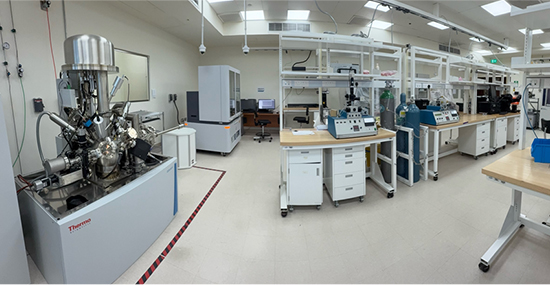
The Surface and Material Sciences Core Laboratory provides advanced analytical capabilities for studying materials and biological samples, including:
| Equipment | Model / Manufacturer |
|---|---|
| X-ray Photoelectron Spectroscopy (XPS) | ESCALAB QXi+ / Thermo Fisher Scientific |
| Powder X-Ray Diffractometer | Empyrean / Malvern Panalytical |
| Single Crystal X-ray Diffraction | Synergy-S Cu and Mo / Rigaku |
| Fourier Transform IR (FTIR) Spectroscopy | Vertex 80v FTIR / Bruker |
| Atomic Force Microscopy (AFM) | NanoObserver / CSI MFD / Oxford Asylum |
| Raman Spectroscopy | alpha300R / WITec Labram Evolution /Horiba |
| Simultaneous Thermal Analyzer: Thermal Gravimetric Aanalysis and Differential Scanning Calorimetry | STA449F3 / NETZSCH |
| Differential Scanning Calorimeter | DSC 404 F1 Pegasus / NETZSCH |

Dr. Thomas Delclos

+971 (0)2 312 4340

thomas.delclos@ku.ac.ae

Anjana Tharalekshmy, Dr. Praveen Managutti

Labs 8023/8025/8027, Arzanah Building, Sas Al Nakhl (SAN) Campus, Khalifa University.

• Monday to Thursday: 8:30 am – 5:00 pm
• Friday: 8:30 am – 1:00 pm

To ensure a safe working environment, all users of Research Core Laboratories must complete the university’s Environmental Health and Safety (EHS) training modules relevant to each laboratory they intend to access. The specific training modules along with the user approval process for the Surface and Material Sciences Core Laboratory are detailed at [webpage link].