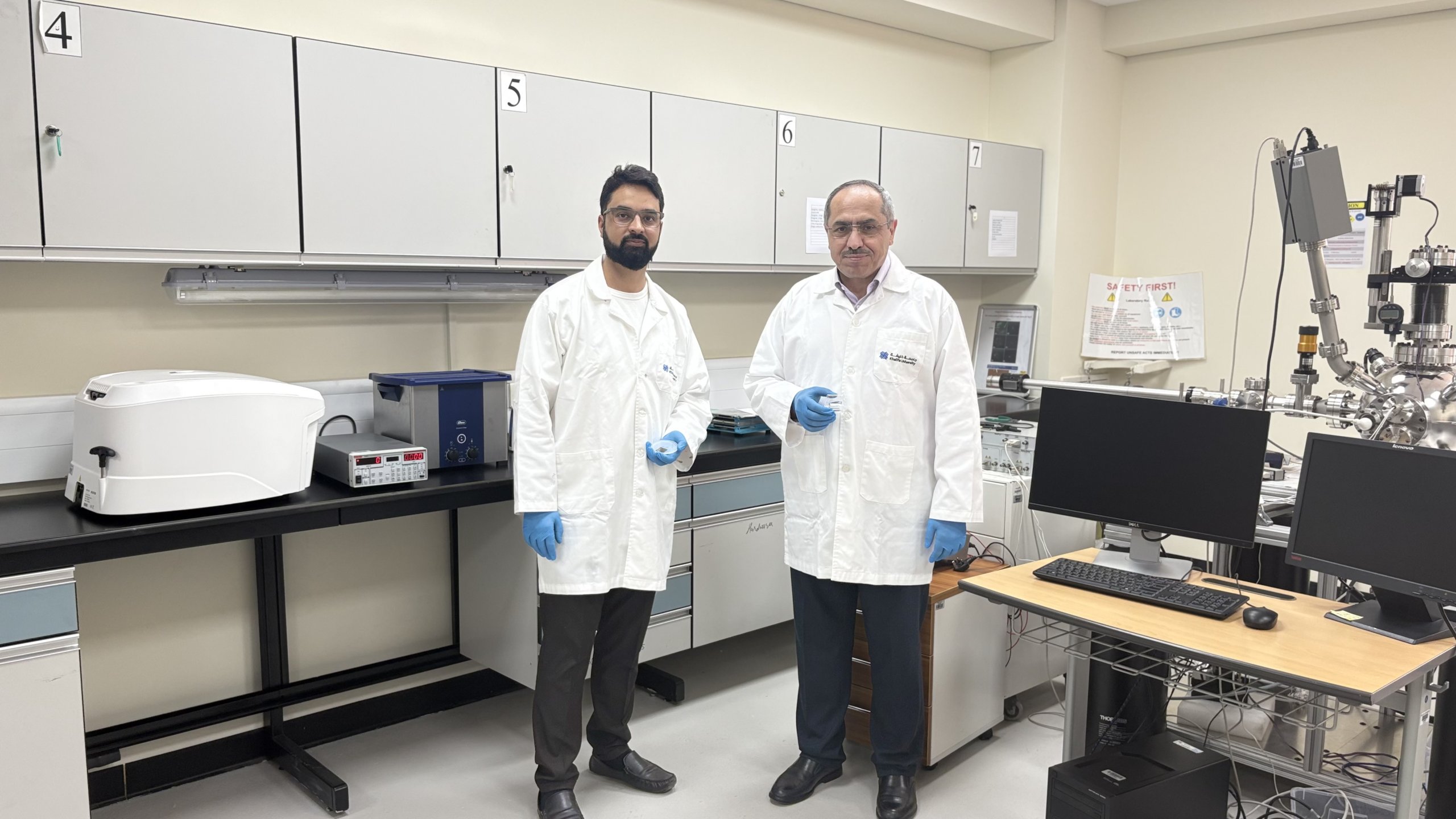




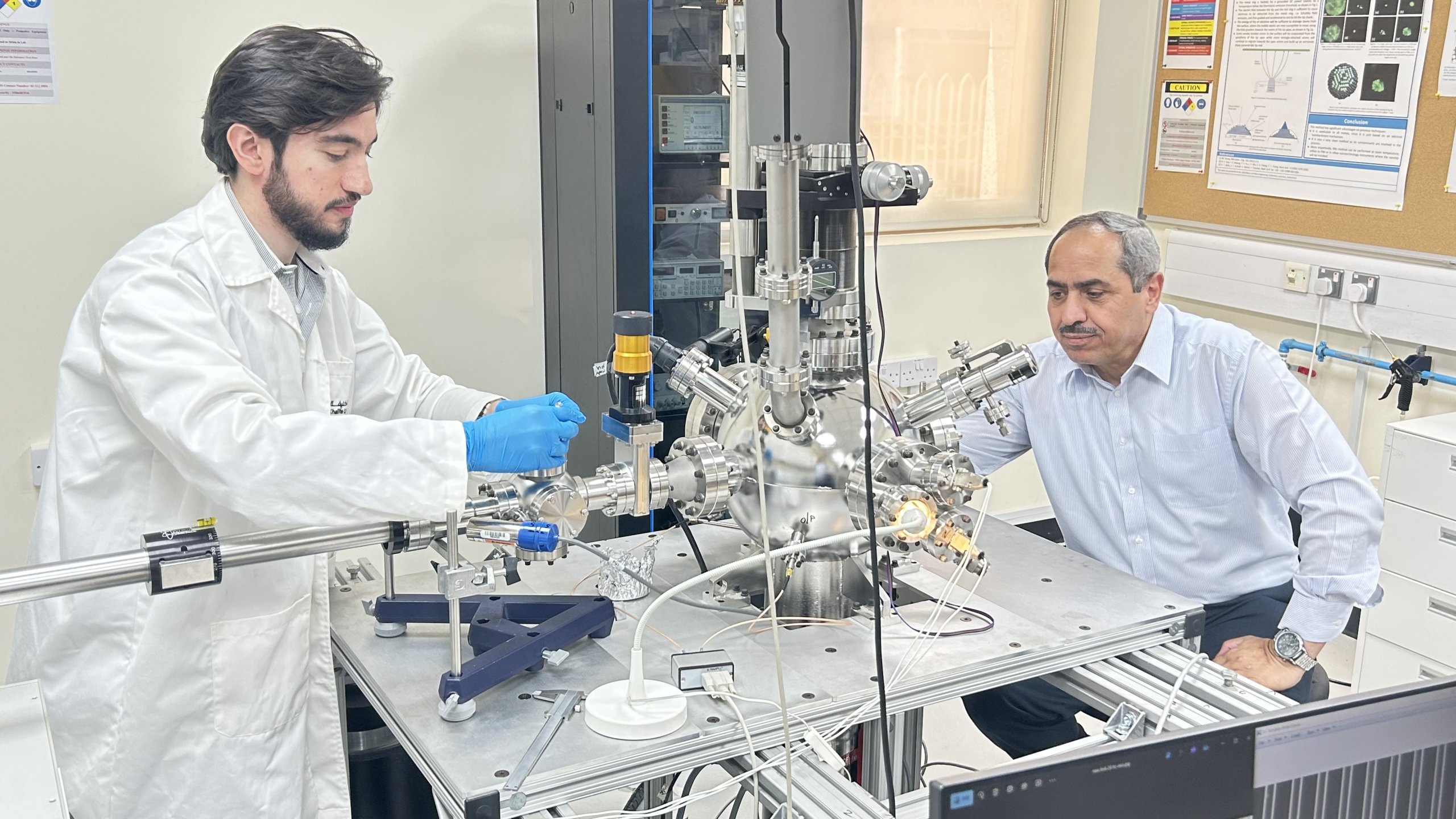
Khalifa University researchers have developed a carbon nanotube rectenna that detects near-infrared radiation without an external power supply, advancing compact, low-power sensing with potential applications in optical and terahertz communications.
Published in Materials Today Nano as “Carbon nanotube-based rectenna architecture for self-powered near-infrared selective photodetection,” the study features the doctoral researcher Husam AlTakroori as a first author, supervised by the project leader Dr. Moh’d Rezeq, Associate Professor of Physics, and draws on expertise across physics, electrical and mechanical engineering, and electron microscopy. https://doi.org/10.1016/j.mtnano.2026.100953
A rectenna combines a receiving antenna with a rectifying element to convert electromagnetic radiation into an electrical signal. This design integrates horizontally aligned multi-walled carbon nanotubes with a platinum–aluminum oxide–silicon metal–insulator–semiconductor diode. The nanotubes act as nanoscale antennas, enhancing light coupling near the junction, where an intrinsic electric field separates photogenerated charge carriers to produce current.
Devices with nanotubes approximately 200–800 nanometers long were tested under visible and near-infrared illumination. Their response varied with nanotube length: the shortest devices showed their strongest signal in the near-infrared, matching predicted antenna resonance and suggesting that physical dimensions can tune the detection wavelength in the visible, near- and infra-red ranges.
Without applied bias, the device generated short-circuit currents of tens of nanoamperes and an open-circuit voltage of approximately 90 millivolts under near-infrared illumination. With a modest applied bias, responsivity reached several amperes per watt. Microscopy, spectroscopy, and simulations supported the nanotubes’ antenna function, while silicon integration suggests compatibility with established semiconductor fabrication.
Building on an earlier terahertz demonstration, the findings suggest a path toward detection spanning visible to far-infrared wavelengths. Potential applications include portable sensors, imaging, environmental and security monitoring, optical energy harvesting, and wavelength-selective optical and terahertz receivers. Ongoing work focuses on improving spectral selectivity and self-powered performance, characterizing polarization sensitivity, scaling detector arrays, and addressing stability and manufacturability.