



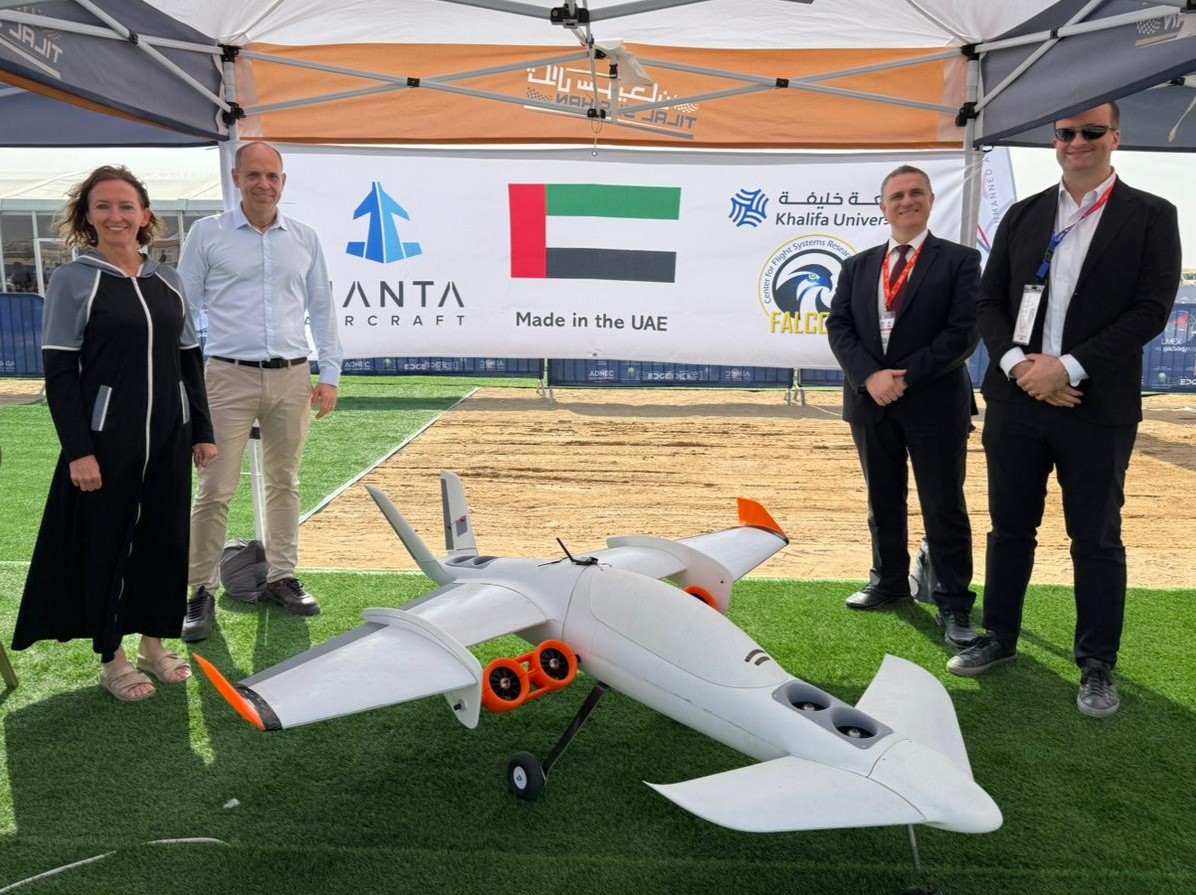
Launch of FALCON-II Prototype and MANTA-ANN Prototype to Transform Energy Management in Aerospace Technology
Khalifa University’s FALCON Program showcased two groundbreaking innovations during UMEX 2026, the world’s largest event for unmanned and autonomous systems, including the FALCON-II prototype at Khalifa University’s main display in ADNEC Centre, and the MANTA-ANN prototype at the Sweihan airfield in Abu Dhabi.
The FALCON-II hybrid-electric Vertical Takeoff and Landing (VTOL) prototype is an intelligent power and propulsion management system, specifically designed to maximize the performance and efficiency of drones and Advanced Air Mobility (AAM) vehicles.
By seamlessly integrating sustainable energy sources, including cutting-edge batteries, solar cells, clean hydrogen fuel cells, and conventional power systems, the FALCON-II system optimizes energy consumption in real time to adapt to diverse mission requirements.
Enhancing the operational range and performance of aerial systems, this state-of-the-art energy management system minimizes environmental impact, reducing emissions and contributing to environmentally responsible aviation operations.
The MANTA-ANN aircraft prototype integrates the latest advancements in avionics and Guidance, Navigation, and Control (GNC) systems, developed by the FALCON Program in collaboration with MANTA International. Its capabilities include sense-and-avoid technologies and next-generation human-machine interaction systems that help in addressing challenges such as operational safety and reliability. The MANTA-ANN meets the complex demands of highly automated and autonomous air transportation, from navigating low-altitude airspace to ensuring passenger and urban safety.
Led by Aerospace Engineering Professor Roberto Sabatini, the FALCON Program stands out for its explicit emphasis on Research, Development, Test, and Evaluation (RDT&E). For hybrid-electric and highly automated aerial systems, early decisions around energy management, autonomy boundaries, and human-machine interaction have far-reaching implications. By addressing certification challenges early in the development phase, the FALCON Program ensures scalability and compliance with international aviation standards, enabling its prototypes to transition seamlessly from research labs to real-world applications.
Professor Roberto Sabatini said: “The FALCON Program is a cornerstone of Khalifa University’s mission to foster the UAE’s innovation ecosystem. The FALCON-II and the MANTA-ANN prototypes mark the Program’s commitment to positioning the UAE as a leader in addressing the challenges of global decarbonization in aerospace. By involving students, researchers, and faculty members in real-world projects, the program equips them with the expertise and skills needed to lead innovative endeavors, enhancing the UAE’s competitiveness in global aerospace markets. Khalifa University’s emphasis on practical and forward-looking innovation ensures that these initiatives not only deliver solutions for sustainability and autonomy but also align strongly with the UAE’s long-term vision for a knowledge-driven, technology-powered economy.”
Alisha Roy
Science Writer