



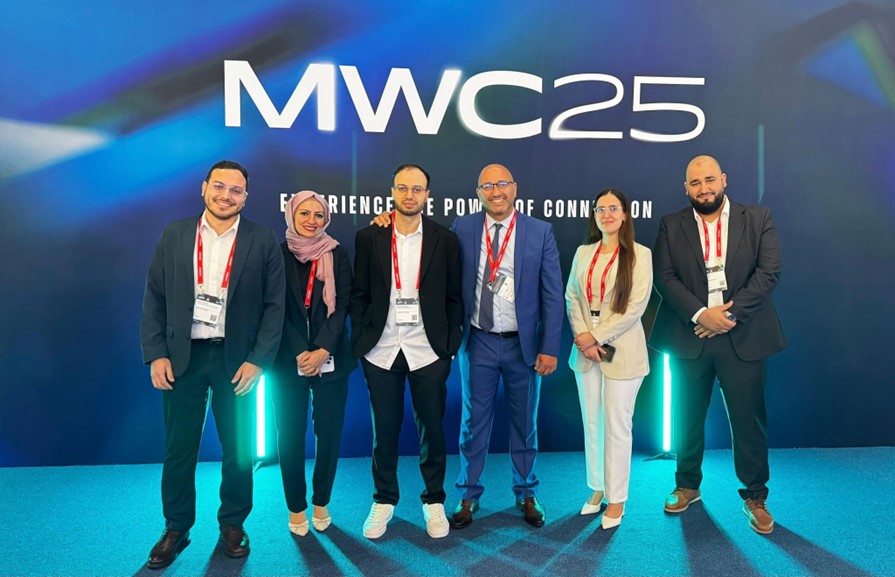
Khalifa University’s 6G Research Center (6GRC) showcased telco AI innovations including three flagship demos that connect research to real operator needs such as the TelecomGPT-Arabic, Deterministic optimization for radio access network (RAN) intelligence, and Arabic voice-to-network-actions at MWC25 Doha.
On the opening day of MWC25 Doha held from 25–26 November, GSMA Foundry and Khalifa University announced a strategic cooperation to advance telco AI, led by Prof. Merouane Debbah, focusing on developing specialized AI data assets, models and benchmarking frameworks for telecom applications. It also focused on the release of key Open Telco assets such as TelecomGPT, a telco-first large language model, and an Open Telco Knowledge Graph built on 3GPP documentation.
Throughout the two-day event, Prof. Debbah and Postdoctoral Fellow Dr. Lina Bariah represented 6GRC and Khalifa University in several high-level sessions, including ‘From Science Fiction to Strategy: Agentic AI Transforming MENA’s Connected Ecosystem’, ‘The Cognitive Network: Rethinking Network Architecture in the Age of AI’, ‘Accelerating Telco AI Adoption: Open Telco LLMs, Benchmarks & the Global Telco AI Challenge’, and ‘MENA’s AI Revolution: From National Vision to Societal Value’.
At the GSMA Foundry Pavilion, the 6GRC team showcased TelecomGPT-Arabic – led by Post Doctoral Fellow Dr. Brahim Mefgouda in collaboration with du, Nokia (Nokia Bell Labs), Microsoft and the International Telecommunication Union (ITU). The first Arabic-native telecom AI assistant, designed to help operators and support teams troubleshoot real network and device issues in Arabic using a multi-agent RAG pipeline.
The Deterministic optimization for RAN intelligence – led by Postdoctoral Fellow Eng. Salma Chèour with BubbleRAN and GSMA was also showcased. This end-to-end optimization pipeline classifies mathematical problems such as Linear Programming (LP) and Quadratic Programming (QP), runs reliable solvers, and automatically translates the results into RAN configuration decisions.
The third was the Arabic voice-to-network-actions, led by Eng. Anis BARA with BubbleRAN and GSMA. A live demo showcased how Arabic voice intents from engineers can be converted into validated, O-RAN / AI-RAN compliant network actions, enabling explainable, zero-touch automation.
Prof. Debbah said: “By representing Khalifa University at MWC25 Doha, the 6G Research Center reinforced its commitment to the UAE’s vision for a knowledge-based, innovation-driven and AI-enabled digital economy, and to building open, trustworthy and energy-efficient AI-native networks for the 6G era and beyond.”