



The Empty Quarter Desert (Rub’ al Khali), one of the world’s most significant natural dust sources, frequently experiences intense dust storms caused by wind erosion. Despite its global relevance, in-situ observations from this hyper-arid region had been lacking until the launch of the Wind-blown Sand Experiment (WISE-UAE) in summer 2022.
Experiment site and Instrumentation:
The WISE Phase-1 deployment was established near Madinat Zayed (23.5761°N, 53.7242°E; elevation: 119 m), approximately 120 km southwest of Abu Dhabi. A 10-meter triangular micrometeorological tower was installed, equipped with horizontal booms at seven levels (0.4, 0.7, 1.25, 2.25, 3, 4, and 10 m above ground) to support:
A dedicated boom at 3 m height holds a 3-D sonic anemometer (see Figure 3a). The tower is stabilized using three guy wires, capable of withstanding wind speeds up to 60 m s⁻¹.
Surface Radiation Energy Balance: To measure the four components of radiation fluxes (incoming/outgoing shortwave and longwave radiation), a Net Radiometer is mounted on a 2-meter tripod, located 4 meters south of the tower.
Saltation Monitoring: To investigate the initiation, intensity, and duration of saltation events, two instruments were deployed 10 meters from the tower:
Both sensors are mounted ~9 cm above the surface and log saltation counts (hits/second) every second using a CR1000X data logger.
To ensure data consistency, the soil surface around the sensors is regularly leveled after significant saltation events and during biweekly maintenance visits.
Erosion Flux Estimation: To quantify horizontal sand transport, Modified Wilson and Cooke (MWAC) traps were deployed:
Visibility Observations: Visibility is monitored using a SEN-TRY™ Visibility Sensor (SVS1), mounted at 2.5 meters on the main tower. The sensor estimates visibility by measuring scattered visible light from suspended dust and aerosol particles.
A detailed description of the WISE-UAE instrumentation and field measurements can be found in our publication in Earth and Space Science. he high-quality measurements collected during the WISE-UAE campaign have been used to validate reanalysis datasets and satellite-derived products. For more information, please refer to our article: https://doi.org/10.3390/rs16193593 .
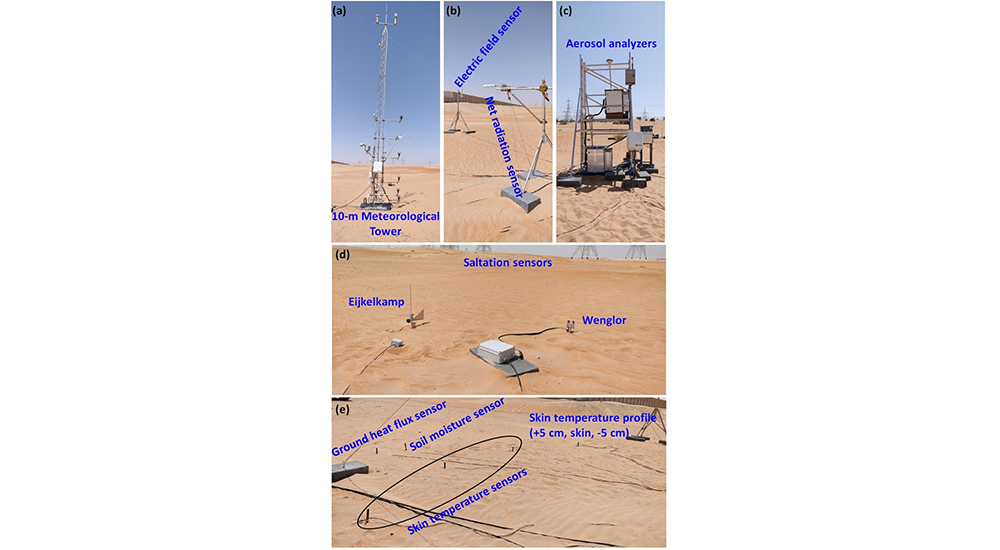
Figure 7. WInd-blown Sand Experiment-United Arab Emirates experiment setup. (a) 10 m meteorological tower showing all the instruments deployed on it. (b) Net radiation (foreground) and electric field (background) sensors. (c) Outdoor enclosures, with aerosol analyzers installed inside, and dust profiler. Ground sensors (d) saltation sensors and (e) soil temperature, soil moisture and ground heat flux.