



Joint Program Bridges UAE and Chinese Research through Lab Tours, Presentations, and Cross-Cultural Exchanges
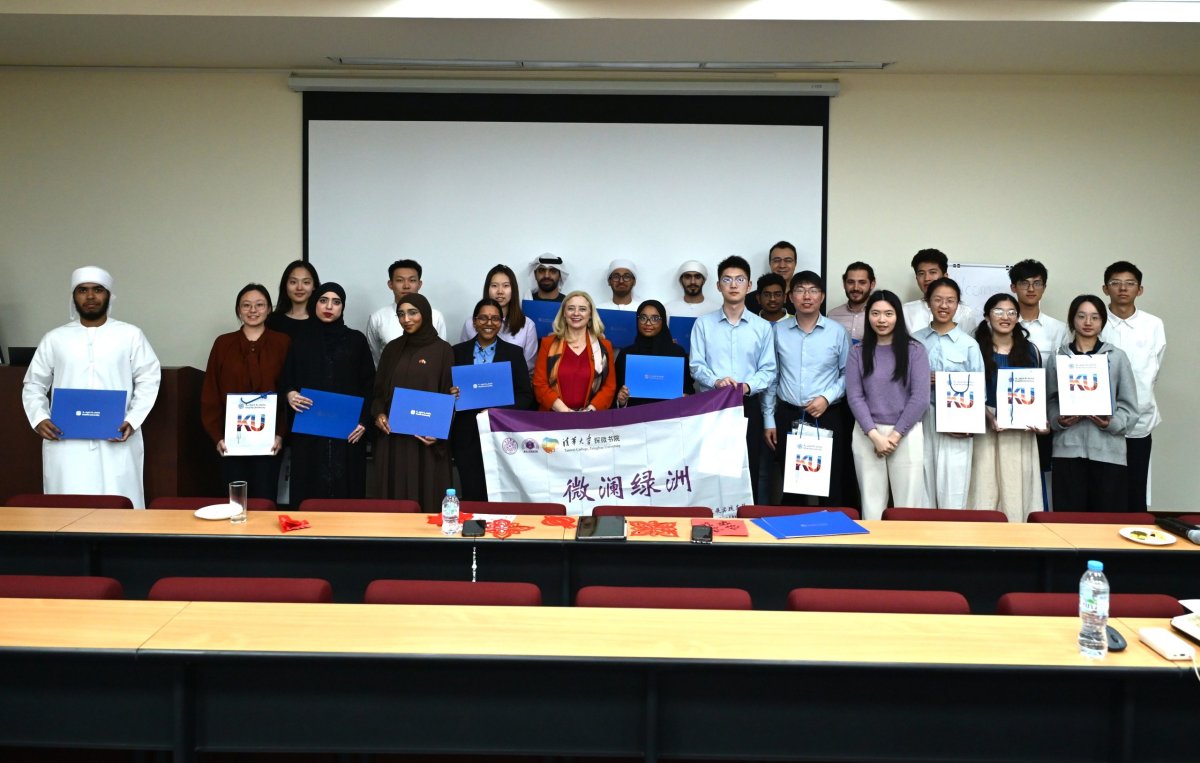
A delegation of 10 undergraduate students, a PhD student and a faculty member from Tanwei College, Tsinghua University, visited the research facilities and labs of Khalifa University in February for a multi-day academic and cultural exchange centered on sustainable energy.
The visit was jointly organized by the Department of Chemical and Petroleum Engineering and the Research and Innovation Center on CO₂ and Hydrogen (RICH), bringing together faculty, researchers, and students from both institutions to share laboratory expertise, present research findings, and marked the start of the Chinese New Year.
The Tsinghua delegation was led by Dr. Tang Cheng, Associate Professor, Department of Chemical Engineering, whose research spans green electrification of the chemical industry, energy materials chemistry, electrocatalysis and electrosynthesis, and green hydrogen. Along with PhD student Yiyao Dai and the students, he met with Khalifa University faculty including Prof. Lourdes Vega, Senior Director of the Energy Institute and former RICH director; Prof. Ali ElKamel, Chair, Department of Chemical and Petroleum Engineering and Theme Lead at the RICH Center; Assistant Professor of Aerospace Engineering Dr. Yarjan Abdul Samad; CORE Labs Director Dr. Thomas Delclos; RIC2D Labs Manager Dr. Osama Shakir; and Postdoctoral Researcher Dr. Yuting Li, Department of Chemical and Petroleum Engineering and RICH Center.
The delegation toured three of Khalifa University’s research facilities including the CORE Labs in the Arzanah building, Sas Al Nakhl (SAN) Campus, where Dr. Delclos introduced a newly installed electron microscopy suite, featuring high-resolution systems capable of imaging materials at the atomic scale. The microscopy suite operates on a user-training model allowing certified students and researchers free access to the equipment.
At the Research and Innovation Center for Graphene and 2D Materials (RIC2D), Dr. Shakir and Dr. Abdul Samad provided a hands-on lab tour and presented the Center’s work highlighting research areas critical to the UAE including MXene-based materials for energy storage and water desalination.
A formal research workshop with five Khalifa University students opened with welcome remarks from Dr. ElKamel and Dr. Tang who introduced the delegation and its research themes, after which five Tsinghua University students each delivered presentations on their undergraduate studies, research training, and campus experiences. Dr. Tang also presented his team’s research on electrochemical energy conversion and highlighted the persistent gap between laboratory catalysts and the simpler materials still used in industrial electrolyzers.
Professor Vega addressed the landscape of clean energy and net-zero strategies, highlighting the role of hydrogen, renewable energy and carbon capture, utilization and storage (CCUS) and sustainable fuels to achieve it. She highlighted some of the flagship activities carried out at the RICH center on CCUS, hydrogen production and production of sustainable fuels. As practical examples, Professor Vega mentioned the emerging role of hydrogen and its derivatives in aviation, outlining technical pathways including direct hydrogen propulsion for smaller aircraft and sustainable aviation fuel production, and identifying hydrogen market development as the central challenge ahead.
The visit included a cultural program coinciding with Lichun, the traditional start of Spring, in the days before the Chinese New Year. Khalifa University students joined their Tsinghua peers in a calligraphy and paper-cutting workshop, learning to write the character Fu (福) — meaning fortune — and to craft traditional window decorations. Participants practiced brush techniques side by side, shared stories of their respective New Year customs and closed the session by displaying their work and exchanging seasonal greetings.
Professor Lourdes Vega said: “Having students and faculty from Tsinghua in our labs was a genuinely enriching experience. The quality of the dialogue on sustainable energy, from hydrogen aviation to electrochemical systems, reflected how aligned our research priorities are. For Khalifa University, exchanges like this reinforce our commitment to building international research partnerships that go beyond the formal with a common drive to move clean energy solutions from the lab to the real world. Collaborations with world-leading institutions like Tsinghua are exactly the kind of partnerships that will help translate national priorities into tangible scientific progress.”
Dr. Tang Cheng said: “This visit to Khalifa University has provided an excellent platform for academic dialogue and mutual learning in the field of sustainable energy. We are impressed by the research strengths and facilities at Khalifa University. We hope this exchange will serve as a starting point for deeper collaboration, including opportunities for student mobility and joint research projects.”
Alisha Roy
Science Writer