




Device Improves Patient Care, Public Health, and Various Industrial Processes
Khalifa University researchers have developed a label-free, rapid DNA (deoxyribonucleic acid) detection method using a gold-based electrical sensor – one that identifies DNA directly without the need for chemical markers – capable of distinguishing DNA sequences and sources, making it a promising tool for clinical diagnostics and biomedical research.
Detecting molecular species is crucial in the biotechnology and healthcare industries to analyze the presence of specific molecular targets, like biomarkers, proteins, and toxic molecules. This enables the diagnosis of diseases for the improvement of patient care, public health, and various industrial processes. The combination of label-free sensing, electrical readout, and scalability also positions the device as a promising solution for next-generation biosensors.
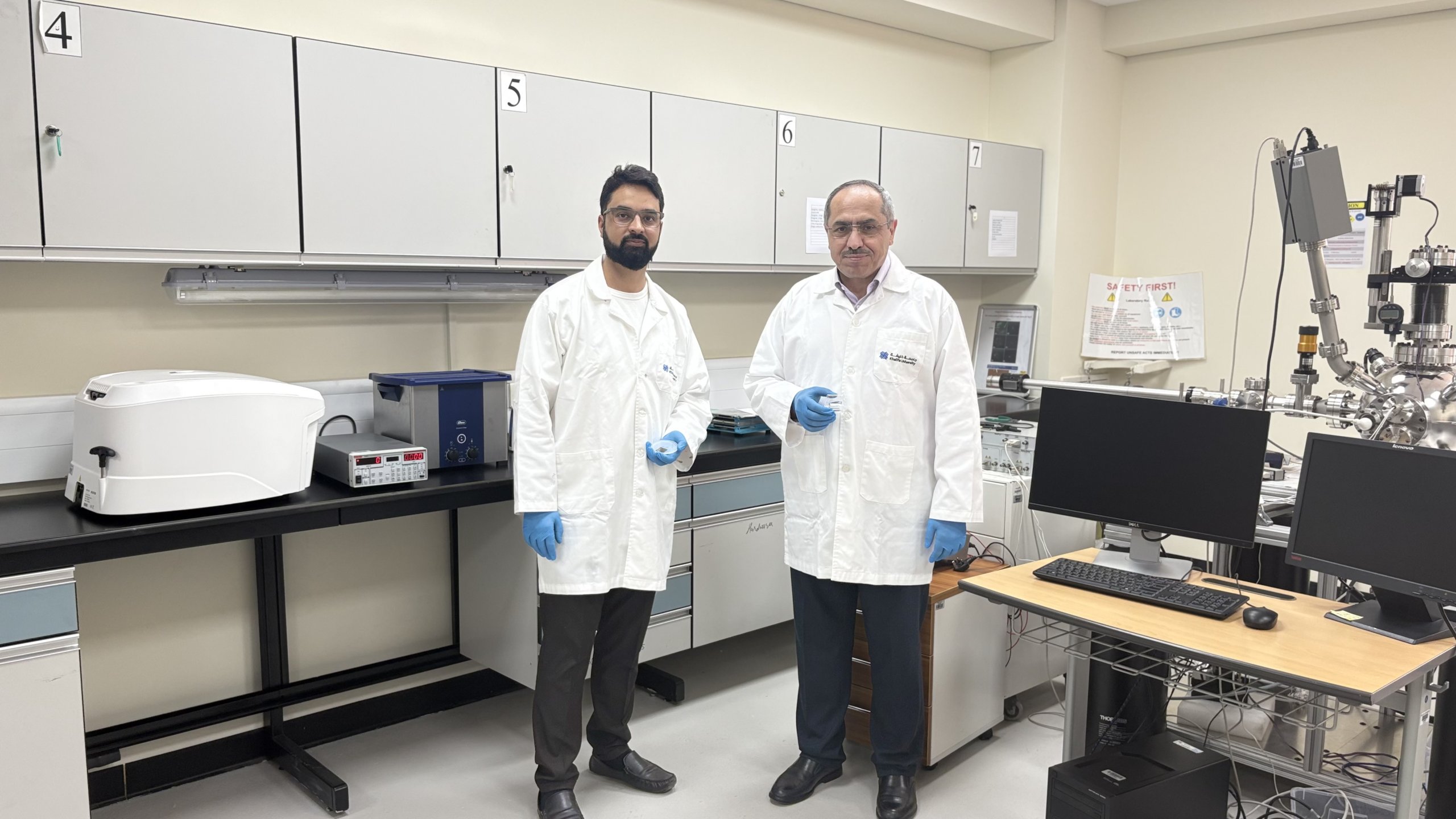
The study, led by Dr. Moh’d Rezeq, Associate Professor, Physics, and Principal Investigator, with lead author Dr. Firdous Ahmad Deader, Researcher, Khalifa University’s System on Chip Lab, is published in Sensors and Actuators A: Physical (2026.) Other authors include Research Scientist Dr. Yawar Abbas, post-doc Firdous Ahmad Deader, Dr. Ahsan Ul Haq Qurashi, Deputy Director, Center for Catalysis and Separation (CeCAS), and Associate Professor, Chemistry, Dr. Mahmoud Al-Qutayri, Associate Provost for Academic Operations and Professor of Electrical Engineering and Computer Science, and Dr. Vincent Chan, Professor, Biomedical Engineering. The DNA samples were received through collaboration with Professor Gulfaraz Khan, College of Medicine and Health Sciences, UAE University.
The device is based on a two-dimensional monolayer of gold nanoparticles (Au-NPs) assembled between microfabricated electrodes on a silicon oxide substrate, forming a field-effect biosensor that converts biomolecular interactions into electrical signals. Unlike conventional DNA detection techniques such as PCR and sequencing, this sensor developed by Khalifa University researchers enables label-free, real-time detection by measuring shifts in current–voltage characteristics caused by DNA adsorption onto the nanoparticle surface.
The sensor was further validated using DNA extracted from Burkitt’s lymphoma cell lines, including virus-infected and non-infected samples. Some of the key findings include a significantly higher current response for infected DNA samples, clear differentiation between infected and non-infected cells, as well as stable, reproducible electrical signals over time. These results highlight the sensor’s potential for disease detection and molecular diagnostics.
Dr. Moh’d Rezeq said: “Our research work demonstrates how nanoscale engineering can transform DNA detection into a direct electrical measurement, significantly reducing complexity while maintaining high sensitivity. The ability to detect differences between infected and non-infected DNA samples highlights the strong potential of this platform for clinical diagnostics.”
The technology has potential applications in clinical diagnostics, precision medicine, biomedical research, and portable point-of-care diagnostic systems.
Clarence Micheal
English Editor – Specialist