PEACE, JUSTICE & STRONG INSTITUTIONS
- Khalifa University is an educational institution based on the principles that promote peace, justice and strength. Various documents are available for corporate governance and communication with internal as well as external stakeholders.
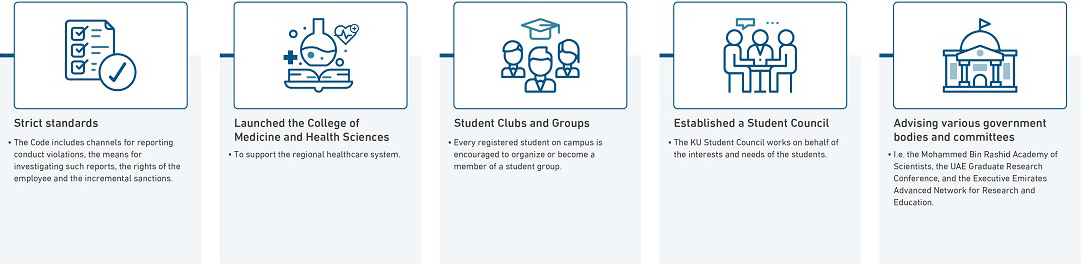
- All employees of KU are expected to adhere to the standards of conduct and ethical behaviors specified the University Code of Conduct. Any violation of these standards are noted and addressed in a timely manner. There are proper channels for reporting conduct violations, the means for investigating such reports, the rights of the employee and the incremental sanctions which may be imposed according to the HR Policy Manual.
- New academic programs, and fresh inroads into developing medical professionals to support the regional healthcare ecosystem were some of the key highlights for Khalifa University during the year 2019. In order to strengthen its institutional standing, Khalifa University has entered into milestone agreements to expand collaborations with national and international partners, while pioneering research innovations that have led to commercialization license to benefit the community.
- Khalifa University encourages the establishment of student groups on campus. Every registered student on campus, undergraduate or graduate, is encouraged to organize or become member of a recognized student group.
- KU is obliged to uphold and preserve its students’ rights to exercise principles of academic freedom. This is exercised through the implementation of Students Rights and Responsibilities Policy.
- There are elected councils of students and faculty, in addition to appointed committees and leadership groups that ensure peace, justice and equity within the university.
- The student council assumes the role of working on behalf of the interests and needs of the students; improves the intellectual, cultural and social character of the university; and empowers the students to foster a living-learning community.
- The Faculty Academic Council (FAC) is a standing advisory council established for the purpose of discussing issues and addressing concerns that relate to the professional academic force of the university.
- The Abu Dhabi Digital Authority (ADDA) signed a strategic Memorandum of Understanding (MoU) with Khalifa University of Science and Technology. following this a number of faculty and leadership of KU are representing the University and acting in advisory roles on various Governmental bodies as well as committees. Dr. Arif Sultan Al Hammadi currently holds the position of the Executive Vice President at Khalifa University. Dr. Arif further chairs the Steering Committee of the UAE Graduate Research Conference and the Executive Committee of the Emirates Advanced Network for Research and Education.
Publications and Activities by KU Researchers that Contribute to SDG #16:
Publication 1: Handbook of Research on Combating Threats to Media Freedom and Journalist Safety
https://www.igi-global.com/book/handbook-research-combating-threats-media/232292
Name: Dr. Sadia Jamil
Department: Humanities & Social Sciences
Details of academic project/publication:
The Handbook of Research on Combating Threats to Media Freedom and Journalist Safety is an essential reference source that evaluates how diverse threats impact on journalists’ wellbeing, their right to freedom of expression, and overall media freedoms in various contexts and assesses inadequacies in national security policies, planning, and coordination relating to the safety of journalists in different countries. Featuring research on topics such as freedom of the press, professional journalism, and media security, this book is ideally designed for journalists, news writers, editors, columnists, press, broadcasters, newscasters, government officials, lawmakers, diplomats, international relations officers, law enforcement, industry professionals, academicians, researchers, and students.
Event 1: Desafíos ante la violencia y por la seguridad de periodistas en tiempos de pandemia (Challenges in the face of violence and for the safety of journalists in times of pandemic OCTOBER 22, 23 AND 24, 2020)
Event organizers: The Network for Freedom of Expression against Violence to Communicators (Mexico), the Xochimilco Metropolitan Autonomous University and the Ibero-American University
Session: Labor and digital violence against women journalists in times of crisis: Speaker, Dr. Sadia Jamil
https://forodesafiosperiodistas.net/participantes/#page-content
Event 2: Moscow Readings 2020
Panel: Digital safety and protection of journalists in the Global South (Chair/organizer, Dr. Sadia Jamil)
Event 3: Delayed virtual event on World Press Freedom Day by UNESCO (Paris), Leiden University and the government of Netherlands (9-10, December, 2020)
Session: Safety risks and Discrimination faced by female journalists
Speaker: Dr. Sadia Jamil