REDUCED INEQUALITIES
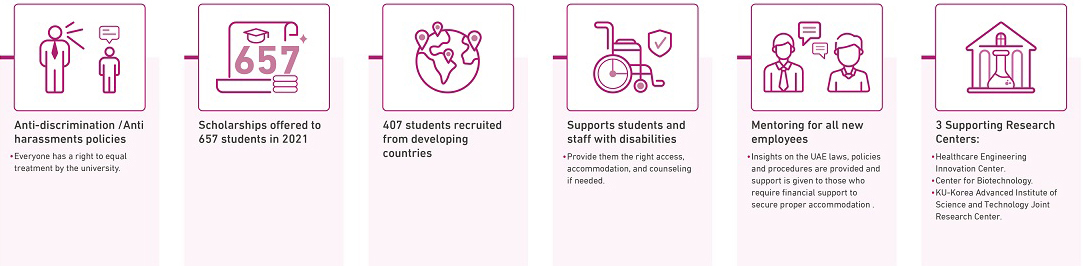
Khalifa University has strict anti-discrimination / anti harassments policies for both students as well as for staff / faculty members where everyone has a right to equal treatment by the university and to be free from discrimination based on race, color, origin, religion, gender or special needs.
- Admissions catalogues clearly states on page 77 that all admissions are free of any discriminations, “A student has a right to be free from discrimination based on race, color, origin, religion, gender or special needs.” https://www.ku.ac.ae/undergraduate-catalog
- The office of enrollment and the Institutional Research office collect and monitor students applications and enrollment considering wide range of categories such as gender, low income students and students with special needs.
- The university offers scholarship schemes to students and managed to attract 407 students from developing countries. Meanwhile, it offers good salary scheme with equal opportunity to all nationalities and genders.
- Khalifa University students receive same level of support and are treated equally.
- Khalifa University supports students and staff with special needs (people of determination) and provide them the right access and personal support if needed.
- Counseling services also assist students with special needs by offering special accommodation to ensure they are not disadvantaged in any way. The guiding principle of counseling is built on trust; hence all counseling sessions are held to high level of confidentiality.
- Additionally, Khalifa University HR provides mentoring for all its new employees, providing insight on the applicable laws, policies and procedures through Orientation program provided on the first day. Moreover, the policy supports helping those who require financial support to secure proper accommodation through Housing advance payments.
Publications by KU Researchers that Contribute to SDG #10
-
Publication 1: Special Edition – Social inequalities & Marginalized Communities
Media Discourses and Representation of Marginalized Communities in Multicultural Societies: https://think.taylorandfrancis.com/special_issues/media-discourse/
Name: Dr. Sadia Jamil
Department: Humanities & Social Sciences
Media discourses and Marginalized Communities in Multicultural Societies is Journalism Practice’s special edition, being edited by Dr. Sadia Jamil (Khalifa University, UAE), Associate Professor Jessica Retis (University of Arizona, US) and Dr. Paul Murschetz (Austrian Academy of Sciences & University of Digital Sciences, Berlin), with a purpose to present impactful studies offering insights into the news media’s role in jeopardizing the representation of minority/or marginalized groups, as well as to address their potential role to combat discrimination against members of marginalized groups such as minority racial and ethnic communities, drug users and drug addicts, sex workers, LGBT persons, and people living with HIV. The term media discourses do not merely imply the manner in which facts or reality is represented in the electronic and printed media, relatively the manner in which reality is shaped by the journalists and media professionals. Thus, one of the key contributions of this special edition is to underline the power and influence of media discourses to not only present, but rather shape social practices.
-
Publication 2: Digital & Social inequalities
Jamil, Sadia. (2020). A widening digital divide and its implications for democracy and social inequalities in Pakistan. In Massimo Ragnedda and Anna Gladkova (Eds), Digital Inequalities in the Global South. London: Palgrave Macmillan, pp. 59-78.
KU Research Centers Contributing to SDG #10:
-
Healthcare Engineering Innovation Center is an initiative aimed at transforming the healthcare innovation landscape in Abu Dhabi, the UAE and the MENA region by bridging the substantial existing gap in healthcare innovation and technology. The center aims to tackle relevant health challenges in the UAE, aiming to attract external funding and evolve as a pioneer self- sustainable unit for medical device design, development and clinical testing, in line with Khalifa University mission of innovation and research excellence and with Abu Dhabi Vision 2030.
Website: https://www.ku.ac.ae/heic
-
Center for Biotechnology is researching genomics, bioinformatics and systems biology to understand risk factors underlying major chronic diseases in the UAE population.
Website: https://www.ku.ac.ae/btc
- Khalifa University – Korean Advanced Institute of Science and Technology (KU-KAIST) Joint Research Center commenced the Smart Healthcare Project in August 2019.